



Food safe filament: how to check materials and workflows
A 3D-printed part is food safe only when three things line up together: the filament carries genuine certification for the colour and batch you bought, it was printed on a controlled workflow with a stainless nozzle, and the finished object suits the contact it will actually see. No polymer name on a spool label does that job alone.
Before you print anything for the kitchen, take three actions:
- Ask your supplier for a Certificate of Compliance (COC) naming the exact polymer, colourant and batch.
- Check whether the use is low risk (brief, dry, cold contact like a cookie cutter) or high risk (sustained, hot, or liquid contact like a cup).
- Match your print settings and post-processing to that risk level before you serve anything from the part.
A generic “food safe” label without ingredient-by-ingredient testing is unreliable, according to a review of the market by 3DMag. Pigments and masterbatch are tested separately from the base resin, and plenty of coloured spools never get that second round of testing at all.
Key Takeaways
Food safety in 3D printing depends on certified filament, stainless hardware, and print settings working together, never on the polymer name alone.
| Point | Details |
|---|---|
| Demand a COC | Request a Certificate of Compliance naming the polymer, colour and batch, not a generic label. |
| Match risk to use | Reserve uncoated prints for brief, dry contact and coat or avoid anything with sustained heat or liquid contact. |
| Fit stainless hardware | Swap brass nozzles for 304 or 316 stainless to avoid lead contamination risk. |
| Tighten print settings | Use low layer height, multiple walls, and 100% infill on contact faces to cut porosity. |
| Buy through Subliblanks | Source filament, nozzles and printers with no minimum order, and ask directly for batch documentation. |
Table of Contents
- Why “food safe filament” depends on the finished part, not the polymer
- Which filament families actually work for food contact?
- Printer setup: hardware and slicing changes that actually reduce risk
- Coatings, curing, and knowing when to retire a part
- What is reasonable to print, and what to avoid entirely
- How to verify a supplier’s claims before you buy
- How Subliblanks supports trade buyers checking filament safety
- Editorial take on verifying filament by documentation
- Get set up properly with Subliblanks
- Frequently asked questions
- Sources
Why “food safe filament” depends on the finished part, not the polymer
Regulators approve substances, not printed objects. A resin can carry legitimate food-contact clearance for its intended application while the mug you printed from it fails outright, because the porous layer lines, the nozzle metal, and the pigment load all change the outcome.
It helps to separate three distinct things suppliers often blur together:
- The food-contact substance: the raw polymer resin as chemically defined.
- The material: that resin plus additives, colourants and processing aids.
- The finished article: the actual printed object, shaped by your printer, settings and hardware.
Approval sits mainly with the first category. 21 CFR 177.1630 covers polyethylene terephthalate resins, and 21 CFR 175.300 governs resinous coatings, but neither clause certifies your specific print. The EU equivalent, Regulation 10/2011, sets migration limits, commonly an overall migration ceiling of 10 mg/dm², meaning it caps how much of a substance can leach into food, not whether your object is automatically compliant.
Pigments, masterbatch carriers and even nozzle wear shift this picture further. A brass nozzle worn down by abrasive filament can shed trace lead into the melt, which is one reason experts frame food safety as a systems-level property rather than something a single polymer name guarantees.
Which filament families actually work for food contact?
PLA and PETG dominate hobbyist food-contact prints, but each has a hard temperature ceiling worth knowing before you print, as detailed in Expleco Limited’s sustainable packaging guide. PLA typically softens at temperatures that make it unsuitable for dishwashers and hot drinks. PETG holds up better, with a glass transition temperature higher than PLA’s, but it is still not suitable for boiling water over sustained contact, 3DMag notes.
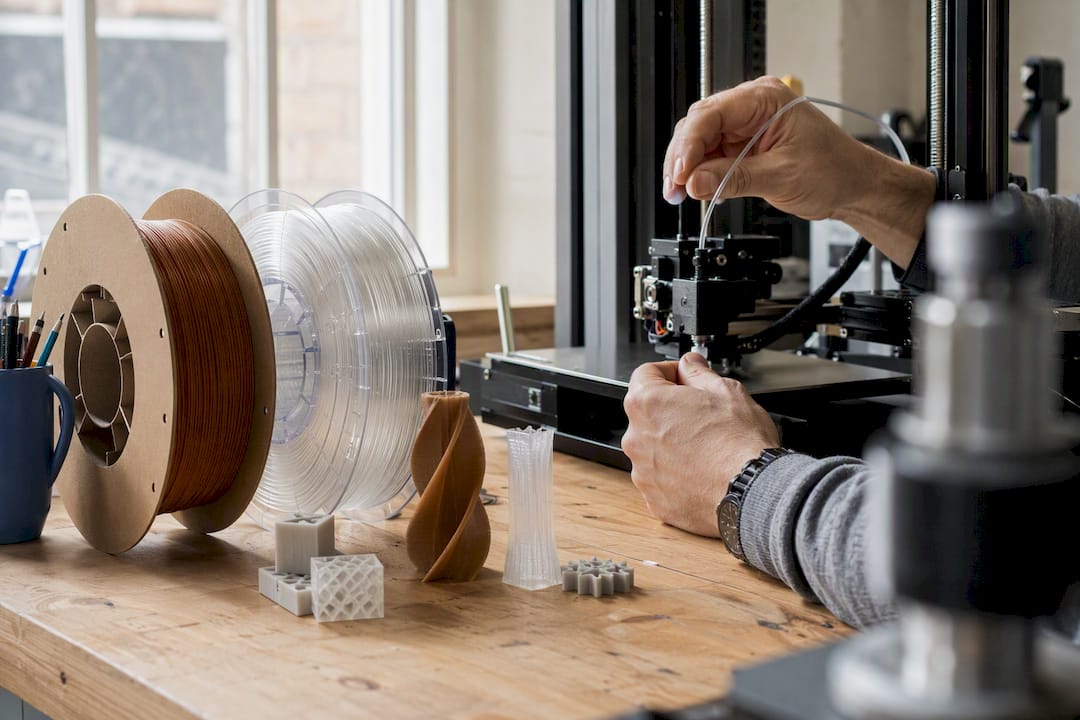
Polypropylene resists chemicals and fatigue well, making it a stronger candidate for reusable containers, though it is trickier to print and warps more than PLA or PETG. Nylon absorbs moisture readily and needs careful drying before and after printing, which limits its appeal for casual kitchen use. Co-polyesters sit between PETG and specialist medical-grade polymers, sometimes with better clarity or toughness, but documentation varies wildly by brand.
Grades and colours are not interchangeable. A natural, uncoloured PETG spool from a supplier who publishes migration data is a safer bet than a bright-orange “food safe” branded reel with no test paperwork behind it.
| Material | Heat tolerance | Common food-contact use |
|---|---|---|
| PLA | Softens ~55–60°C | Cookie cutters, moulds for cold use |
| PETG | Glass transition ~80–85°C | Cups, scoops, short warm-liquid contact |
| Polypropylene | Higher fatigue and chemical resistance | Reusable containers, lids |
| Nylon | High strength, absorbs moisture | Utensils, low-moisture applications |
Printer setup: hardware and slicing changes that actually reduce risk
Layer-by-layer printing leaves microscopic ridges that trap bacteria far more effectively than a moulded surface, which is why Formlabs’ guide to food-safe 3D printing treats surface porosity as the central hazard, not just the polymer choice. Fixing that starts at the hardware level.
- Fit a stainless steel nozzle, ideally 304 or 316 grade. Brass nozzles can leach lead into the melt over time; FilamentPicks flags this as a contamination source in hobby setups requiring attention.
- Dedicate a printer, or at minimum a thoroughly cleaned hot end and bed, to food-contact prints only. Cross-contamination from previous filaments is hard to fully eliminate otherwise.
- Drop layer height to a low setting and raise wall count to several perimeters. Qidi Tech’s testing links finer layers and thicker walls directly to reduced porosity.
- Push your extrusion multiplier slightly above 100% and set contact faces to full infill, or make those walls solid rather than relying on standard infill patterns.
- Store spools sealed with desiccant between prints; moisture absorption can degrade layer adhesion and worsen porosity on food-contact surfaces.
Stainless conducts heat less efficiently than brass, so expect to raise your nozzle temperature moderately or slow the print speed slightly to keep extrusion consistent. Our guide to setting up a 3D filament printer walks through nozzle swaps and slicer profiles in more detail.
Pro Tip: Keep a dedicated set of slicer profiles labelled “food contact” with your wall count, infill and temperature settings locked in, so you never accidentally print a kitchen item on a generic profile.
Coatings, curing, and knowing when to retire a part
Sealing is often the step that turns a merely acceptable print into something suitable for sustained contact. A food-grade epoxy that cites 21 CFR 175.300 on its own documentation creates a continuous film over those trapped layer lines, but only once fully cured, which for many epoxies means 72 hours or more at room temperature, not the surface-dry stage after a few hours.
Before trusting a coated part, check it against a short list:
- Confirm the coating supplier names the CFR clause it was tested against, not just a marketing phrase.
- Inspect the surface under strong light for pinholes, thin patches or bubbles before first use.
- Recoat as soon as scratches or dulling appear; a compromised coating is worse than no coating, since it can trap moisture beneath it.
- Hand wash coated items rather than running them through a dishwasher, since abrasive detergent and heat cycles degrade most coatings faster than manufacturers advertise.
Solvent smoothing (acetone vapour on ABS, for instance) can reduce visible porosity but does not equal certified coating, and should never be presented to customers as a food-safety measure on its own.
What is reasonable to print, and what to avoid entirely
Contact time and temperature decide almost everything here. A cookie cutter touches dough briefly, then the dough gets baked, which kills most pathogens regardless of what happened at the cutter stage, a point Qidi Tech makes explicitly when comparing cutters against drinking vessels.
- Cookie cutters: low risk, uncoated PETG or PLA is generally reasonable given the short, dry contact and subsequent baking.
- Scoops for dry goods: low to moderate risk, print with the settings above and inspect regularly.
- Cups and mugs: high risk, require a certified coating and hand washing, never dishwasher cycles.
- Utensils for hot food: high risk, PETG’s heat ceiling makes prolonged use marginal even with coating.
- Moulds for raw meat or use by immunocompromised people: avoid printed parts entirely and use commercially manufactured equipment instead.
How to verify a supplier’s claims before you buy
Marketing copy that simply says “FDA approved” deserves scepticism, because approvals typically apply to a raw resin under specific conditions, not to a coloured spool or a finished print, as 3DMag’s review of supplier claims points out.
- Request a Certificate of Compliance naming the polymer, the specific colour or masterbatch, and the batch number, not a generic badge.
- Ask which clause was tested against, such as 21 CFR 177.1630 or EU 10/2011, and check that citation against the FDA’s CFR search tool yourself.
- Look for a technical data sheet that states the scope of testing, including whether pigments were tested alongside the base resin.
- Treat a vague answer, or no documentation at all, as a reason to choose a different spool or commission independent migration testing before committing to that supplier for repeat trade orders.
How Subliblanks supports trade buyers checking filament safety
Subliblanks stocks 3D printing filaments alongside the wider supply chain trade buyers already rely on, and our team can talk through nozzle choice, spool documentation, and workflow setup before you commit to a batch. Read our breakdown of how filaments shape manufacturing and prototyping for background on why traceable supply matters at scale.
- Ask us for supplier documentation before ordering in volume.
- Get practical advice on stainless nozzle compatibility for your printer.
- For commercial or repeated food-contact use, pair any spool documentation with independent migration testing.
Editorial take on verifying filament by documentation
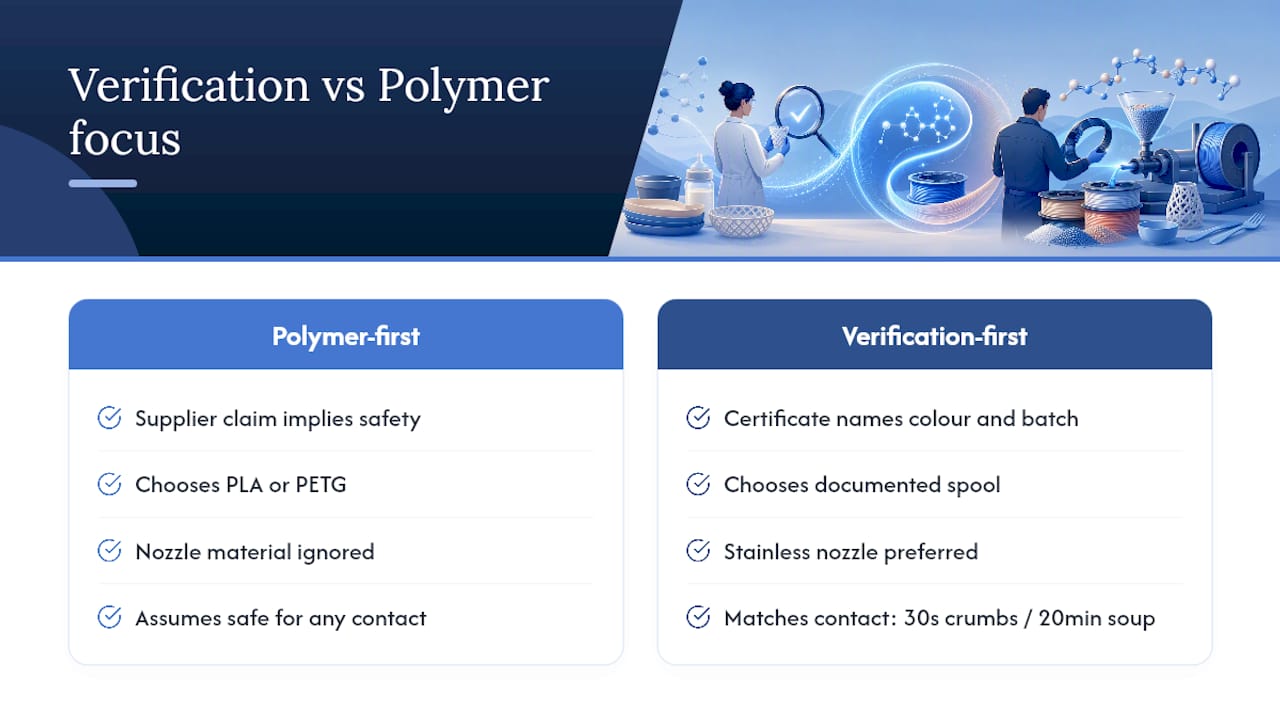
The industry’s biggest blind spot is treating “food safe” as a fixed property of a material rather than an outcome of a process. PLA and PETG get cited constantly as the safe choices, but that framing skips the part that actually matters: whether the specific spool in your hand was tested with its pigment, whether your nozzle is brass or stainless, and whether the object touches dry crumbs for thirty seconds or hot soup for twenty minutes.
Conventional advice tends to stop at “buy a food-safe filament”, as though that phrase on a listing settles the question. It doesn’t. The documentation does. If a supplier cannot produce a Certificate of Compliance naming your colour and batch, you are printing on faith, not evidence, regardless of how reputable the brand sounds.
My advice: prioritise verification over polymer choice. A well-documented PETG spool with a stainless nozzle beats an undocumented “food-grade” PLA every time, because the paperwork tells you what actually happened during manufacture, not what the label hopes you’ll assume.
Get set up properly with Subliblanks
Subliblanks supplies 3D printing filaments alongside the printers, nozzles and equipment you need to run a genuinely controlled food-contact workflow, all with no minimum order quantity, so you’re not stuck buying more spools than you need just to test a new supplier or colour.
If you’re weighing up a stainless nozzle upgrade or a dedicated printer setup for food-contact work, browse our range of sublimation printers and equipment or head to the Subliblanks homepage to see the full filament range and request documentation on a specific spool before you order.
Frequently asked questions
Is PETG food safe? PETG can be suitable for brief, dry or cool food contact when printed with a stainless nozzle and dense walls, but its glass transition of roughly 80 to 85°C limits it for sustained hot-liquid use without a certified coating.
Is PLA food safe? PLA can work for cold, short-contact items like cookie cutters, but it softens around 55 to 60°C, so it is unsuitable for dishwashers, hot drinks or anything left in a warm environment.
Does biodegradable filament mean it’s automatically food safe? No. Being biodegradable describes how a material breaks down in the environment; it says nothing about migration testing or whether the specific coloured batch was certified for food contact.
Can I make any 3D print food safe by coating it? Only if the coating itself is certified, referencing a clause like 21 CFR 175.300, and fully cured, which often takes 72 hours or more, and even then it needs regular inspection for wear.
What’s the single biggest red flag when buying filament for food use? A supplier who cannot produce a Certificate of Compliance naming the specific polymer, colour and batch, and instead relies on a generic “food safe” label with no supporting test data.
Sources
- The essential guide to food safe 3D printing: regulations, technologies, materials, and more — Formlabs
- Food-safe 3D printer filament: what is actually safe to print? — 3DMag
- Is PETG food safe? Cookie cutters and the CFR — Qidi Tech


