



Best packaging supplies 2026: the UK SME guide
For UK small and medium businesses in 2026, the best packaging supplies are properly sized corrugated boxes, mono-material or verified recyclable mailers, paper-based cushioning or air pillows, tamper-evident tape, and clear shipping labels. Before you order anything, audit your product dimensions, your average damage and returns rate, and the end-of-life pathway for every material you use. That single audit will save you more money than any bulk discount.
Five must-stock items for UK SMEs in 2026:
- Corrugated shipping boxes in two or three standard sizes (32 ECT minimum for most parcels)
- Recyclable or mono-material mailing bags for soft goods and apparel
- Paper void fill or air pillows for cushioning and gap-filling
- Polypropylene or paper-reinforced tape with a tape gun dispenser
- Thermal or laser shipping labels (A6 or 4×6 inch format)
Pro Tip: Standardise on two or three box sizes rather than stocking ten. Fewer SKUs mean less storage space, faster packing, and far fewer dimensional-weight surcharges from couriers.
Subliblanks stocks all of these categories as a trade wholesaler with no minimum order quantity, which means you can test materials and sizes before committing to volume. The Sustainable Packaging Coalition’s 2026 report confirms that the industry has moved firmly from vague eco-intent to measurable, verifiable outcomes — a shift that affects both what you buy and what you can credibly claim to your customers.
Table of Contents
- Why packaging choices are a core operational decision in 2026
- What should every UK e-commerce business stock in 2026?
- How do you match packaging to your specific business model?
- How do you choose a packaging supplier in 2026?
- How do you verify sustainability claims in 2026?
- Where should UK businesses buy packaging supplies in 2026?
- What packaging innovations should you watch in 2026?
- What regulations apply to packaging in the UK in 2026?
- What does packaging actually cost when you add everything up?
- How do packaging materials compare on durability, cost, and environmental impact?
- Key takeaways
- The packaging mistake most UK SMEs keep making
- Subliblanks: trade packaging supplies with no minimum order
- Useful sources and further reading
Why packaging choices are a core operational decision in 2026
Packaging affects your margins more directly than most business owners realise. The sticker price per box is almost never the real cost. Fit-for-purpose packaging reduces damage and repacking costs that routinely exceed any savings from buying the cheapest unit available.
Statistic callout: Innova Market Insights identifies ‘substantiated sustainability’ and digitalisation as the top two global packaging trends for 2026, with a significant portion of consumers using connective packaging features such as QR codes to learn more about a product. Brands that cannot back their eco-claims with data are increasingly exposed.
Three specific pressures are reshaping packaging decisions for UK SMEs right now:
- Dimensional-weight pricing. Every major UK courier charges on the greater of actual weight or calculated volumetric weight. An oversized box that adds 2 cm on each side can push a parcel into the next price band. Over thousands of shipments, that compounds fast.
- Damage rates and returns costs. Under-spec packaging — thin corrugated, no cushioning, poor tape — generates returns, replacement shipments, and negative reviews. The true cost of ownership includes all of those downstream costs, not just the price per unit.
- Regulatory and consumer pressure. The UK’s Extended Producer Responsibility (EPR) scheme for packaging is tightening obligations on businesses that place packaged goods on the market. The Sustainable Packaging Coalition’s 2026 trends report highlights EPR developments and the likely rise of fees for harder-to-recycle formats. Businesses that have already switched to verifiable recyclable or mono-material formats are better positioned for compliance.
The global packaging market continues to expand, which means supplier investment in new materials is accelerating. For UK SMEs, that is good news: more affordable sustainable alternatives are reaching the market each year.
What should every UK e-commerce business stock in 2026?
A practical starter toolkit covers eight categories. Not every business needs all eight, but knowing what each does and when to use it stops you from either over-spending or leaving products under-protected.

Corrugated shipping boxes
The workhorse of e-commerce. Look for 32 ECT (Edge Crush Test) as a minimum for standard parcels; 44 ECT for heavier or fragile goods. Stock two or three sizes — a small (roughly 200×150×100 mm), a medium (300×220×150 mm), and a large (400×300×200 mm) covers the majority of SKUs for most SMEs. Single-wall corrugated suits most orders under 10 kg; double-wall is worth the extra cost for anything fragile or heavy.
Mailing bags and envelopes
For soft goods, apparel, and anything that does not need rigid protection, a mailing bag is lighter and cheaper to post than a box. Mono-material polyethylene bags are accepted in a growing number of UK store drop-off recycling schemes. Compostable mailers are available but check that industrial composting is actually accessible to your customers before making that claim on-pack.
Padded envelopes and bubble pouches
Self-seal bubble pouches are the fastest way to protect small fragile items. Combining a general box kit with self-seal bubble pouches for delicate goods balances coverage and packing speed well. Paper-padded envelopes (honeycomb or kraft-lined) are a recyclable alternative to bubble-lined options where the item is not too sharp-edged.
Void fill and cushioning
Paper crinkle fill, kraft paper rolls, and air pillows all serve the same function: prevent movement inside the box. Paper options are curbside recyclable and increasingly preferred by consumers. Moulded fibre inserts cost more per unit but eliminate movement entirely for high-value or fragile goods. Biodegradable and engineered fibre materials including moulded fibre and corrugated paper wrap are practical sustainable alternatives with clear end-of-life pathways.
Tape and tamper-evidence
Polypropylene tape with a dispenser is the standard. For tamper-evidence, use printed security tape or void tape that leaves a “VOID” pattern on the box if removed. Paper tape is a recyclable alternative that bonds well to corrugated and is accepted in most UK paper recycling streams.
Labels and shipping stationery
Thermal labels (A6 / 4×6 inch) are the fastest format for high-volume despatch. Keep packing slips and returns information inside every parcel — it reduces customer service contacts and speeds up returns processing.
Pallet wrap and load security
For B2B or palletised shipments, hand-stretch pallet wrap (typically 17–23 micron) secures loads and protects against moisture. Corner protectors and pallet strapping prevent shift damage in transit.
Branded presentation items and tools
Tissue paper, stickers, and branded tape add perceived value at low cost. A tape gun, parcel scales, and a box cutter are the minimum toolkit for any packing station.
| Category | Protection level | Relative cost | Curbside recyclable (UK) |
|---|---|---|---|
| Corrugated box (small, 32 ECT) | High | Low–medium | Yes (card) |
| Mono-material poly mailer | Low–medium | Low | Via store drop-off |
| Paper padded envelope | Medium | Low–medium | Yes |
| Air pillow void fill | Medium | Low | No (check locally) |
| Moulded fibre insert | High | Medium–high | Yes (card/fibre) |
Pro Tip: When you standardise on two or three box sizes, you can negotiate better unit prices, reduce storage footprint, and cut the time packers spend selecting the right box. Dimensional-weight savings alone often pay for the switch within a quarter.
How do you match packaging to your specific business model?
The toolkit above is the same for everyone; how you weight it depends on what you sell and how you sell it.
Small bespoke or handmade sellers typically ship low volumes of varied, often fragile products. Prioritise a small corrugated box range, self-seal bubble pouches, and branded tissue. Speed matters less than protection and presentation. A step-by-step packing approach that matches each product type to a specific pack format will cut damage rates quickly.
High-volume parcel sellers need speed above almost everything else. Standardise box sizes, use pre-formed mailers, and invest in a good tape gun and label printer. Every second saved per parcel adds up across hundreds of daily despatch items. Void fill should be quick to apply — air pillows beat paper crinkle fill on speed, even if paper scores better on recyclability.
Subscription box businesses have a fixed outer format, which is an advantage. Spend the saved decision-making time on the inner presentation: tissue, branded inserts, and a consistent unboxing experience. The outer box spec should be tested against courier drop-test conditions before you lock in a supplier.
B2B and palletised distribution demands load security over presentation. Pallet wrap, corner protectors, and strapping are non-negotiable. Individual unit packaging within the pallet can be simpler and lighter than direct-to-consumer formats.
For storage and fulfilment operations, flat-pack corrugated and roll-stock mailers save significant warehouse space compared with pre-formed alternatives. If you are using a third-party fulfilment centre, confirm that your chosen formats are compatible with their packing stations before ordering.
How do you choose a packaging supplier in 2026?
Start with a short scorecard before you commit to any supplier. The criteria that matter most for UK SMEs are:
- Stock depth. Can the supplier fulfil a repeat order of your core sizes within 3–5 working days? Stockouts at peak periods are expensive.
- Lead times. Standard lead times of 1–3 working days for stocked items are reasonable; anything longer needs a buffer stock plan.
- Minimum order quantities. A supplier with no MOQ lets you test new materials and sizes without committing to a pallet. Wholesale suppliers with deep catalogues and flexible order sizes provide operational consistency and stock reliability.
- Price tiers. Understand at what volume unit prices drop. Even if you start small, knowing the break points helps you plan.
- Sample policy. Any credible supplier will send samples. If they will not, move on.
- Sustainability substantiation. Ask for recycled content percentages, certification numbers, and end-of-life guidance in writing — not just a “recyclable” badge on the website.
- Returns and quality handling. What happens if a batch is off-spec? A clear policy matters more than a low price.
- Customisation options. Printed tape, branded boxes, and custom mailers are available from many trade suppliers; confirm lead times and minimum print runs.
| Cost driver | What it affects | Typical SME impact |
|---|---|---|
| Unit price | Direct material cost | Visible but often not the largest cost |
| Courier dimensional weight | Postage per parcel | Can exceed material cost on oversized boxes |
| Damage and returns rate | Replacement + processing cost | Often hidden; audit quarterly |
| Storage footprint | Warehouse space cost | Flat-pack vs pre-formed is a real trade-off |
| Packing time per order | Labour cost | Standardised formats cut this significantly |
Pro Tip: Request sustainability certificates and recycling trial data in writing before placing a first order. A supplier who cannot produce a recycled content percentage or a certification number is unlikely to be able to help you substantiate eco-claims to your own customers.
Negotiation levers worth using: consolidate deliveries to reduce per-order shipping costs, forecast 4–6 weeks ahead to qualify for better price tiers, and stage initial orders across two or three formats to test real-world performance before scaling.
How do you verify sustainability claims in 2026?
The era of a green leaf logo and the word “eco-friendly” is over. The Sustainable Packaging Coalition’s 2026 Sustainable Packaging Trends Report is explicit: the industry has moved from intent to evidence, and procurement teams must seek measurable, verifiable recycling outcomes with harmonised definitions of recyclability.
Statistic callout: Innova Market Insights identifies substantiated sustainability as a top global packaging trend for 2026, with consumers increasingly expecting brands to back claims with traceable data rather than general statements.
What verifiable credentials actually look like in practice:
- Recycled content percentage. A supplier should be able to state, for example, “30% post-consumer recycled content” and provide a chain-of-custody certificate.
- Mono-material construction. A mailer made entirely from one polymer type (e.g. LDPE) is recyclable via store drop-off schemes in the UK; a laminated multi-layer mailer generally is not.
- Industrial compostability certification. Look for EN 13432 or equivalent. Critically, check whether industrial composting infrastructure is accessible to your customers — if it is not, the claim is misleading.
- Curbside recyclability. Corrugated card, kraft paper, and paper tape are accepted in virtually all UK kerbside collections. Confirm this for any material before making the claim on-pack.
- Cradle-to-cradle or lifecycle assessments. These are more rigorous but increasingly available from larger converters.
A practical example: a mono-material LDPE mailing bag labelled “recyclable at store drop-off” is a substantiated claim in the UK, because the infrastructure exists. A “compostable” mailer with no EN 13432 mark and no local industrial composting access is not. Biodegradable materials such as moulded fibre and corrugated paper wrap have clear, verifiable end-of-life pathways that make substantiation straightforward.
Quick verification questions for procurement teams:
- What is the exact recycled content percentage, and do you have a certificate?
- Is this material accepted in UK kerbside collections or only via store drop-off?
- If you claim compostability, which certification standard applies?
- What is the end-of-life pathway if the customer cannot access industrial composting?
Where should UK businesses buy packaging supplies in 2026?
Five supplier types serve the UK market, and each has a different profile on price, flexibility, and service.
Trade wholesalers with no MOQ are the most flexible option for SMEs. You can order small quantities to test, scale up when you find what works, and access a broad catalogue from a single account. Subliblanks operates on exactly this model: a trade wholesaler with no minimum order quantity and a catalogue that covers packaging supplies for UK businesses alongside print and customisation equipment. That breadth matters when you want to consolidate suppliers.
Bulk industrial suppliers offer the lowest unit prices but typically require pallet-quantity minimums. Suitable for businesses with predictable, high-volume demand and adequate storage. Not practical for testing new formats.
Specialist branded pack converters produce custom-printed boxes, mailers, and tissue. Lead times of 10–20 working days are common; minimum print runs vary but are often 250–500 units. The unit cost premium over plain packaging is usually recovered in customer perception and reduced need for branded inserts.
Print-on-demand packaging printers offer short-run custom printing with no large minimum. Unit costs are higher than converter runs, but the flexibility suits seasonal or limited-edition packaging.
Online marketplaces (general e-commerce platforms) provide convenience but limited technical support, inconsistent quality, and no sustainability substantiation. Fine for one-off purchases; not a reliable supply chain for a growing business.
Questions to ask any supplier before a first order:
- What are your standard lead times for stocked items?
- What is your minimum order quantity, and do you offer samples?
- Can you provide recycled content certificates or recyclability data?
- What happens if a batch is off-spec or damaged in transit?
- Do you offer consolidated delivery for mixed orders?
What packaging innovations should you watch in 2026?
Several material and technology developments are moving from pilot to mainstream this year, and some are already accessible to UK SMEs at reasonable cost.
Paper-based alternatives to plastic cushioning have improved significantly. Honeycomb paper wrap, crinkle kraft fill, and paper air cushions now match bubble wrap on protection for most non-sharp items, and all are curbside recyclable. The cost gap versus plastic has narrowed as production volumes have scaled.
Moulded fibre inserts are no longer only for electronics brands. Smaller producers can now access moulded fibre trays and end-caps for fragile goods at lower minimum quantities than two years ago. They are fully recyclable, compostable, and increasingly cost-competitive with expanded polystyrene.
Digital and connective packaging is growing fast. Nearly half of consumers use QR codes and other connective features on packaging to learn more about products. For SMEs, a QR code linking to care instructions, a returns portal, or sustainability credentials adds value at near-zero cost and supports traceability claims.
Water-activated paper tape is replacing polypropylene tape in many operations. It bonds directly to corrugated fibre, creating a stronger seal that is also recyclable with the box. The upfront cost of a water-activated tape dispenser is offset by reduced tape usage and improved tamper-evidence.
Biopolymer films and certified compostable mailers are available but require careful verification (see the sustainability section above). The technology is sound; the infrastructure gap remains the limiting factor for most UK consumers.
What regulations apply to packaging in the UK in 2026?
UK packaging compliance sits across several overlapping frameworks, and the requirements are tightening.
Extended Producer Responsibility (EPR) for packaging is the most significant change for UK businesses. Under the UK EPR scheme, businesses that supply packaged goods are required to register, report packaging data, and pay fees based on the type and weight of packaging they place on the market. Harder-to-recycle materials attract higher fees. The Sustainable Packaging Coalition highlights EPR developments and the likely rise of fees for formats that cannot demonstrate recyclability. Businesses should check their obligations with the Environment Agency (England), SEPA (Scotland), NRW (Wales), or NIEA (Northern Ireland) for their specific situation.
The Plastic Packaging Tax (PPT) applies to plastic packaging manufactured in or imported into the UK that contains less than 30% recycled plastic content. The rate is set by HMRC and applies per tonne. Businesses should confirm current rates and thresholds directly with HMRC, as these are subject to annual review.
Packaging (Essential Requirements) Regulations require that packaging is the minimum necessary for safety, hygiene, and consumer acceptance; that it is recoverable; and that hazardous substances are minimised. These apply to all businesses placing packaged goods on the UK market.
Labelling requirements for packaging include accurate recycling instructions. The UK Plastics Pact and OPRL (On-Pack Recycling Label) scheme provide guidance on on-pack recycling claims. Using OPRL-approved labels is the clearest way to make substantiated, consumer-facing recyclability claims.
This article provides general information on packaging regulations and is not legal or compliance advice. Confirm your specific obligations with the relevant regulatory authority or a qualified adviser.
What does packaging actually cost when you add everything up?
Unit price is the number most buyers focus on. It is rarely the most important one.
True packaging cost must include damage replacement, returns processing, and dimensional-weight postal fees. A box that costs 5p more per unit but reduces your damage rate by even a small margin will almost always be cheaper in total. The same logic applies to tape: cheap tape that fails in transit generates a return that costs many times the saving.
The main cost components to track:
- Material cost per parcel. Box + void fill + tape + label + mailer (where applicable).
- Postage uplift from oversizing. Calculate the volumetric weight of your current box sizes and compare to actual weight. If volumetric weight is consistently higher, you are paying a surcharge on every parcel.
- Damage and returns rate. Track this quarterly. Even a 1% damage rate on 5,000 monthly orders is 50 replacement shipments, each carrying its own material, postage, and handling cost.
- Storage cost. Pre-formed boxes take more space than flat-pack. For businesses with limited warehouse space, the storage cost of carrying excess box sizes is real.
- Packing time. Labour is often the largest variable cost in a packing operation. Standardised formats, pre-formed mailers, and good tools (tape guns, label printers) cut time per parcel.
A useful exercise: take your three most-shipped product types, calculate the full cost per parcel including postage and a pro-rated damage cost, and compare two or three box or mailer options. The result usually surprises businesses that have only ever compared unit prices.
How do packaging materials compare on durability, cost, and environmental impact?
Different materials suit different jobs, and the trade-offs are worth understanding before you standardise.
Corrugated cardboard is the most versatile option. High durability, good stacking strength, curbside recyclable, and available in a wide range of sizes and grades. The cost per unit is low at volume. Its main limitation is bulk: flat-pack storage is manageable, but pre-formed boxes take significant space.
Poly mailing bags are lightweight, water-resistant, and cheap per unit. They offer low protection for rigid or fragile items but are ideal for soft goods. Mono-material LDPE versions are recyclable via store drop-off. Multi-layer laminated versions are not recyclable in most UK streams.
Paper mailers and padded envelopes sit between corrugated and poly on protection and cost. Fully recyclable at kerbside, they are a strong choice for small, non-fragile items where a box would be oversized. The paper-padded (honeycomb or kraft-lined) format has largely replaced bubble-lined envelopes in sustainability-conscious operations.
Moulded fibre inserts offer the highest protection-to-weight ratio for fragile items. Cost is higher per unit than loose void fill, but they eliminate movement entirely and are recyclable. For high-value goods, the reduction in damage claims typically justifies the cost.
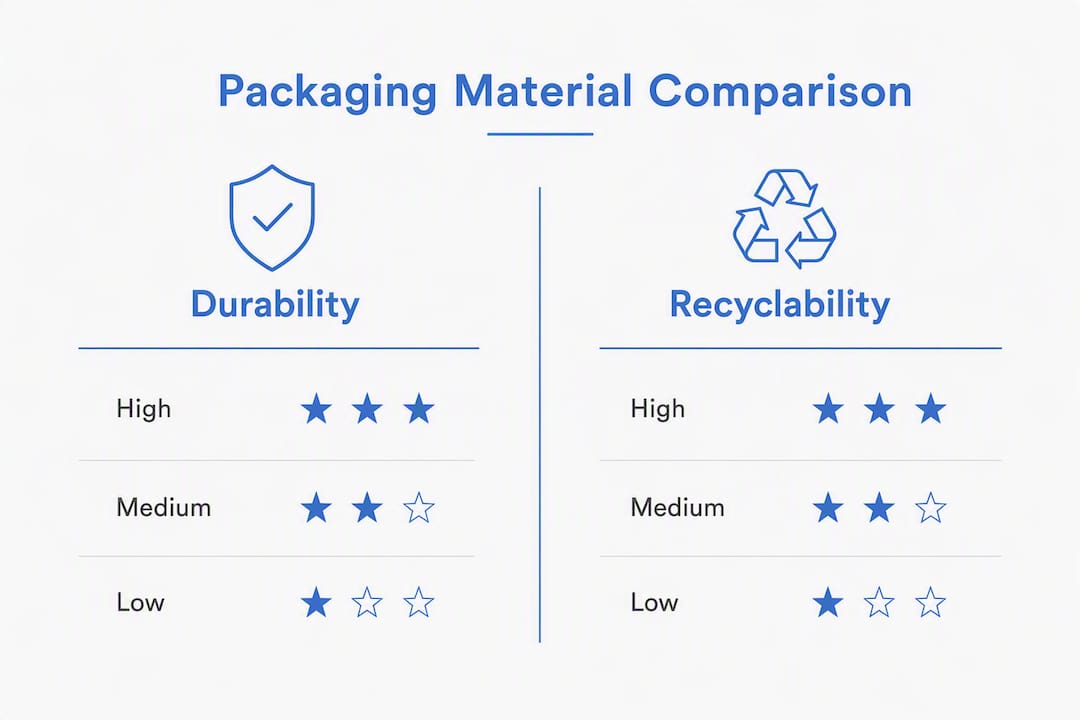
Air pillows and bubble wrap are effective cushioning materials but score poorly on recyclability. Air pillows made from LDPE film can be recycled via store drop-off; bubble wrap is similar. Neither is accepted in kerbside collections. For businesses with strong sustainability commitments, paper alternatives are now a practical substitute for most applications.
| Material | Durability | Cost efficiency | UK recyclability |
|---|---|---|---|
| Corrugated box (32 ECT) | High | Good at volume | Kerbside (card) |
| Mono-material poly mailer | Low–medium | Very good | Store drop-off |
| Paper padded envelope | Medium | Good | Kerbside (paper) |
| Moulded fibre insert | High | Moderate | Kerbside (fibre) |
| Air pillow (LDPE) | Medium | Good | Store drop-off |
The right choice is always the one that protects the product, fits the courier’s pricing structure, and can be substantiated to customers. No single material wins on all three criteria for every product type.
Key takeaways
Fit-for-purpose packaging, verified sustainability credentials, and total cost of ownership tracking are the three factors that separate efficient UK SME packaging operations in 2026 from those still losing money on oversized boxes and unsubstantiated eco-claims.
| Point | Details |
|---|---|
| Audit before you order | Measure product dimensions and track damage rates before selecting box sizes or mailer formats. |
| Standardise box sizes | Two or three standard sizes cut dimensional-weight surcharges, storage costs, and packing time. |
| Demand sustainability proof | Ask suppliers for recycled content certificates and end-of-life data — not just a “recyclable” label. |
| Track total cost of ownership | Include postage uplift, damage replacement, and packing time, not just unit price. |
| Subliblanks for no-MOQ trade supply | Subliblanks offers packaging supplies with no minimum order quantity, letting you test formats before scaling. |
The packaging mistake most UK SMEs keep making
The most common error is treating packaging as a procurement afterthought — something to buy cheaply and in bulk once, then forget. The businesses that get it right do the opposite: they treat packaging as a variable they actively manage, the same way they manage postage rates or supplier terms.
Dimensional-weight pricing is the clearest example of where this matters. Couriers have been charging on volumetric weight for years, yet a surprising number of SMEs have never calculated whether their standard box sizes are triggering surcharges. The fix is simple and the saving is immediate.
The sustainability piece is more nuanced. Switching to “eco” packaging without verifying the end-of-life pathway is not just a compliance risk under EPR — it is a credibility risk with customers who are increasingly sceptical of vague green claims. The businesses that will be in the strongest position in 2026 are those that can point to a certificate, a recycled content percentage, or an OPRL label and say exactly what happens to the packaging after use.
Subliblanks’s position as a no-MOQ trade wholesaler is useful here precisely because it removes the pressure to over-commit. You can order a small quantity of a new sustainable format, test it against your real damage and postage data, and scale only when you have evidence it works. That is a better approach than buying a pallet of something because it looked good in a brochure.
Subliblanks: trade packaging supplies with no minimum order
If you are looking for a practical starting point for the best packaging supplies in 2026, Subliblanks gives UK SMEs direct access to a broad trade catalogue with no minimum order quantity. That means you can order exactly what you need to test a new box size, a sustainable mailer, or a paper void fill option without committing to a full pallet.
Subliblanks supplies packaging materials alongside sublimation, DTF, laser engraving, and print equipment, so businesses that need both packaging and print supplies can consolidate into a single trade account. Specific resources available include:
- Sample-quantity orders across core packaging categories
- Guidance on selecting the right packaging supplies for your product types and shipping volumes
- A practical wholesale packaging guide covering cost optimisation and supplier selection
- Technical support on material choices, including sustainability substantiation
Browse the full range and place a no-MOQ trade order at Subliblanks.
Useful sources and further reading
The following sources informed this article and are worth bookmarking for procurement and sustainability leads:
- 2026 Sustainable Packaging Trends Report — Sustainable Packaging Coalition — The primary industry report on substantiated sustainability, EPR developments, and recyclability definitions for 2026. Essential reading for anyone making sustainability claims.
- Top Global Packaging Trends 2026 — Innova Market Insights — Consumer trend data on measurable sustainability, digital packaging features, and connective packaging adoption.
- Packaging Market Size, Share and Trends 2026–2035 — Towards Packaging — Market sizing and growth forecasts; useful context for investment and innovation planning.
- Top 10 Biodegradable Packaging Materials 2026 — APG-GO — Practical breakdown of biodegradable and engineered fibre materials with operational fit and end-of-life notes.
- Best Packaging Supplies for Small Business 2026 — Busho Designer — Practitioner guidance on fit-for-purpose selection and total cost of ownership for small businesses.
- Best Packing Supplies Kit for Handmade Sellers 2026 — HomeOfficePilot — Practical packing strategy for small and handmade sellers, including self-seal bubble pouch recommendations.
- Best Bulk Packaging Wholesale Suppliers 2026 — Binfire — Market commentary on wholesale supplier selection criteria, catalogue depth, and flexible MOQs.
- Subliblanks packaging guides and resources — Practical UK and Ireland-focused guides covering packaging categories, selection criteria, and use-case examples for SMEs.


