



Why choose eco-friendly packaging for UK businesses
Choose eco-friendly packaging because it reduces your environmental footprint, strengthens your brand with customers who care, and often lowers your total operating cost once you account for freight and returns. Bodies like WRAP and FSC UK have built the certification frameworks UK businesses can rely on, and Life Cycle Assessment (LCA) methodology gives you the evidence to back every claim you make.
Three reasons this matters right now for UK decision-makers:
- Environmental impact: Packaging is a direct contributor to carbon emissions, landfill volume, and plastic pollution. Switching materials and right-sizing your pack reduces all three.
- Commercial upside: Consumers are more likely to change buying behaviour for credibly sustainable packaging, and logistics optimisation alone cuts freight costs by reducing dimensional weight.
- Regulatory and market pressure: UK retailers and regulators are tightening requirements. Getting ahead of WRAP targets and FSC chain-of-custody expectations now is cheaper than reacting later.
Key takeaways
Eco-friendly packaging reduces environmental harm, strengthens brand credibility, and often lowers total operating cost when right-sizing and logistics savings are included in the calculation.
| Point | Details |
|---|---|
| Start with a pilot | Test one SKU over 8–16 weeks before committing to a full range switch. |
| Right-sizing delivers fast payback | Reducing dimensional weight cuts freight cost on every order, often offsetting higher material cost. |
| Certifications matter | Always verify FSC, BSI, or recycled-content claims with a certificate number from the issuing body. |
| LCA beats single-material claims | Assess packaging across its full lifecycle; a material that looks greener may not be in practice. |
| Subliblanks suits pilot-scale buying | No minimum order quantities mean UK trade buyers can test eco packaging without bulk commitment. |
Table of Contents
- Why choose eco-friendly packaging: what it actually means
- How eco-friendly packaging reduces environmental harm
- What are the commercial benefits for UK businesses?
- Which eco-friendly packaging materials suit UK businesses?
- Which certifications and standards should UK buyers trust?
- How to choose eco-friendly packaging: a practical checklist
- What does switching typically cost, and how long does it take?
- Quick wins from UK trade experience
- The case for starting small and measuring everything
- Subliblanks packaging supplies for UK trade buyers
- Sources
Why choose eco-friendly packaging: what it actually means
Sustainable packaging is packaging designed to minimise environmental harm across its full life, from raw material extraction through manufacture, transport, use, and end-of-life recovery. That last phrase matters: a box made from recycled board but laminated with non-recyclable film is not genuinely sustainable, regardless of what the label says.
The scope covers four dimensions:
- Materials: recycled content, responsibly sourced virgin fibre (FSC-certified), compostable bioplastics, or reusable formats
- Design: right-sizing to eliminate void fill, lightweighting to cut transport emissions, mono-material construction to aid sorting
- Manufacture: energy and water use in production, proximity of supply to reduce transport
- End-of-life: recyclability in UK kerbside collections, industrial compostability, or reuse systems
LCA (Life Cycle Assessment) is the methodology that measures all of these together. It differs from simple material claims because it counts every stage. A bioplastic bag may look greener than a polyethylene bag, but if it requires energy-intensive manufacture and there is no industrial composting facility nearby, its real-world impact may be worse. Circular design, right-sizing and designing for real recycling are the principles that consistently improve recovery rates when matched to local infrastructure.
Pro Tip: Ask any supplier for their chain-of-custody certificate before you order. A credible eco claim comes with a certificate number you can verify, not just a logo on a webpage.
How eco-friendly packaging reduces environmental harm
The environmental case for switching is not abstract. Packaging choices affect greenhouse gas emissions, landfill volumes, forest health, water use, and ocean plastic leakage, all in measurable ways.
The main mechanisms:
- Lower greenhouse gas emissions: Recycled content requires less energy to produce than virgin material. Right-sized packs reduce the number of vehicles needed per delivery run.
- Less landfill and plastic leakage: Single-use plastic packaging is a primary source of long-term ecological harm. Reducing it directly cuts the volume entering landfill or leaking to waterways and oceans.
- Forest conservation: Sourcing FSC-certified fibre reduces pressure on forest ecosystems and supports credible sustainability claims. The pulp and paper sector carries significant biodiversity and water impacts; responsible sourcing and recycled content reduce both.
- Lower water and air pollution: Shorter, simpler supply chains and recycled feedstocks reduce industrial effluent and particulate emissions compared with virgin material production.
LCA evidence reinforces why design decisions compound. A packaging redesign that reduces material use by around 8% in a single product can generate large aggregate material and transport savings when scaled across a full product range. That figure sounds modest per unit; across thousands of shipments, it becomes a meaningful carbon and cost reduction.
Right-sizing and recycled content work together. A lighter, smaller pack uses less raw material, ships more units per pallet, and is easier to sort and recover. Each of those effects compounds the others.
What are the commercial benefits for UK businesses?
Environmental benefits translate into commercial language faster than many buyers expect. The consumer preference for sustainable packaging is real and documented: brands that match credible claims with performance see higher conversion and loyalty. Beyond brand perception, the operational gains are often more immediate.
Direct commercial benefits for UK businesses:
- Brand trust and conversion: Customers notice credible eco credentials at point of purchase. Retailers increasingly require them as a listing condition.
- Lower shipping costs: Carriers price by dimensional weight. A right-sized mailer that eliminates a significant portion of void fill reduces your freight bill on every single order.
- Fewer returns: Better-designed, right-sized packs protect products more reliably, reducing damage in transit and the cost of processing returns.
- Supply chain resilience: Diversifying into recycled-content or FSC-certified materials reduces exposure to virgin commodity price swings.
- Regulatory readiness: Getting ahead of UK Extended Producer Responsibility (EPR) requirements avoids reactive compliance costs later.
The accounting perspective most buyers miss is total landed cost versus per-unit invoice price. An FSC-certified mailer might cost a few pence more per unit than a standard equivalent. But if it ships at a lower dimensional weight, reduces one return per hundred orders, and removes the need for void fill, the net position often favours the eco option. Logistics optimisation through lightweighting and right-sizing is frequently the mechanism that delivers commercial payback fastest.
Pro Tip: Before comparing supplier quotes, build a simple landed-cost model: unit price + freight rate per pack + average return cost per hundred units. The eco option often wins on that basis even when its invoice price is higher.
Which eco-friendly packaging materials suit UK businesses?
Matching material to product and logistics need is where most switching decisions go wrong. There is no single best material; there is only the right material for your product, your supply chain, and the recovery infrastructure your customers actually have access to.
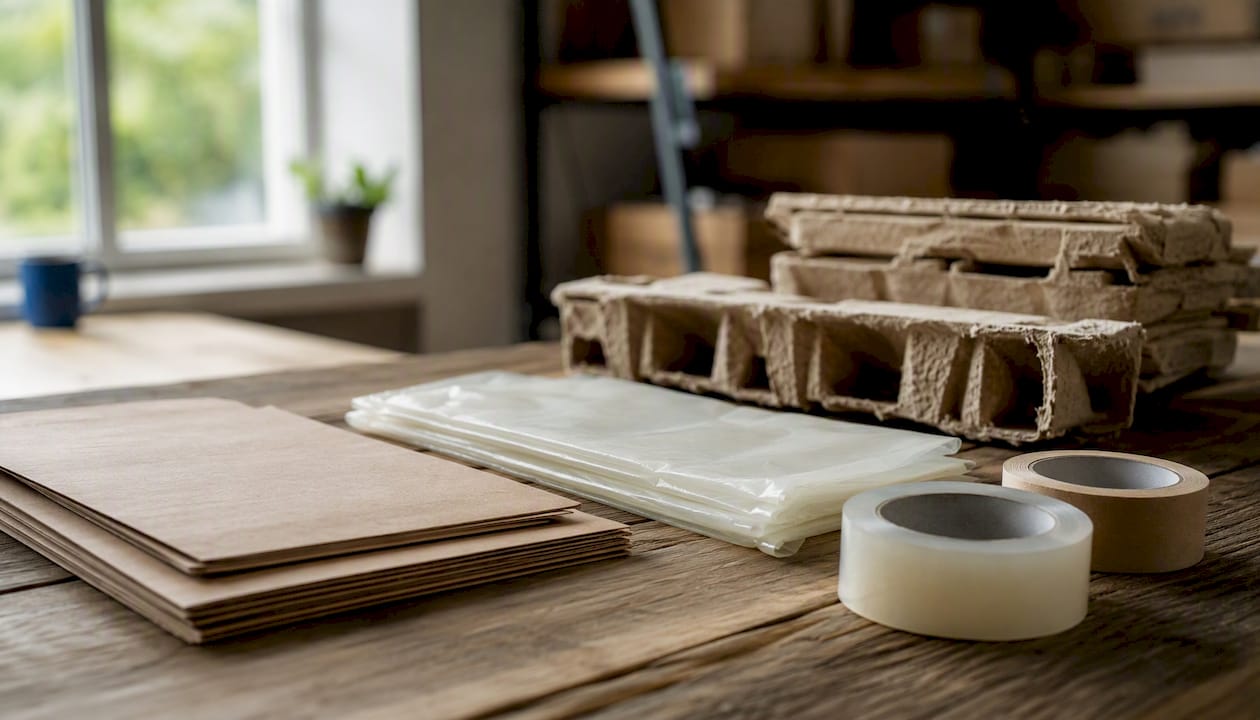
FSC-certified paper and cardboard are the most practical starting point for most UK businesses. They enter kerbside recycling reliably, carry credible certification, and are widely available from UK wholesalers. The limitation is moisture sensitivity; they are not suitable for wet or greasy products without additional treatment, which often compromises recyclability.
Post-consumer recycled (PCR) plastics use material already in the system rather than virgin feedstock, reducing upstream impact. The caution: plastic recycling faces structural challenges around sorting, contamination, and economics. Ask suppliers for recovery evidence rather than accepting recycled-content claims at face value.
Compostable bioplastics are appropriate for food-contact applications where contamination prevents conventional recycling. The critical caveat for UK buyers is infrastructure: most compostable packaging requires industrial composting, and UK kerbside food-waste collections do not universally accept it. Without a clear end-of-life route for your customers, compostable materials can end up in general waste, which defeats the purpose.
Moulded fibre (pulp trays, end caps) is an excellent alternative to expanded polystyrene for protective packaging. It is kerbside recyclable, made from recycled feedstock, and increasingly cost-competitive.
Reusable systems suit high-frequency B2B logistics where you control both ends of the supply chain. The upfront cost is higher, but the per-use cost falls sharply over time.
For most UK SMEs shipping physical goods, FSC-certified cardboard combined with PCR tape and right-sized void fill is the most practical, credible, and commercially sound starting point. You can verify the right packaging supplies for your business before committing to a full switch.
Which certifications and standards should UK buyers trust?
Greenwashing is common in packaging. The way to protect yourself is to know which labels carry independent verification and which are self-declared marketing claims.
Certifications worth trusting:
- FSC (Forest Stewardship Council): Covers paper, cardboard, and wood-based materials. A chain-of-custody certificate means every link in the supply chain has been audited. Check the certificate code at Info.
- WRAP (Waste and Resources Action Programme): The UK’s leading resource-efficiency body. WRAP’s Plastic Pact and Courtauld Commitment set targets that UK retailers and suppliers sign up to. Their guidance is the practical benchmark for UK packaging programmes.
- BSI (British Standards Institution): BSI standards such as BS EN 13432 define what qualifies as industrially compostable in the UK and EU context. If a supplier claims compostability, ask which standard they certify to.
- OK compost (TÜV Austria): A widely recognised compostability label in Europe, covering both industrial (OK compost INDUSTRIAL) and home composting (OK compost HOME) variants. Home composting certification is significantly harder to achieve and more meaningful.
- Recycled content labels: Look for independently verified recycled content percentages, not self-declared claims. The Global Recycled Standard (GRS) provides third-party verification.
How to read a label: check the certificate number, verify it with the issuing body, and ask for the scope of the certificate (does it cover the specific product you are buying, or just the supplier’s facility?). When a supplier cannot provide a certificate number, treat the claim as unverified.
For higher-value decisions, ask for an LCA summary or at minimum a material data sheet showing recycled content percentage and recovery pathway. UK and Ireland packaging standards are worth reviewing before finalising supplier agreements.
How to choose eco-friendly packaging: a practical checklist
A structured approach prevents the two most common mistakes: buying on price alone and switching everything at once.
Step-by-step decision process:
- Define your objective. Are you targeting carbon reduction, recycled content percentage, compostability, or all three? Pick the primary metric first; it shapes every subsequent decision.
- Map your logistics constraints. Weight limits, moisture exposure, fragility of contents, and whether customers have access to kerbside recycling all constrain your material options.
- Set performance and cost targets. Decide the maximum acceptable unit cost increase and the minimum performance standard (drop-test, moisture resistance, print quality if branded).
- Shortlist materials. Use the material matrix above to narrow to two or three candidates.
- Request samples and documentation. Do not commit without physical samples and verified certificates.
- Run a pilot. Test on one SKU or one shipping route before rolling out.
Supplier questions to ask:
- What certifications does this product hold, and can you provide the certificate number?
- What is the verified recycled content percentage, and how is it measured?
- Do you have an LCA summary or environmental product declaration for this line?
- What are your minimum order quantities and lead times for UK delivery?
- What is the recommended end-of-life route for UK consumers?
Red flags to watch for:
- Vague claims (“eco-friendly”, “green”, “sustainable”) with no certificate number
- Missing chain-of-custody documentation for paper or cardboard products
- Non-recyclable laminates or coatings described as “recyclable”
- Compostable claims with no standard cited
Pilot plan template:
- Weeks 1–2: Procure samples, run internal drop and moisture tests
- Weeks 3–4: Ship 50–100 live orders using the new pack
- Weeks 5–12: Track damage rate, customer feedback, freight cost per order, and return rate
- Week 13: Decision gate — scale, adjust, or reject based on KPIs
Pro Tip: Keep your pilot to one SKU and one carrier. Isolating variables makes it far easier to attribute any change in damage rate or freight cost to the packaging switch rather than other factors.
For a step-by-step guide to preparing product packaging at small scale, the step-by-step product packaging guide covers the practical detail.
What does switching typically cost, and how long does it take?
Cost and timeline are the two questions that stall most switching decisions. The honest answer is: a pilot costs less than most buyers expect, and the payback timeline depends almost entirely on whether you right-size at the same time as you switch materials.
Cost factors to budget for:
- Material unit price (often 5–15% higher for certified eco options versus standard equivalents, though this varies by volume and supplier)
- Sample procurement and internal testing time
- Any tooling or print plate changes for branded packaging
- Storage and handling changes if pack dimensions change
- Staff time for supplier onboarding and documentation review
Typical timeline:
- Sample to pilot decision: 2–4 weeks
- Live pilot: 8–16 weeks on a single SKU
- Full rollout across a product range: 3–6 months depending on SKU count and supplier lead times
The ROI case is straightforward when right-sizing is included. Add reduced void fill spend and a lower return rate from better pack performance, and the net position over a 12-month period is often positive. Bulk packaging choices and their effect on supply chain cost are worth reviewing when building your cost model.
Quick wins from UK trade experience
The fastest gains come from changes that require no tooling, no new supplier relationships, and no minimum order commitment. Three examples from trade experience with UK businesses:
Right-sizing mailers: A small print-on-demand business shipping A4 products in C3 mailers switched to correctly sized C4 equivalents. Freight cost per order fell because dimensional weight dropped, and damage rates fell because the product had less room to move inside the pack. No certification change required; the saving was immediate.

Switching to FSC-certified liners and tissue: A gift retailer replaced standard tissue paper with FSC-certified equivalents at a marginal cost increase. The change gave them a verifiable claim for their packaging inserts and social media, with no change to their fulfilment process.
PCR tape instead of standard polypropylene: Switching to tape with verified post-consumer recycled content is one of the lowest-friction changes available. It costs marginally more per roll, requires no process change, and adds a credible recycled-content claim to every outbound shipment.
For SMEs, the principle is the same in each case: pick the change with the lowest switching cost and the clearest verification route first. Scale the more complex changes once you have internal buy-in from a demonstrated win.
Pro Tip: Start your packaging audit with the three highest-volume SKUs by shipment count. Changes there produce the largest aggregate impact and the clearest data for your next internal review.
Subliblanks supplies packaging materials including mailers, boxes, and protective supplies to UK trade customers, with no minimum order quantity, which makes it practical to run a small pilot without committing to bulk stock. Browse the packaging supplies range for options suited to print and personalisation businesses.
The case for starting small and measuring everything
The businesses that stall on eco packaging almost always make the same mistake: they treat it as an all-or-nothing project. They wait for a full sustainability audit, a board-level sign-off, or the perfect certified supplier before making any change. Meanwhile, the businesses that move fastest pick one pack, run a 10-week pilot, measure three KPIs, and make a decision.
The pilot-first approach is not a compromise. It is the right method. It gives you real data to present to stakeholders, a verified cost model rather than a theoretical one, and a proof of concept that makes the next switch easier to approve. Framing it internally as a “risk-managed trial with defined exit criteria” tends to get faster sign-off than “we are switching all our packaging to eco materials.”
The commercial case for sustainable packaging is strong and getting stronger as retailer requirements and UK regulatory expectations tighten. But the strongest argument in any internal meeting is a spreadsheet showing what happened on your own orders over eight weeks, not a general industry trend.
Subliblanks packaging supplies for UK trade buyers
Subliblanks gives UK trade buyers access to packaging supplies with no minimum order quantity, which means you can run a genuine pilot without tying up cash in bulk stock you are not yet committed to.
For print shops, makers, and personalisation businesses, that flexibility matters. You can test an FSC-certified mailer on 50 orders, check the freight cost and damage rate, and scale only when the numbers work. The range covers mailers, boxes, protective materials, and accessories, all available for direct order through the Subliblanks wholesale platform.
If you are ready to review your current packaging and find credible eco alternatives, browse the full Subliblanks range or read the practical guide to packaging solutions for small businesses to see which options fit your product type and shipping volume.
Sources
Reliable, independently maintained resources for UK businesses evaluating sustainable packaging:
When evaluating any supplier, request their chain-of-custody documentation and, for higher-volume decisions, an LCA summary or environmental product declaration. Self-declared claims without supporting documentation are not a reliable basis for a compliance or marketing claim.


