



Packaging First: Pick Stamp Ink by Substrate to Avoid Smeared Batches
Use water-based ink for cardboard and paper, solvent-based quick-dry ink for plastics, film and metal, and an FDA-compliant, low-migration ink whenever the mark could touch food indirectly. Water-based formulas soak into fibres and dry naturally on porous stock. Non-porous surfaces need solvent chemistry that evaporates rather than absorbs, which means faster drying but more frequent re-inking.
TL;DR:
- Water-based inks are suitable only for porous surfaces like cardboard and paper, while solvent-based quick-dry inks are necessary for non-porous materials such as plastic, film, and metal.
- Printing on laminated or coated stock often requires testing in advance, as surface coatings can severely impair ink adhesion and drying times.
- For food-contact packaging, low-migration, FDA-compliant inks with verified safety data are essential, especially on external marks, and NSF R1 markers are recommended for equipment surfaces.
- Quick-dry inks evaporate faster on open pads, demanding more frequent re-inking and careful storage; testing batch adhesion and durability before production minimizes costly mistakes.
- Compatibility between ink, substrate, and stamp system is critical; testing small batch samples is the best way to prevent smudging, ineffective adhesion, or regulatory issues at scale.
Table of Contents
- Stamp ink for packaging: water-based, quick-dry and marker types
- How to choose the right ink for your packaging project
- Food-safe stamp ink and FDA 21 CFR limits
- Quick-dry stamp ink: drying times and fixing smudges
- Trade perspective: pairing dies, pads and ink correctly
- Environmental and safety considerations for packaging inks
- Choosing ink colour for packaging branding
- Storing stamp ink correctly to protect shelf life
- Do coatings like varnish and lamination affect ink adhesion?
- Editorial take: why substrate rules beat brand loyalty
- Where to buy stamp ink for packaging and test samples
- Sources
- FAQ
Stamp ink for packaging: water-based, quick-dry and marker types
Three ink families cover almost every packaging job, and picking the wrong one is the single biggest cause of smeared batches and ruined pads.
Water-based ink is the industry default for cardboard, kraft paper and other porous stock. It gives clean, consistent impressions and works fine in standard self-inking systems, which is why it’s recommended for invoices, packing slips and routine office documents. The catch is that it does almost nothing on plastic, foil or laminated film. It just beads up and smears.
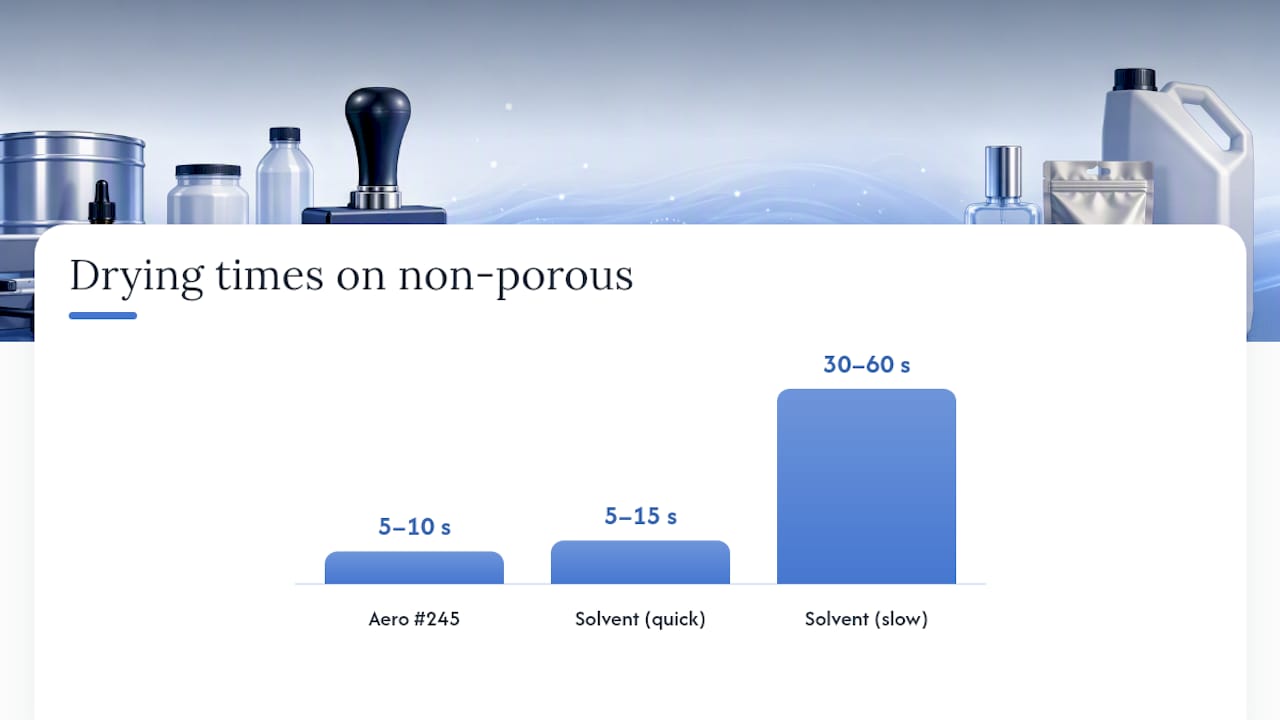
Solvent-based quick-dry ink is the one non-porous packaging demands. Plastic pouches, glossy shrink film, metal tins and coated cartons all need an ink that evaporates rather than absorbs, and drying times on these formulas run anywhere from 5 to 15 seconds up to 30 to 60 seconds depending on the specific chemistry and how much surface energy the substrate has. The trade-off is real: solvent inks dry out in open pads faster and need more frequent re-inking than water-based equivalents.
Permanent, archival and marker-style products fill a different niche. These are for durable tagging (equipment IDs, batch codes on drums, asset marking) rather than everyday retail packaging, and they’re often chosen for resistance to abrasion, chemicals or repeated washing rather than for speed.
A couple of named examples help make label claims easier to read:
- Aero #245 packaging ink is a purpose-built kit sold with a quick dry time of around 5 to 10 seconds and marketed for exterior food packaging imprints. It’s a useful benchmark for what a dedicated packaging formula should offer.
- SAFE-MARK is an NSF R1-registered marker aimed at food-contact surfaces and processing equipment rather than retail cartons, and it’s worth knowing the difference between the two categories before you buy either.
How to choose the right ink for your packaging project
Work through the substrate first, then the compliance risk, and the rest of the decision mostly makes itself.
- Identify the substrate. Cardboard and uncoated paper point to water-based ink. Plastic film, foil, glass and coated stock point to solvent or quick-dry.
- Check the stamp system. Self-inking stamps, hand stamps and pre-inked stamps all have preferred ink chemistries, so match the ink to what the stamp or pad was built for.
- Confirm the drying requirement. If cartons move straight onto a conveyor or get stacked within seconds, quick-dry is non-negotiable regardless of substrate.
- Think about downstream processes. Heat sealing, shrink-wrapping or cold storage can all smear or fade a mark that looked fine on the bench.
- Assess food-contact risk. If the pack holds food and the stamp lands on the outside, you need an FDA-aligned, low-migration formula, not a generic office ink.
Compatibility matters more than most people assume. Putting solvent-based ink into a pad designed for water-based refills is one of the more common ways stamps and pads get ruined, according to practitioner guidance on stamp and ink care. Always check the manufacturer’s compatibility notes before mixing formulas across a pad.
Before committing to a bulk run, test on an actual production sample: stamp a handful of pieces, let them sit for the same time they’d sit in your real workflow, then rub and wipe them to see how the mark holds up. Check adhesion again after any sealing, stacking or cold-storage step the batch will actually go through.
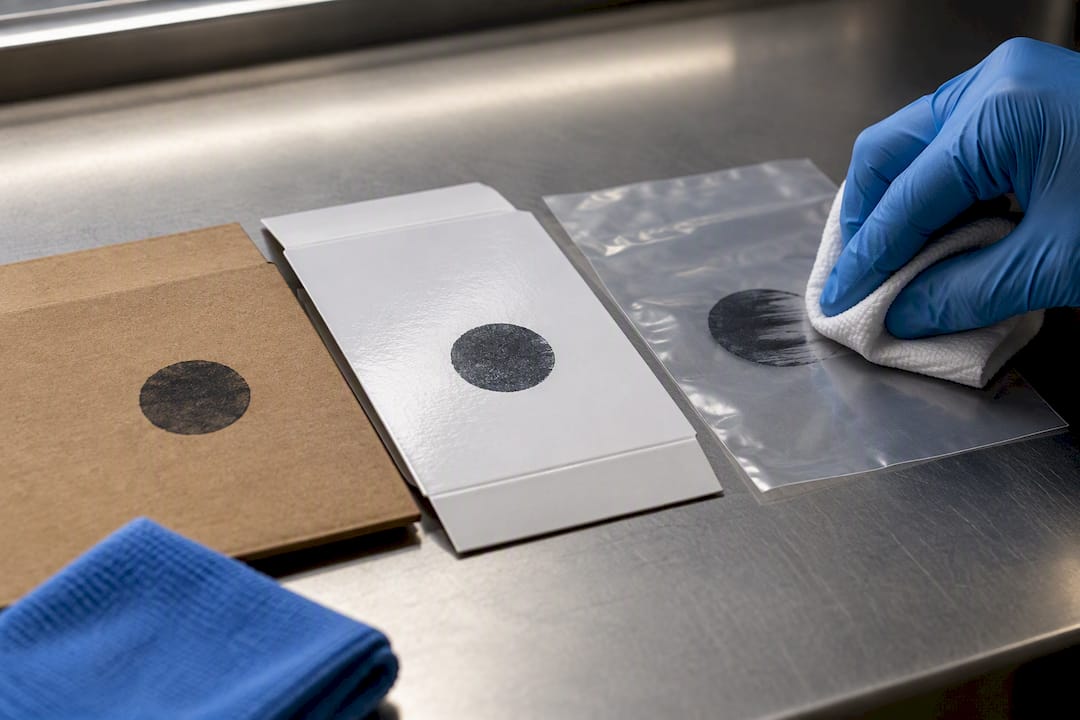
Pro Tip: Keep a small log of re-ink intervals when you switch to a quick-dry formula. Solvent inks dry out in open pads faster than water-based ones, and knowing your pad’s real refill rhythm saves you from mid-run surprises on a big order.
Food-safe stamp ink and FDA 21 CFR limits
“Food-safe” for an external stamp doesn’t mean the ink is edible. It means the formula is low-migration and tested clean of heavy metals, so nothing transfers through the packaging to the product inside.
In the US, that baseline sits with FDA guidance on indirect food contact substances under 21 CFR. Inks marketed for food packaging should be formulated against that standard, and suppliers should be able to back the claim with actual data rather than a label alone.
A few practical rules worth following:
- Look for explicit low-migration and heavy-metal testing claims on the datasheet, not just the word “food-safe” on the front of the bottle.
- For processing equipment and surfaces with repeated food contact, NSF R1-registered markers are the stronger choice. They’re built to withstand sterilisation and are approved specifically for indirect food contact surfaces.
- External marking on cartons and film is generally permitted under indirect-contact rules, but that’s a general principle, not a blanket pass for every ink on the shelf.
For anything genuinely critical, such as a recall-sensitive product line, ask the supplier for migration test results and certificates rather than relying on marketing copy. It’s a five-minute email that can save a much bigger headache later.
Quick-dry stamp ink: drying times and fixing smudges
Drying speed on non-porous packaging depends heavily on surface energy, which is why the same ink behaves differently on matte film versus a glossy laminate. Some industrial quick-dry formulas set in 5 to 15 seconds, while others need 30 to 60 seconds to fully cure.
If marks are smearing before they set, a few fixes usually sort it:
- Try a primer or adhesion promoter on stubborn glossy or coated surfaces before stamping.
- A light, gentle heat pass can speed curing on borderline cases, but test first, since too much heat just spreads the ink.
- Matte films generally take ink better than high-gloss finishes, so swapping film grade is sometimes the cheaper fix.
- Reseal pads between uses and keep reactivator or reconditioner products on hand, since manufacturers expect more frequent re-inking with quick-dry chemistry.
Pro Tip: If you’re running hundreds of cartons a shift and manual stamping keeps falling behind, that’s usually the sign to look at flexography instead. Flexographic printing systems are built for the rapid-evaporation inks that manual pads struggle to keep up with at volume.
Trade perspective: pairing dies, pads and ink correctly
Ink choice never sits alone. Die material and pad type both shape how a mark lands on packaging, and Subliblanks covers the practical side of that pairing in guides on stamp making for packaging and stamp machine types. Before locking in a bulk order, it’s worth trialling a small batch of ink and pad together, since no minimum order quantity means you can test compatibility cheaply rather than guessing at scale.
Environmental and safety considerations for packaging inks
VOC content is the main environmental variable that separates ink families. Water-based formulas generally carry lower solvent emissions, which matters for indoor air quality on a production floor running stamps all shift. Solvent-based quick-dry inks, by their nature, rely on evaporating carriers to achieve fast set times, and that evaporation is exactly what releases more VOCs into the workspace.
That doesn’t make quick-dry inks unsafe to use. It means ventilation and storage practice matter more with solvent formulas than with water-based ones, and pads should be sealed between uses rather than left open on a bench.
Recyclability is a separate question from the ink’s chemistry. Most packaging recycling streams care about the substrate (cardboard, film, glass) rather than trace ink coverage, so a stamped mark rarely disqualifies a carton from standard recycling. Heavy, full-coverage solvent printing at industrial scale is a different conversation, which is one reason large flexographic operations increasingly look at lower-VOC formulations.
For a small packaging operation, the practical takeaway is straightforward: choose water-based ink wherever the substrate allows it, reserve solvent quick-dry for the surfaces that genuinely need it, and keep pads sealed and stored properly rather than left open to off-gas on a shelf.
Choosing ink colour for packaging branding
Pigmentation quality affects more than how a mark looks under warehouse lighting. It determines whether a logo or date code stays legible after handling, sunlight exposure, or a spell in cold storage.
Black and dark colours generally show the best contrast and hold up longest on kraft and plain cardboard, which is why they dominate batch codes and date stamps. Brighter pigments (red, blue, green) read well on white or light-coated stock but can fade faster under UV exposure if cartons sit near a warehouse window or loading dock for weeks.
Glossy or laminated film changes the calculation again. A pigment that looks vivid on matte cardboard can look washed out or patchy on a reflective surface, simply because the ink sits differently on a non-absorbent film. If brand colour consistency matters, test the actual pigment against the actual packaging finish rather than trusting a swatch card.
For aesthetic branding stamps as opposed to functional codes, water-based pigmented inks tend to give richer, more even colour on porous stock, while solvent formulas on film often look slightly flatter but compensate with durability. Neither is “better” in the abstract. It depends on whether the mark needs to look good or needs to survive handling, and often it needs to do both.
Storing stamp ink correctly to protect shelf life
Heat and evaporation are the two enemies of stamp ink sitting on a shelf. Solvent-based quick-dry formulas lose their fastest-drying properties first when caps are left loose or bottles sit near a heat source, because the volatile carriers that make them dry fast are the same ones that evaporate in storage.
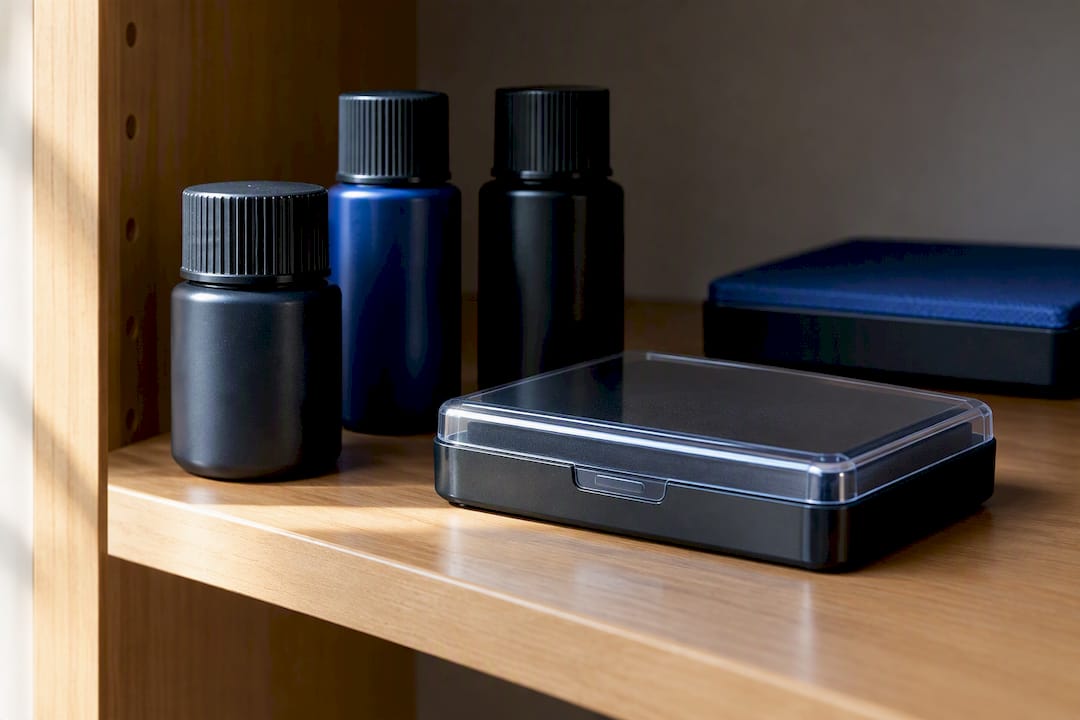
Keep bottles capped tightly, store them somewhere cool and out of direct sunlight, and avoid stacking them near heaters or loading-bay doors where temperatures swing. Water-based inks are generally more forgiving of ambient temperature shifts but can still thicken or separate if left unused for long stretches, so give a bottle a proper shake before a big run rather than assuming it’s ready straight off the shelf.
Pads themselves need the same care as the ink inside them. A pad left open on a workbench dries out far faster than one sealed in its housing between shifts, and that’s true for both ink families, though quick-dry solvent pads suffer the effect noticeably faster given how readily their carriers evaporate.
If a batch of ink has been sitting untouched for a long time, don’t just assume it still performs to spec. Run a quick test stamp before committing it to a full production run, especially for food-packaging ink where migration properties could shift as a formula ages.
Do coatings like varnish and lamination affect ink adhesion?
Yes, and this is one of the most overlooked reasons a perfectly good ink suddenly stops performing. Varnish and lamination both change the surface energy of packaging, which is exactly the property that determines how well an ink wets and bonds to a substrate.
A laminated carton behaves more like plastic film than like cardboard, even though the base material underneath is paper. That means an ink chosen for “cardboard” on the label might smear or wipe off entirely once it hits a laminated finish, simply because the coating has sealed off the porous fibres the water-based ink was counting on to absorb into.
Varnished stock causes a similar problem in reverse: a glossy varnish coat can resist quick-dry solvent ink just as stubbornly as a plastic film does, depending on the varnish chemistry. The fix is the same one that solves most adhesion problems: test on the actual finished stock, not a raw substrate sample, and consider a primer or adhesion promoter if the coating is resisting the mark.
This is also where drying time claims can mislead. A quick-dry ink rated for 5 to 10 seconds on bare cardboard may need noticeably longer on a heavily coated or laminated version of the same board, because the coating slows how the ink sets even when it doesn’t stop it from bonding altogether.
Editorial take: why substrate rules beat brand loyalty
The biggest mistake in this category isn’t picking a bad ink. It’s picking a good ink for the wrong surface and assuming the label’s marketing claim covers your specific packaging. “Quick-dry” and “food-safe” are both doing a lot of work on a bottle, and neither term guarantees performance on your exact substrate, coating, or handling process.
What the evidence here actually supports is a simple hierarchy: match chemistry to substrate first, verify compliance second, and only then start comparing brands or colours. Most conventional advice skips straight to product recommendations without asking whether the reader even knows if their packaging is porous, laminated, or headed for cold storage.
If you take one thing from this, test before you commit to volume. A small trial run costs you a few minutes and a handful of samples. Guessing wrong on a 5,000-unit order costs a lot more.
— chris
Where to buy stamp ink for packaging and test samples
A practical approach to avoiding guesswork with ink brands is to source small test batches of packaging materials and consumables to confirm ink, pad and substrate compatibility before committing to a full production run.
That matters most in packaging, where the wrong pairing (solvent ink in a water-based pad, or the wrong ink on a laminated carton) tends to show up only after you’ve already run a few hundred units. Alongside stamp-making machines and pads, the packaging materials collection gives you a straightforward way to trial substrates against the ink families covered above, and the consumables range covers refills and pad accessories for when you’ve settled on a formula that works. Starting with a small order to confirm the pairing holds up under real handling processes before scaling is advised.
Sources
For migration data, composition details and food-contact standards, check the FDA’s guidance on food contact substances and request the specific ink manufacturer’s safety data sheet directly.
FAQ
What type of stamp ink stays on plastic packaging?
Solvent-based quick-dry ink is the type built to bond to plastic, film and other non-porous surfaces, since it evaporates rather than absorbing into the material. Water-based ink, by contrast, tends to bead up and wipe off plastic almost immediately.
What ink is best for stamping packaging overall?
There’s no single best ink across all packaging. Water-based formulas are best for cardboard and paper, while solvent-based quick-dry inks handle plastic, foil and glossy film better because they set faster on non-absorbent surfaces.
What ink is safe for food packaging?
Ink used on the outside of food packaging should meet FDA 21 CFR guidance for indirect food contact, meaning it’s tested as low-migration and free of heavy metals. For equipment and surfaces with repeated food contact, an NSF R1-registered marker is the more appropriate choice.
What can I use instead of stamp ink for packaging marks?
Some operations move to flexographic printing once manual stamping can’t keep pace with rapid-evaporation solvent inks at volume. For smaller runs, pre-inked stamps or dedicated packaging ink kits, such as products in the Aero #245 category, offer a middle ground between manual stamping and full print production.
How often should I re-ink a pad used with quick-dry ink?
Quick-dry solvent formulas dry out in open pads faster than water-based ink, so expect more frequent re-inking, though the exact interval depends on how often the pad is used and how well it’s sealed between runs. Keeping pads capped or housed when not in use, and having a reactivator on hand, extends the interval noticeably.


