



6–8mm Cells Won’t Fix Warping: Laser Honeycomb Beds for Small Shops
A laser honeycomb bed is a perforated support grid, usually aluminium, that holds your workpiece above the machine’s base while letting smoke, vapour and reflected beam energy pass straight through it. It earns its place on any laser that cuts thin sheet material or engraves in volume, because it stops the underside of your work scorching and keeps airflow moving under the cut. If you’re mostly engraving thick, solid blocks, you may never need one.
TL;DR:
- Honeycomb beds are most beneficial for cutting thin sheet materials like acrylic, plywood, or paper, as they reduce underside scorch marks and improve airflow.
- Cell size affects support and ventilation, with smaller cells offering stability for delicate work and larger cells allowing faster smoke clearance for thicker or less fragile materials.
- Using a framed aluminium honeycomb panel with a metal backing plate ensures long-term flatness, better vibration damping, and easier maintenance compared to unframed or thinner options.
- Alternatives like slat beds support heavier stock, pin tables accommodate warped or irregular pieces, and sacrificial plates protect the bed during messy jobs.
- Proper sizing, framing, and routine maintenance, including compressed air cleaning and early replacement signs, are essential for reliable daily use of honeycomb laser beds.
Table of Contents
- What a laser honeycomb bed actually does for your cuts
- Cell size, panel thickness and material: what actually changes performance
- Slat beds, pin tables and sacrificial plates: the main alternatives
- Building or ordering a custom panel: sizing, framing and shipping
- Cleaning routines, wear signs and when to replace the panel
- What to check before you buy: fit, specs and price
- Sourcing and spares: keeping a small shop production ready
- The bed that actually holds up in daily use
- Complementary machines and blanks for your laser workshop
- Where these figures and claims come from
- Sources
- FAQ
What a laser honeycomb bed actually does for your cuts
The grid does two jobs at once. It supports the workpiece on hundreds of small hexagonal cells instead of one flat surface, and it lets the laser beam, smoke, and heat escape downward rather than bouncing back up into your material. That second part is the one people underestimate.
When a beam hits a solid bed underneath thin acrylic or paper, a fraction of it reflects straight back into the underside of the cut. That reflection is what causes the brown scorch line you sometimes see on the back of an otherwise clean engrave. A honeycomb structure breaks that reflection up across dozens of tiny cells, so there’s far less flat surface to bounce off. Vendor documentation on honeycomb tables backs this up directly: they’re built to give multiple support points while helping vapour escape and reducing back-flash, which is exactly why they’re the standard fixture for thin-sheet work and high-volume engraving runs.
Where the difference shows up most:
- Cutting thin acrylic or plywood, where a solid bed causes visible underside melt marks
- Engraving paper or card, which scorches almost instantly on a flat, non-vented surface
- Working veneer or thin wood, where trapped smoke discolours the grain from below
- Any job where the underside finish matters as much as the top face
Skip the honeycomb bed and cut a thick, solid block instead, and you probably won’t notice much difference. The grid earns its keep specifically on thin, flat material.
Cell size, panel thickness and material: what actually changes performance
Not all honeycomb beds behave the same way, and the two specs that matter most are cell diameter and total panel thickness. Get either wrong for your material and you’ll either lose support or choke your airflow.
Cell size is a trade-off between support and ventilation. Smaller cells, typically in the 6 to 8mm range, give thin or delicate material more contact points so it doesn’t sag or curl mid-cut. Larger cells clear smoke faster but leave small parts less stable, which matters if you’re cutting fiddly shapes out of card or thin veneer.
Panel thickness determines rigidity as much as cell size does. A thin, unframed sheet of honeycomb core will flex under its own weight across a large bed, throwing your focus distance out at the edges. Suppliers selling raw core for DIY builds commonly list 6.4mm cell aluminium honeycomb in 20mm thickness as a workable standard for framed beds, and that combination gives enough rigidity without adding unnecessary weight.
Material choice matters just as much as dimensions:
- Aluminium is the default for most laser beds. It’s light, non-magnetic, and doesn’t corrode from the moisture in cutting smoke.
- Stainless steel honeycomb is heavier and more rigid over large spans, useful on bigger industrial beds where sag is a real risk.
- Magnetic panels let you use magnetic hold-downs for warped stock, though most standard aluminium cores are non-magnetic by design.
Industry guidance on laser bed design points to something worth remembering here: rigidity, vibration damping and thermal stability matter more for long-term precision than the honeycomb pattern itself. A flexible, poorly framed bed will ruin your accuracy even if the cell size is perfect.
Slat beds, pin tables and sacrificial plates: the main alternatives
Honeycomb isn’t the only option, and for a lot of jobs it isn’t even the best one. Three alternatives come up constantly in workshop setups, each suited to a different kind of work.
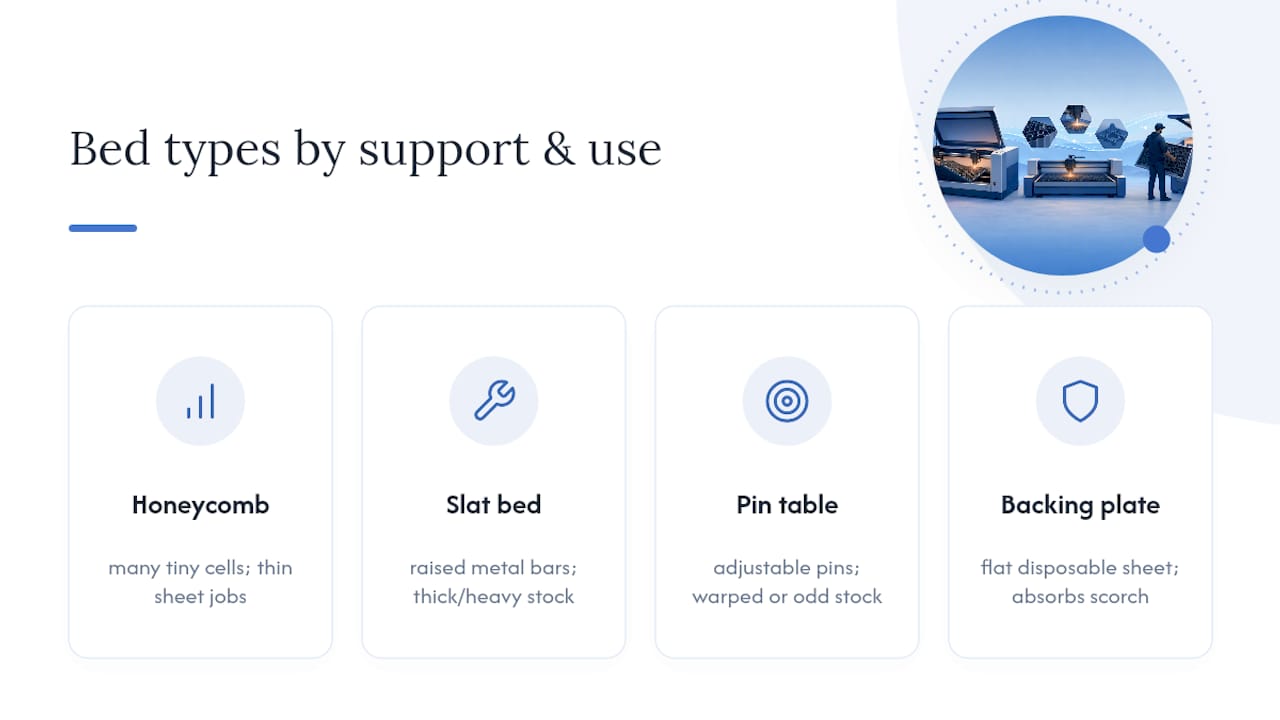
Slat beds use a series of raised metal bars instead of a full grid, so your material only touches the bed at a handful of narrow lines rather than hundreds of tiny cells. That drastically cuts the reflected-beam problem and works well for thicker, heavier stock or repeated heavy-duty cutting where the honeycomb’s finer structure would clog with debris too fast.
Pin tables swap the grid for a bed of adjustable pins that support the workpiece from below at a few precise points. They’re the better choice for warped, uneven or oddly shaped stock, since you can raise or lower individual pins to level a piece that a flat honeycomb bed simply can’t hold flush. Assembly work and irregular offcuts both suit pin tables well.
Sacrificial backing plates are the cheapest fix of all: a flat, disposable sheet, often MDF or thin plywood, laid directly on top of whatever bed you already have. It absorbs scorching and stray beam energy so your honeycomb or slat bed underneath stays clean, and you simply swap it out once it’s too charred to use.
If you’re deciding between them, think about the material first. Thin sheet and engraving work still favours honeycomb. Thick or heavy material favours slats. Warped or irregular stock favours pins. And any time you want to protect a good bed from an especially messy job, a backing plate is the cheap insurance policy.
Building or ordering a custom panel: sizing, framing and shipping
Plenty of makers end up building their own bed rather than buying one off the shelf, usually because their machine’s working area doesn’t match a standard product size. It’s a manageable project if you plan the frame and shipping properly.
- Source the core first. Raw aluminium honeycomb blocks are sold in standard cell and thickness combinations, and picking a widely stocked size makes replacement far easier down the line than a custom-cut oddity.
- Choose steel or aluminium for the frame. Both give the rigidity the panel needs to stay flat under its own weight; timber or plastic framing flexes over time and introduces a fire risk you don’t want near a laser.
- Plan for shipping damage before you order. Large honeycomb panels are awkward, thin, and surprisingly easy to bend in transit. Practitioner reports on custom orders note that packaging and shipping for oversized panels can cost as much as the panel itself, so ask any supplier how they crate large sheets before you commit.
- Check squareness on arrival. Custom rails frequently arrive slightly out of true. The usual fix is shimming the frame or removing and re-squaring the rails before the panel goes anywhere near the machine.
- Add pins or magnets once it’s mounted. A few locating pins around the edge make repeat jobs faster to position, and they help secure material that’s slightly warped rather than dead flat.
A well-built DIY bed will outlast most off-the-shelf desktop panels, provided the frame stays rigid and the core doesn’t get bent in the post.
Cleaning routines, wear signs and when to replace the panel
Honeycomb beds are sacrificial by nature, so treat cleaning as routine maintenance rather than an occasional chore. Blast compressed air through the cells after every session to clear loose soot and offcuts before they compact into the grid. Schedule a proper deep clean, soap and water or a degreaser, whenever you start seeing burn marks transferring to the underside of otherwise clean cuts.
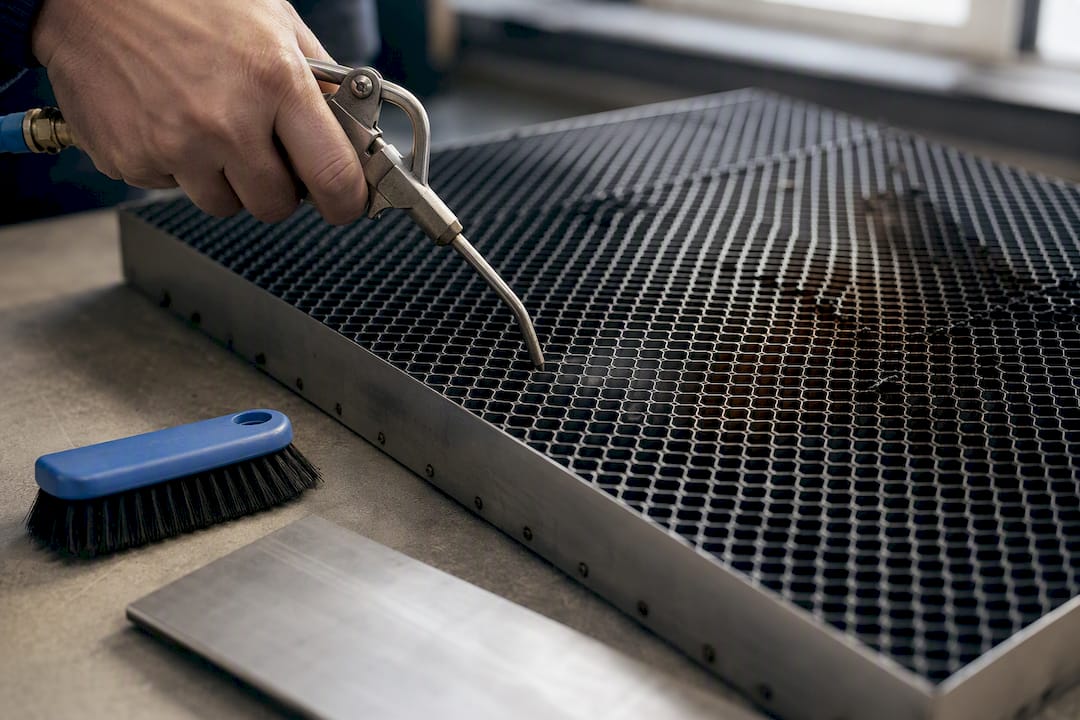
Watch for three failure signs. Persistent clogging that compressed air won’t shift means carbon has bonded to the cell walls and is starting to affect airflow and cut quality. Visible warping across the panel throws your focus height out at the edges, which shows up as uneven engraving depth. And a bed that’s scorched black across most of its surface has stopped reflecting heat away efficiently, which is usually the point to replace rather than keep cleaning. Practitioner advice from laser forums backs this pattern: regular compressed-air cleaning combined with pins for warped stock keeps most beds usable for a long stretch before replacement is needed.
Pro Tip: Always run a metal backing plate underneath the honeycomb, and never frame the bed in anything flammable. A metal plate blocks stray reflections from reaching your machine’s base, and steel or aluminium framing removes a fire risk that timber or plastic simply can’t match.
What to check before you buy: fit, specs and price
Before ordering any panel, ready-made or custom, measure your machine’s actual usable cut area rather than the outer frame dimensions advertised on a listing. Framed panels often have a lip or border that eats into the space you thought you were getting.
Run through this list with any seller:
- Does the price include a backing plate, or is that sold separately?
- Is the frame steel or aluminium, and how is it finished against corrosion?
- What tolerance do they guarantee on squareness for custom sizes?
- Is there a warranty on the panel itself, separate from the frame?
- What does shipping cost for the size you need, and how is it packaged?
Expect to pay noticeably more for shipping and packaging once panels get large, since oversized honeycomb sheets are fragile in transit and need proper crating. Small desktop panels for hobby-class machines sit at the budget end of the market, while custom large-format panels for industrial beds cost considerably more once you factor in framing and freight. Check cell size and total thickness against the specs discussed earlier before you commit to any listing, whether you’re buying an entry-level laser engravable blanks setup or fitting out a full production bed.
Sourcing and spares: keeping a small shop production ready
For a small production shop, the buy versus build decision usually comes down to volume. If you’re running one or two machines with occasional custom sizes, buying a ready-made panel almost always beats the time cost of fabricating your own frame. Once you’re running multiple machines or a genuinely oversized bed, sourcing raw core and building in house starts to make financial sense.
Either way, keep a spare backing plate and a replacement honeycomb panel on hand rather than ordering reactively. A clogged or warped bed that takes a week to replace costs a production shop far more in downtime than the part itself ever would. Protect finished pieces by mounting your bed level and keeping a clean sacrificial layer between the grid and anything you can’t afford to scorch, particularly on jobs using laser engravable materials with a finished face that shows every mark.
The bed that actually holds up in daily use
Most people overthink cell size and underthink the frame. Given the choice, go for a framed aluminium honeycomb panel paired with a separate metal backing plate underneath, rather than chasing the smallest cell diameter you can find. The frame is what keeps the whole thing flat over months of use, and a separate backing plate means you’re replacing a cheap sacrificial sheet instead of the honeycomb core when the underside finally gets too scorched to use. Reliability and easy maintenance beat marginal airflow gains every time you’re running a bed daily rather than occasionally.
— chris
Complementary machines and blanks for your laser workshop
Once you’ve settled on the right bed, the machine and materials sitting on top of it matter just as much for finish quality. Some suppliers offer laser engraving machines, laser-engraveable blanks, and accessories that support workshop operations without requiring minimum order quantities.

Whether you’re speccing a new machine to pair with a custom-built bed or restocking laser-engraveable blanks for a production run, it helps to work with a supplier who understands how bed choice, material thickness and finish quality connect. Some suppliers stock machines, blanks, and consumables compatible with your bed setup, without requiring minimum order quantities on small or trial runs. Browse the full product range to see what’s available, or check the sublimation printer collection if you’re expanding beyond laser work into a wider personalisation setup, and get in touch for advice on compatible accessories before you order.
Where these figures and claims come from
Several claims in this article draw on manufacturer and practitioner sources worth reading directly if you want the fuller technical detail:
- What Physical Properties Matter in a Laser Cutting Machine Bed?, on rigidity, vibration damping and thermal stability
- Laser cutting bed - Accessories | Gravotech, on honeycomb table function and vapour evacuation
- Aluminium Honeycomb Bed for DIY Laser Cutting Machine, on cell size and thickness specs for DIY builds
Sources
- What Physical Properties Matter in a Laser Cutting Machine Bed?
- Laser cutting bed - Accessories | Gravotech
- Aluminium Honeycomb Bed for DIY Laser Cutting Machine - Easy Composites
FAQ
Do I need a honeycomb bed for laser cutting?
You need one for thin sheet material, paper, and high-volume engraving where underside scorching or airflow is a problem, but thick solid blocks often cut fine on a slat bed or sacrificial plate instead.
What is the price of a 4x8 laser cutting bed?
Prices vary widely by material and supplier, and large custom panels typically add substantial shipping and packaging cost on top of the panel price itself, so always ask for a delivered quote rather than comparing panel prices alone.
What are some alternatives to honeycomb laser beds?
The three main alternatives are slat beds for thicker material, pin tables for warped or uneven stock, and sacrificial backing plates laid over an existing bed for cheap, disposable protection.
What should you not laser engrave?
Avoid engraving flammable framing materials near your bed and any material releasing hazardous fumes when cut, and always run a metal backing plate beneath your honeycomb to stop stray reflections reaching the machine base.


