



Stop Nozzle Clogs: Sublimation Ink Shelf Life for Small Shops
Yes, sublimation ink expires. Unopened bottles typically last 12 to 24 months when stored correctly, but that clock starts ticking faster the moment you open one. Ink left sitting in an idle printer can start degrading in as little as 30 to 60 days. Check the manufacture date on the bottle now, store unopened stock somewhere cool and dark, and label anything you’ve already opened.
TL;DR:
- Unopened sublimation ink typically lasts 12 to 24 months if stored properly in a cool, dark place, but once opened, its usable window drops to a few months.
- Heat, UV light, and moisture accelerate ink degradation by disturbing dye suspension, which can lead to color shifts and poorer print quality.
- Ink stored in printers can start drying or separating in as little as 30 to 60 days if not maintained regularly through scheduled nozzle checks and cleaning.
- Signs of degraded ink include sediment, unusual smells, faded colors, streaking, or color imbalance in test prints, which can damage print heads or waste substrates.
- Proper storage, consistent maintenance, and matching ink purchase sizes to actual usage help maximize ink shelf life and prevent costly degradation.
Table of Contents
- What is sublimation ink shelf life and why does the chemistry matter?
- How long does sublimation ink last unopened versus opened?
- What happens to opened ink and ink sitting inside a printer?
- How can you tell if sublimation ink has gone bad?
- How do you store sublimation ink to extend its usable life?
- Why trust this guidance on sublimation ink storage?
- How much does substrate and finishing care affect print durability?
- Why maintenance habits matter more than the date on the bottle
- Get the printers and ink that make storage easier to manage
- Sources
- FAQ
What is sublimation ink shelf life and why does the chemistry matter?
Sublimation ink is a dye based liquid, not a pigment suspension. The colour comes from tiny dispersed dye particles held in a carrier solution, and that dye needs to stay evenly suspended to print true. Heat, ultraviolet light, and moisture all disturb that balance. Warmth speeds up chemical breakdown, UV light can fade or alter the dye molecules directly, and moisture invites microbial growth or throws off the ink’s viscosity. None of this is unique to sublimation ink, but the dispersed dye chemistry makes it more sensitive than, say, standard pigment inkjet ink.
This is where the label on your bottle stops being a formality. A manufacture date tells you when the batch was made. A shelf life figure tells you how long it should perform if stored as instructed. A “use by” date, where printed, is the manufacturer’s hard cutoff. These three numbers are not interchangeable, and skipping past them is how businesses end up with ink that looks fine but prints badly.
A few things explain why one bottle of ink outlasts another sitting on the same shelf:
- Formulation quality: established brands such as Sawgrass and Epson engineer their dye chemistry for stability, while third-party inks vary considerably in how well they hold up over time.
- Packaging integrity: a poor seal lets in air and moisture faster than a well-made bottle or cartridge.
- Batch age at purchase: ink can sit in a warehouse for months before it reaches you, eating into its usable window before you’ve even opened the box.
Always check the technical data sheet for the specific product you’re using rather than assuming every sublimation ink behaves the same way.
How long does sublimation ink last unopened versus opened?
The honest answer depends heavily on which stage of use you’re asking about, because unopened, opened, and installed-in-a-printer are three completely different clocks.
Unopened bottles or cartridges stored correctly generally last 12 to 24 months, a range confirmed across multiple trade sources and consistent with manufacturer guidance. One widely referenced technical data sheet states a shelf life of 12 months for all colours when the ink is kept sealed at 15 to 25°C, so treat 12 months as a sensible baseline and 24 months as the optimistic end reserved for premium formulations in ideal conditions.
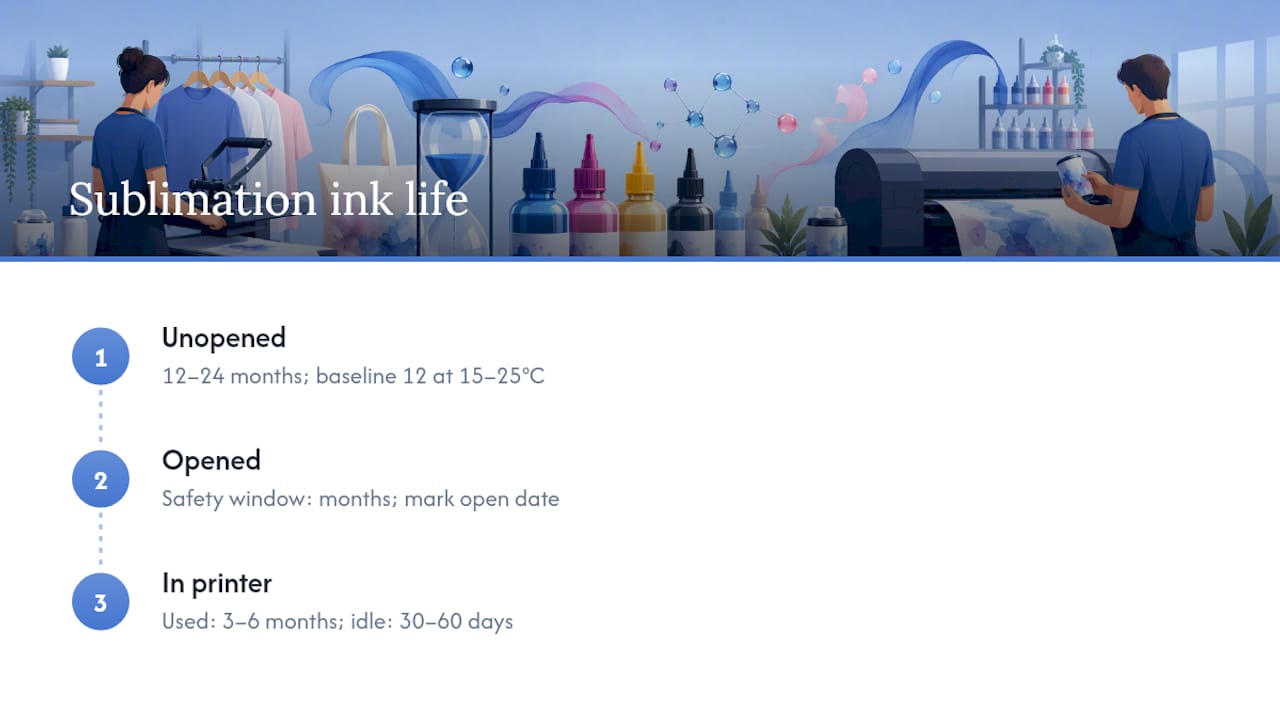
Opened bottles lose that safety margin fast. Once air gets in, oxidation and moisture absorption begin, and you’re realistically looking at a window measured in months rather than years. Label the bottle with the date you opened it the moment you crack the seal.
Ink loaded into a printer behaves differently again. Used regularly, it stays workable for 3 to 6 months. Left idle in a printer that isn’t run, separation or partial drying can set in within 30 to 60 days.
Statistic callout: A manufacturer technical data sheet puts sealed shelf life at 12 months when stored at 15 to 25°C; trade guides broaden that to 12 to 24 months across different brands and storage setups.
Temperature swings, high humidity, and cheaper formulations all shrink these windows. A bottle stored in a hot storeroom won’t come close to hitting the upper end of any of these ranges, regardless of what the label says.
What happens to opened ink and ink sitting inside a printer?
Ink doesn’t fail all at once. It degrades through a handful of predictable mechanical and chemical processes, and knowing which one you’re dealing with tells you how urgent the problem is.
- Dye separation: dispersed dye particles settle out of the carrier liquid over time, especially once a bottle has been opened and exposed to temperature changes.
- Oxidation: contact with air alters the chemical structure of the dye, gradually shifting colour accuracy and reducing vibrancy.
- Microbial contamination: moisture ingress, even trace amounts, can introduce growth that changes viscosity and clogs fine nozzle channels.
- Nozzle drying: ink sitting stationary in a print head’s feed channels evaporates at the surface, hardening and blocking the nozzle.
The package type changes how quickly each risk shows up. Sealed cartridges resist oxidation reasonably well until installed, since the ink has no air contact until then. Bulk ink tank systems and continuous ink supply setups keep ink flowing but leave more surface area exposed to air over the long term. Bottle fed systems sit somewhere in between, depending on how tightly the feed line seals.
Watch for these operational tells: needing head cleaning cycles more often than usual, visible banding across prints, colours drifting from what you expect, or the printer running more purge cycles just to keep nozzles clear. Any of these point to ink that’s past its best, not a printer fault.
How can you tell if sublimation ink has gone bad?
Two checks catch almost every case of degraded ink before it ruins a production run: look at the bottle, then look at a test print.
On the bottle, check for sediment settled at the bottom, visible separation between layers, or a noticeably unusual smell compared with a fresh bottle. Any of these suggest the dye has started breaking down or the formulation has been contaminated.
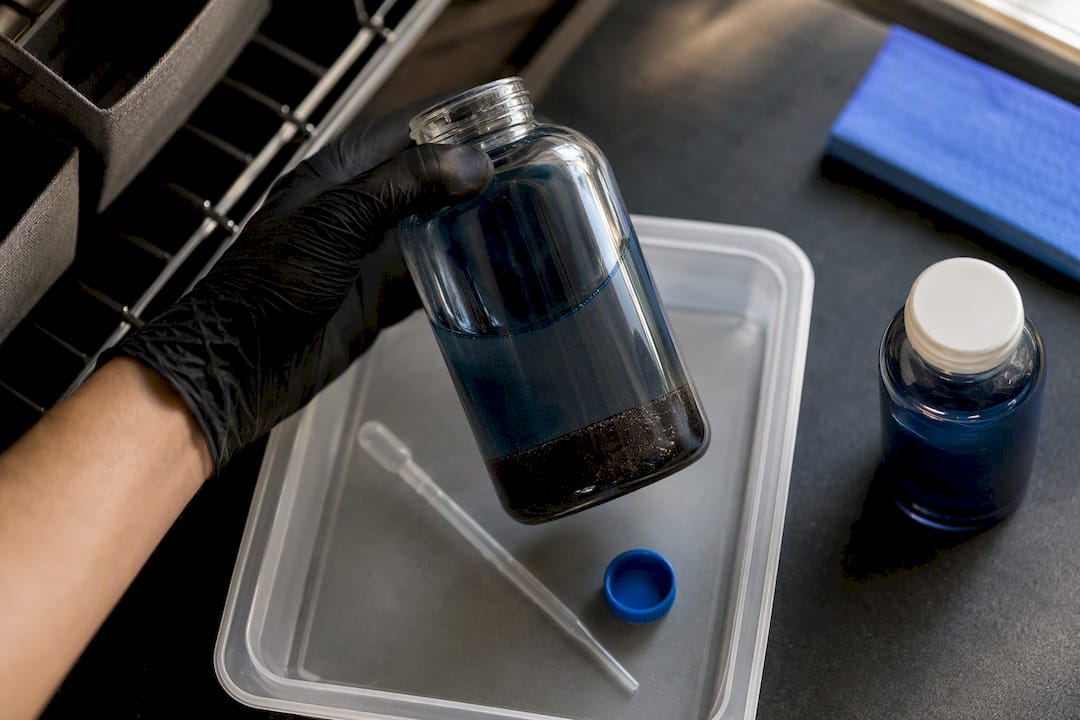
On paper, run a test print and look for faded transfers, streaking across solid colour blocks, or an obvious imbalance where one colour dominates and others look weak. These are classic signs of ink that’s degraded past reliable use, even if the bottle itself looked fine.
Using ink past this point carries real costs, not just cosmetic ones:
- Damaged or clogged print heads that need professional servicing or replacement.
- Wasted substrates from a failed run, which adds up fast on hard goods like tumblers or plaques.
- Poor colour fastness on the finished product, meaning even a print that looks acceptable off the press may fade or wash out prematurely.
Before any production job you can’t afford to reprint, run a quick sequence: check the bottle visually, print a small test pattern on scrap substrate, and compare the colours against a known good reference print.
Pro Tip: Keep one reference print from a fresh batch of ink pinned near your workstation. Comparing new test prints against it catches subtle colour drift long before it’s obvious to the naked eye.
How do you store sublimation ink to extend its usable life?
Storage discipline is the single biggest lever you control, and it costs nothing beyond a bit of organisation.
- Control temperature and light: keep sealed bottles upright, in their original containers, in a dark, dry space between 15°C and 25°C (59°F to 77°F). Avoid windowsills, unventilated garages, and anywhere temperatures swing widely between day and night.
- Never refrigerate ink: cold storage might sound like it slows degradation, but the condensation that forms during warm up when you bring a bottle back to room temperature introduces moisture directly into the ink.
- Adopt FIFO stock rotation: label every bottle with its open date and use the oldest stock first, particularly in a shared shop where several people might grab ink without checking dates.
- Buy bottle sizes that match your throughput: a large discounted bottle isn’t a saving if half of it degrades before you use it. Match purchase volume to your realistic monthly usage.
- Run maintenance prints on a schedule: if a printer sits idle, print a short nozzle check pattern every few days to keep ink moving through the feed system and prevent drying at the print head.
- Purge before extended downtime: if you know a printer won’t run for a couple of weeks, run a full purge cycle first rather than leaving old ink sitting in the lines.
For mild separation, a gentle re-mix (rolling the bottle rather than shaking it vigorously, which introduces air bubbles) can sometimes restore usability, and inline filtration can catch minor sediment before it reaches the print head. But there’s a threshold where remediation isn’t worth the risk: if you see heavy sediment, a strong odour, or persistent colour shifts after a re-mix, discard the ink. A printer setup guide covering routine maintenance is worth bookmarking alongside your ink storage checklist.
Pro Tip: Stick a simple date label directly on the cap, not the side of the bottle. Side labels get obscured once bottles are packed together on a shelf; cap labels stay visible at a glance.
Why trust this guidance on sublimation ink storage?
Subliblanks operates as a trade wholesaler supplying sublimation blanks, printers, and equipment with no minimum order quantities, which means the guidance here reflects patterns seen across a genuinely wide range of small operators, not a single workflow.
That range includes stocking Epson and Ricoh sublimation printers, a market that depends on customers understanding ink handling correctly, since printer warranty claims and print quality complaints trace back to storage mistakes far more often than manufacturing faults.
A few points worth flagging directly:
- Subliblanks publishes ongoing guides on sublimation techniques and business setup aimed at operators building or scaling a print business.
- The advice in this article draws on manufacturer technical data sheets rather than anecdotal shop-floor rumour, which matters when a wrong storage assumption can cost you an entire ink stock.
- No two ink brands behave identically, so always cross-check the specific TDS for whatever you’re using against the general ranges given here.
How much does substrate and finishing care affect print durability?
Ink shelf life only tells half the story. Once a transfer is pressed, the substrate and how you finish it determine how long that print actually survives in daily use, and this is where a lot of businesses lose durability they thought they’d already secured.
Prints on 100% polyester, pressed at the correct temperature and dwell time, can last the life of the garment through 50 or more wash cycles when cared for properly. Blended fabrics, by contrast, accept dye less completely, so even ink in perfect condition produces a print that fades faster and looks less vibrant from day one. Hard goods follow a different pattern: ceramic mugs can hold a sublimated print for 5 to 10 years or more with hand washing, while outdoor polyester banners typically hold up for a few years before UV exposure visibly degrades the print.
Post-press handling matters just as much as the press settings themselves. Washing garments inside out, avoiding fabric softener, and skipping the tumble dryer on high heat all extend the life of a print that started out perfectly sound. Dishwashing a sublimated mug, even one rated dishwasher safe, accelerates wear far faster than hand washing does. If a customer reports a print fading within weeks, the cause is more often poor substrate choice or aggressive care than anything wrong with the ink itself. Getting the transfer process right at the pressing stage is what locks in the durability the ink chemistry made possible in the first place.
Why maintenance habits matter more than the date on the bottle
Most advice on this topic treats shelf life as a fixed number to memorise, and that’s the wrong frame. The 12 to 24 month range from manufacturer data sheets is a starting point, not a guarantee, and I’d argue too many small operators treat the printed date as the whole answer while ignoring the conditions that actually determine whether ink reaches that date in usable condition.
The conventional advice undersells the printer itself as a storage environment. Everyone focuses on the shelf, the temperature, the dark cupboard, and rightly so. But ink sitting unused in a printer for six weeks is often the failure point businesses don’t see coming, because the printer looks idle rather than actively degrading anything.
If you take one thing from this, prioritise the maintenance print habit over anything else. It’s cheap, it takes seconds, and it catches the single most common failure mode in low-volume sublimation setups: ink drying at the nozzle because nobody printed anything for three weeks. Storage temperature matters, but a printer that runs a short nozzle check every few days will outlast a perfectly stored bottle that sits forgotten in a cartridge.
— chris
Get the printers and ink that make storage easier to manage
Equipment and consumables are available that make good ink management straightforward rather than a constant battle. Buying the exact quantity of ink and blanks needed prevents committing to bulk orders that might sit half used and slowly degrade on a shelf.
That matters more than it might seem. Buying smaller, more frequent batches that align with your usage rate is one of the most effective ways to avoid the opened-bottle degradation covered above, and it’s far easier to do when your supplier doesn’t force you into large minimum orders. Browse the range of sublimation printers and heat presses if your current setup is contributing to ink sitting idle for weeks at a time, or check the sublimation blanks collection to match substrate purchases to your actual production schedule. If you’re setting up fresh or reworking your stock rotation, place an order sized to what you’ll use in the next few months rather than the next few years.
Sources
- TDS_MASTERJET-SUBLI-PLUS_EN.pdf
- How long does sublimation ink last — Printable Press
- How long can sublimation ink stay in a printer?
FAQ
Can sublimation ink expire?
Yes. Sublimation ink degrades over time due to its dye based chemistry, with unopened bottles typically rated for 12 to 24 months when stored correctly.
How long can you keep sublimation ink?
Unopened and stored at 15 to 25°C, most sublimation ink stays usable for around 12 months per manufacturer guidance, sometimes stretching to 24 months for premium formulations. Once opened, expect a much shorter window measured in months, and ink loaded into a printer used regularly stays reliable for 3 to 6 months.
Does printer brand affect sublimation ink shelf life?
Formulation quality varies between brands, with established manufacturers generally engineering more stable dye chemistry than third-party alternatives. Always check the specific technical data sheet for the ink you’re using rather than assuming all brands perform identically.
Can sublimation ink dry out?
Yes, particularly inside a printer left idle. Ink sitting stationary in nozzle channels can begin drying or separating within 30 to 60 days, which is why regular maintenance prints matter for anyone not running a printer daily.
What is the shelf life of sublimation ink once opened?
Opened bottles lose their sealed-storage advantage immediately, and practical usable life drops to a matter of months rather than the 12 to 24 month range quoted for unopened stock. Labelling the bottle with its open date helps you track exactly how long it’s been exposed to air.


