



Stop Guessing: Filament for Functional Parts, Settings, and Tests
For most durable, easy-to-print functional parts, PETG is the safest default: it balances strength and impact resistance without demanding an enclosure. Step up to nylon or polycarbonate when a part faces heavy wear, load, or heat above 60°C, reach for ASA or ABS when it lives outdoors, and use TPU when the job needs flex rather than rigidity. The right choice always shifts once you factor in your printer’s capability and the part’s operating environment.
TL;DR:
- PETG remains the best default for durable, impact-resistant parts that require minimal enclosure, handling brackets, mounts, and jigs effectively.
- Nylon offers superior toughness and wear resistance, making it ideal for gears, bushings, and hinges, but it demands moisture control and careful storage.
- Parts near high temperatures above 90°C should use polycarbonate, which requires high extrusion temperatures and an enclosure to prevent warping.
- For outdoor applications, ASA provides UV resistance without the thermal limitations of PC, but both require an enclosure and proper ventilation when printing.
- Proper print settings, orientation along load directions, and post-processing are critical to achieving functional strength and longevity in finished parts.
Table of Contents
- Key factors when selecting functional parts filament
- Filament families and what each one reliably delivers
- How to match materials to the job, not the hype
- Printing and handling tips that change how a part performs
- Post-processing and testing before a part goes into service
- Where to source filament and get it right the first time
- Wear and abrasion resistance in functional parts
- Functional filaments versus standard filaments for mechanical parts
- An editorial take: three checks before you trust a printed part
- Ready to source functional parts filament without the minimum-order hassle?
- Sources
Key factors when selecting functional parts filament
Before you even open a spool, work out what the part actually has to survive. Most failures in functional printing trace back to someone picking a filament because it printed well on a benchmark model, not because it matched the load, heat, or chemical exposure the finished part will face.
Start with mechanical demand. A bracket under constant static load needs different properties to a snap-fit clip that flexes thousands of times a day. Tensile strength tells you how much straight pulling force a part resists; flexural strength matters for anything that bends; impact resistance decides whether a dropped part cracks or survives; and fatigue resistance governs anything cycled repeatedly, like a hinge or a gear tooth.
Thermal performance matters just as much, and it’s where people get caught out. A filament’s glass transition temperature (Tg) is not its melting point. It’s the point where the plastic starts to soften and lose rigidity, often well below where it visibly deforms. A part sitting near a car dashboard or an engine bay needs a much higher service temperature margin than one living in a drawer.
Beyond strength and heat, weigh:
- Dimensional stability — how much the material shrinks or warps as it cools, which decides whether tight-tolerance parts actually fit
- Environmental exposure — UV, solvents, oils, or moisture the part will meet in service
- Printer compatibility — nozzle temperature range, heated bed, enclosure needs, and whether abrasive-filled filaments demand a hardened nozzle
- Cost and supply — engineering filaments can cost two to three times more than standard PLA, and not every reel is easy to source consistently
Get these right before you touch a slicer, and you avoid the most common cause of functional-part failure: choosing a material for its reputation rather than the job.
Filament families and what each one reliably delivers
Here’s a working shortlist of the material families that actually earn a place in a functional-parts workflow, roughly ordered by how often they’re the right call.
- PETG. The workhorse. It balances strength, impact resistance and ease of printing, printing at roughly 220 to 250°C on a bed of 70 to 80°C without needing an enclosure. It handles brackets, enclosures, jigs, and mounts well, and it shrugs off moderate moisture and mild chemicals better than PLA. Some modern blends push this further: Bambu Lab markets its PETG Basic on improved bending strength and impact toughness, a sign that PETG formulations keep improving rather than standing still.
- PLA+ / tough PLA. PLA+ improves impact resistance over standard PLA but stays heat-limited around 60°C, so it suits indoor jigs, fixtures, and low-stress brackets. It prints easily on almost any machine, which makes it a reasonable stopgap when you need a functional prototype fast.
- ABS. Tougher and more heat-resistant than PLA, but it warps if you print it without a heated bed and decent airflow control, and it fumes enough that ventilation isn’t optional.
- ASA. The outdoor specialist. It’s preferred over ABS for UV exposure, and both usually need an enclosure and good ventilation while printing. Choose it for brackets, housings, or fixtures that live outside.
- Nylon (PA). Superior toughness, wear resistance, and strength-to-weight ratio, which makes it the natural pick for gears, bushings, and living hinges. The catch: it’s hygroscopic, so it demands drying and careful storage or the printed part turns brittle and stringy.
- Polycarbonate (PC). The heat champion, with service temperatures around 100 to 110°C, but it needs extrusion temperatures of 260 to 300°C and an enclosed, heated chamber to avoid warping and delamination. This is not a beginner-printer filament.
- TPU. Flexible, abrasion-resistant, and the obvious choice for gaskets, seals, cable grommets, and vibration dampers. Print speed drops noticeably, and retraction settings need patience.
- Carbon or glass-fibre reinforced composites. Add stiffness and reduce warping in parts that need rigidity under load, at the cost of nozzle wear, so a hardened steel or ruby nozzle stops becoming optional.
Pro Tip: Don’t reach for the highest-strength material on the datasheet by habit. A carbon-filled nylon part that fits a printer never designed for abrasive filament will wreck your nozzle long before it proves anything about strength.
How to match materials to the job, not the hype
Work through this in order: what stress dominates, what environment the part lives in, and what your printer can actually achieve. Only then pick the material.
A part that mostly resists steady load and stays indoors is a PETG or ABS job. A part cycling constantly against another surface, like a gear or a slider, wants nylon for its wear resistance. Heat is the deciding factor for anything near a motor, a light fitting, or direct sunlight through glass. PC covers the high end; ASA covers UV without the thermal ceiling PC demands.
Typical mappings that hold up in practice:
- Interior brackets, enclosures, and jigs: PETG
- Gears, bushings, wear surfaces: nylon
- Parts near heat sources, over roughly 90°C: polycarbonate
- Outdoor housings and fixtures: ASA
- Seals, gaskets, and flexible mounts: TPU
- Parts needing extra stiffness with minimal warp: carbon or glass-fibre filled filament
Production considerations often override the ideal material choice. Nylon needs disciplined drying between prints, which slows batch runs. PC needs an enclosure most desktop printers don’t have out of the box. If repeatability across a production run matters more than squeezing out the last few megapascals of strength, a slightly weaker but more forgiving material like PETG usually wins over an engineering polymer that only performs when everything, humidity included, goes right.
Printing and handling tips that change how a part performs
Print settings decide more of a part’s real-world strength than the filament choice alone. Two identical spools of PETG can produce parts with wildly different failure points depending on how they’re printed.
Layer adhesion is the biggest lever. Push extrusion temperature toward the higher end of the manufacturer’s range, dial back part cooling, and add a couple of extra perimeters with generous wall overlap. This closes the microscopic gaps between layers where cracks start under load.
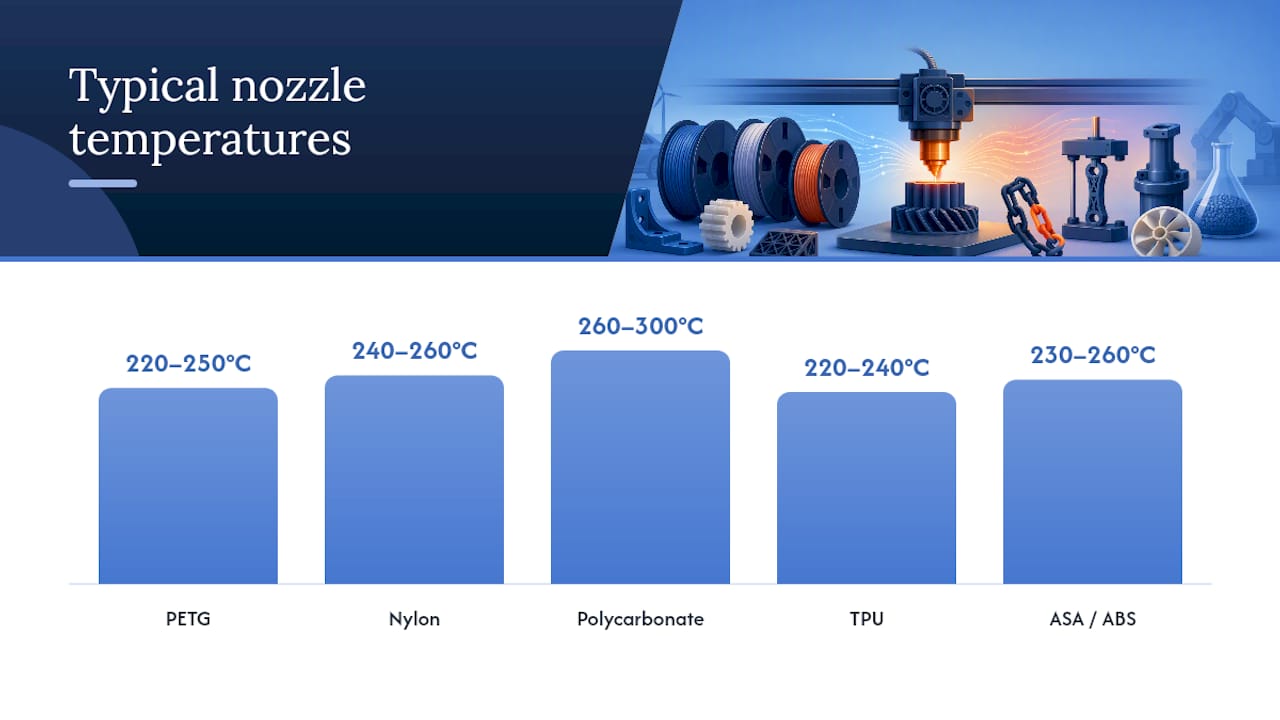
Typical ranges worth knowing:
- PETG: 220 to 250°C nozzle, 70 to 80°C bed, no enclosure required
- Nylon: 240 to 260°C nozzle, 70 to 90°C bed, dry the filament first
- Polycarbonate: 260 to 300°C nozzle, 90 to 110°C bed, enclosure strongly recommended
- TPU: 220 to 240°C nozzle, minimal cooling, slower print speed
- ASA/ABS: 230 to 260°C nozzle, 90 to 110°C bed, enclosed chamber with steady airflow
Orient parts so the load runs along the print, not across layer lines, since that’s usually the weakest axis. Higher infill and more perimeters add strength faster than a dense infill pattern alone. Store nylon and TPU in sealed containers with desiccant the moment you open the spool; moisture uptake is often the real reason a “weak batch” of nylon fails, not the material itself.
Pro Tip: If a part keeps snapping along layer lines rather than across them, that’s almost always a temperature or cooling problem, not a material problem. Try the fix before you switch filaments.
Post-processing and testing before a part goes into service
Printing the part is only half the job. Before anything goes into real use, run it through basic checks.
- Fit and tolerance check. Test the part against its mating hardware or assembly before final printing a full batch.
- Incremental load or cycle test. Apply gradual load, or cycle a moving part repeatedly, to find the failure point before the part finds it for you.
- Functional bench test. Run the part in something close to its real operating conditions, not just a static check.
- Post-processing where it helps. Annealing can raise heat resistance in some materials, acetone smoothing works on ABS but slightly softens dimensional accuracy, and threaded inserts add durable fastening points that printed threads rarely match.
Service providers consistently advise documenting settings and running small load or cycle tests before committing to a production run, and escalating to professional testing or an alternative manufacturing method once tolerances get critical enough that a printed failure becomes expensive.
Where to source filament and get it right the first time
Getting the material specification right matters more than getting a good deal on the reel. 3D printing filaments are available from trade wholesale suppliers with no minimum order quantity, allowing trials of new material families without committing to full cases. For deeper background on selection logic, the guide on how 3D filaments shape manufacturing and prototyping and the practical 3D filament printing setup guide cover the ground in more depth. Get in touch directly for bulk quantities or less common filament specifications.
Wear and abrasion resistance in functional parts
Abrasion resistance decides how long a moving part lasts, not just how strong it is on day one. A gear or bushing can have excellent tensile strength and still wear out in weeks if the material’s surface degrades every time it rubs against another component.
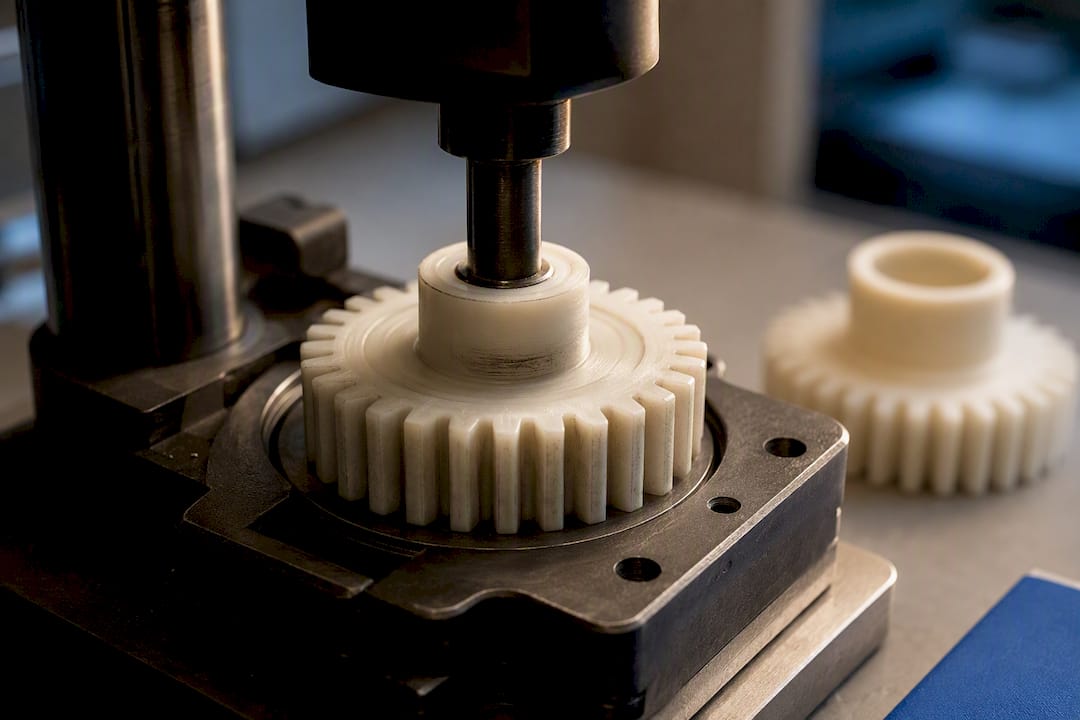
Nylon leads this category by a wide margin. Its combination of toughness and low surface friction is exactly why it suits gears and bushings better than PETG or ABS, both of which wear visibly faster under repeated contact. TPU handles abrasion differently: it doesn’t resist wear through hardness but through flexibility, absorbing the friction rather than fighting it, which is why it holds up well in grommets and protective sleeves.
Composite filaments loaded with carbon or glass fibre add stiffness but don’t automatically improve wear resistance. Some fibre-reinforced blends actually accelerate wear on the mating surface, particularly metal, because the fibres act like fine abrasive particles. If two printed parts slide against each other constantly, matching nylon against nylon, or adding a bronze or PTFE-infused variant, usually beats reaching for the stiffest composite on the shelf.
Surface finish also plays a role most people overlook. A rough, under-cooled print surface wears faster than a well-tuned one, because microscopic ridges act as stress points that shear off under repeated contact. Slowing print speed slightly on wear surfaces and increasing wall count both measurably extend service life, often more than switching material family entirely.
Functional filaments versus standard filaments for mechanical parts
Standard PLA prints beautifully and looks great on a shelf, but it was never built for load-bearing duty. Its low heat resistance and brittle failure mode mean it cracks under sudden impact rather than flexing, and it softens under moderate warmth, such as a car interior or a sunny windowsill, well within normal use.
Functional filaments trade some of that ease for genuine mechanical margin. PETG holds up to impact and mild chemical exposure where PLA would crack or discolour. Nylon and polycarbonate extend both wear resistance and heat tolerance well beyond anything standard PLA or basic ABS can offer. The trade-off is real: functional filaments generally need higher extrusion temperatures, tighter humidity control, and sometimes an enclosure, none of which standard filament demands.
The honest comparison isn’t “functional filament is always better.” A one-off decorative print or a quick prototype checked for fit doesn’t need nylon’s drying regime or PC’s enclosure requirement. But the moment a part carries load, cycles repeatedly, or sits somewhere hot, standard filament becomes a liability rather than a shortcut. The failure mode is rarely dramatic. It’s usually a slow crack along a layer line, a gear tooth that rounds off after a few thousand cycles, or a bracket that sags on a warm day, exactly the failures a correctly chosen functional filament avoids.
An editorial take: three checks before you trust a printed part
Check your printer can actually hit the material’s temperature and enclosure needs, pick the family for the job rather than the datasheet’s biggest number, then print a small validation coupon and load-test it before committing. Watch nylon’s moisture pickup and PC’s enclosure requirement especially closely; both are where good parts quietly fail.
— chris
Ready to source functional parts filament without the minimum-order hassle?
Once you’ve settled on a material family, the next problem is usually supply: most engineering filaments come in awkward minimum order quantities that force you to overbuy or overpay per reel. Trade wholesalers with no minimum order quantity allow orders of exactly what a job needs, whether that’s a single spool for a prototype run or a bulk order for production gears, without the usual case-quantity lock-in.
Browse the current filament range on the Subliblanks storefront, or get in touch directly to request a quote for bulk or specialist filament needs, including materials not listed on the general catalogue. If you’re also sourcing sublimation or laser equipment alongside your filament order, the same no-minimum policy applies across the wider equipment and printer range.
Sources
- Best Filament for Functional Parts Compared
- Types of Filament for 3D Printing: The Ultimate Guide
- Best Filaments for Functional Parts: The Ultimate Must-Have Buying Guide
- Custom Online 3D Printing Services - 3D Printing Quote


