



Die Cut Mailer Boxes: Specify a Precision Fit, No Minimum Order
Choose a die-cut mailer box when the product needs a snug, branded fit rather than a generic carton stuffed with void fill. You get precision protection, a sharper unboxing moment, and fewer damaged returns because the box is cut to the item, not the other way around. Wholesale suppliers support this with no minimum order quantities and dieline assistance, so smaller sellers can commission a proper custom mailer without committing to a warehouse-sized run.
TL;DR:
- Die-cut mailers offer precise protection and a bespoke fit, reducing damage and void fill compared to generic cartons, especially for fragile or multi-component products.
- E-flute and B-flute corrugated boards provide the best crush resistance for transit, with higher ECT ratings necessary for heavier or more fragile goods.
- Customisation features like internal inserts, windows, and easy-open closures improve unboxing and handling, but priority should be given to fitting and structural integrity.
- The initial tooling cost for the steel-rule die is fixed and can be offset by volume, with no minimum order requirement supporting small-scale tests or first runs.
- Proper dieline preparation, product measurement, and sample approval are critical to avoiding costly mistakes and ensuring the final box matches product needs.
Table of Contents
- What types of die-cut mailer boxes are there?
- Which board grade and material should you choose?
- How do you customise a mailer box design?
- What drives the cost of a custom die-cut mailer box?
- How do you prepare dielines and artwork for manufacture?
- Where do die-cut mailers outperform stock boxes?
- How are die-cut mailer boxes actually manufactured?
- How do die-cut mailers compare with other packaging types?
- How well do die-cut mailers hold up in transit?
- What mistakes should you avoid when ordering die-cut mailers?
- What labelling and regulatory rules apply to packaging materials?
- What actually matters when specifying a die-cut mailer
- Get your die-cut mailer specified without the minimum order barrier
- Sources
What types of die-cut mailer boxes are there?
The right format depends on what you’re shipping, not what looks impressive in a portfolio. Auto-locking (also called self-locking) mailers fold flat for storage and pop into shape with barely any assembly, which matters enormously once you’re packing fifty orders on a Tuesday afternoon rather than one sample for a photoshoot.
Tuck-in and flat mailer die-cuts suit thinner, rigid items, apparel, documents, phone accessories, where you need a slim profile that still ships in a standard parcel bracket without paying for wasted volume. Window or sleeve mailers add a reveal element: a die-cut aperture, sometimes backed with acetate, that shows the product before the customer even opens the box. That’s the format most subscription boxes and gift-led brands lean on because the first five seconds of an unboxing video happen before the lid comes off.
For anything with multiple components, kits, accessory sets, cosmetics bundles, internal die-cut inserts do the real work. Precision-fit die-cut mailers are engineered around the product itself, which lets you build in:
- Folded tray inserts that hold items apart during transit
- Partitions for multi-SKU kits where items can’t touch
- Recessed cavities cut to the exact footprint of a single product
- Locking tabs that keep inserts seated even if the box is dropped or tipped
Match the format to the fragility and shape of what’s inside, not to whichever template looks the neatest on a supplier’s website.
Which board grade and material should you choose?
Board choice comes down to a straightforward trade off: corrugated protects better over distance, SBS (solid bleached sulphate) prints better up close. Kraft sits in between, cheaper than SBS, more rustic in finish, and increasingly popular where brands want an unbleached, recyclable look without corrugated’s bulk.
Flute type is where transit performance actually gets decided. E-flute and B-flute corrugated give reasonable crush resistance in a thin profile, ideal for mailers going through parcel networks and sortation machinery. The ECT (edge crush test) rating tells you how much stacking and compression the box can take before it fails, and it’s the number worth asking a supplier for if you’re shipping anything with weight or fragility concerns.
A quick materials comparison:
- SBS/folding carton: best print quality and finish, weakest in transit, suited to lightweight retail-style mailers
- Kraft: mid-strength, natural aesthetic, generally recyclable without special coatings
- Corrugated (E/B-flute): strongest option for parcel shipping, holds up under stacking and rough handling
Sustainability trade-offs matter here too. Recycled-content board and uncoated finishes recycle more easily than laminated or foil-heavy boxes, though custom die-cut packaging that cuts void fill and reduces total material use often has a smaller footprint overall than a bigger stock box padded with plastic air pillows. Up-spec the board when the product is heavy, sharp-edged, or high-value; accept lighter board when you’re shipping something soft, cheap to replace, or already well-cushioned by its own packaging.
How do you customise a mailer box design?
Every added feature earns its keep or it doesn’t, and it’s worth being honest with yourself about which is which. Windows, thumb cuts for easy opening, die-cut closures that skip tape entirely, and integrated carry handles are the customisations buyers ask for most, because each solves a real problem: presentation, usability, or shelf appeal.
Insert strategy is where the real return on investment sits. A die-cut folded tray, partition set, or card insert removes the need for loose fill almost entirely, which cuts material cost and stops small items rattling around during transit.
Printing method affects both cost and minimum order size:
- Digital printing suits smaller runs and variable designs, higher unit cost, low or no minimum
- Litho (offset) printing delivers sharper colour and lower unit cost at volume, but usually needs a larger minimum to justify plate setup
Finishes, foil stamping, embossing, soft-touch lamination, add real unboxing impact but also add cost and, in some cases, complicate recycling. A soft-touch laminate feels premium in the hand; it also usually means the box can’t go straight into standard paper recycling. If you’re coordinating printed patches or applied embellishments alongside your packaging, partners like OctoPatches can help align that branding across both the product and the box itself.
Pro Tip: Spend your customisation budget on the insert before the finish. A well-fitted internal tray does more for both protection and perceived quality than any amount of foil on the lid.
What drives the cost of a custom die-cut mailer box?
Every custom mailer starts with a fixed cost that has nothing to do with quantity: the steel-rule die itself. That upfront tooling expense gets amortised across the print run, which is exactly why unit prices drop sharply as order volume rises, and why suppliers with no minimum order quantity are worth seeking out if you’re testing a new SKU before committing to volume.
Beyond the die, four factors set your price:
- Quantity – the single biggest lever; doubling volume rarely doubles cost
- Board grade – corrugated typically costs more than lightweight SBS or kraft
- Print colours and coverage – full-colour, edge-to-edge printing costs more than one or two spot colours
- Finishing and inserts – foil, lamination, and die-cut trays each add a line item
Lead times follow a predictable sequence: dieline creation and approval, digital or physical proof, a production sample, then the full run. Rushing the proof stage is the most common way orders go wrong, so build in time for at least one sample review before signing off thousands of units.
When you request quotes, ask for the same five things every time so you can actually compare them: unit price at your target quantity, one-off setup or die cost, sample cost (and whether it’s refunded against a full order), total lead time from artwork approval to delivery, and the supplier’s policy on proof revisions before charging again.
How do you prepare dielines and artwork for manufacture?
Getting this stage right the first time saves more lead time than any other single decision in the process. Preparing a proper packaging workflow before you contact a supplier means fewer rounds of revisions and a faster route from design to finished box.
- Measure the product first. Record maximum dimensions for every internal component, decide your movement tolerance in millimetres, and note any access points needed for packing or assembly.
- Request a single-line dieline with clearly labelled panels, fold and score lines, and glue or flap areas marked to scale, not a rough sketch.
- Supply artwork to spec: CMYK or spot colour breakdowns, sufficient resolution for print, defined safe areas away from fold lines, and clear notes on any white ink or varnish placement.
- Approve a pre-production digital proof before physical sampling, then check a physical sample against a signed-off checklist covering fit, print alignment, and structural integrity.
- Document any change requests in writing before the full production run starts, not after.
Pro Tip: Confirm item orientation and list every internal component’s maximum dimensions before you ask for a dieline. Suppliers can only cut accurately to the numbers you give them.
For low-volume or first-time orders, requesting a physical sample or a short pilot run is worth the small extra cost. It validates fit, transit protection, and print alignment before you commit to a full production batch.
Where do die-cut mailers outperform stock boxes?
The clearest wins show up wherever a generic box would need extra packing materials to do the job a die-cut design does natively.
- Electronics accessory kits and small parts benefit most from integrated inserts, cables, adapters, and connectors stay separated and don’t rattle against each other in transit.
- Apparel and accessory bundles look tidier and feel more considered when void fill disappears and the product sits flush against a shaped interior.
- Fragile single items like mugs or glassware need far less cushioning when the box itself, such as a die-cut acetate mug box, holds the item in place structurally.
- Subscription and welcome kits rely on the unboxing sequence itself to drive repeat engagement, and a die-cut design can guide that sequence deliberately, lid, insert, reveal, rather than leaving it to chance.
Die-cut designs also assemble faster on a packing bench than standard slotted cartons, which adds up quickly once you’re fulfilling dozens of orders a day rather than one.
How are die-cut mailer boxes actually manufactured?
The process starts with the dieline, a flat, single-line template that maps every fold, score, and cut the finished box will need. Once that’s approved, a steel-rule die is built: a wooden board with sharpened steel blades bent into the exact shape of the dieline, mounted for use on a cutting press.
Board arrives in large flat sheets, and if it’s corrugated, the flute is laminated between liner sheets before cutting begins. The sheet is printed first, usually flexographic or litho printing for larger runs, digital for shorter ones, then fed through the die press, which stamps the cut and score lines in a single pass.
After cutting, the sheet doesn’t fall apart immediately; small uncut nicks called “bridges” hold the waste material in place until a separate stripping station removes it. Any gluing, for pre-glued mailers with a permanent bottom seam, happens next on a folder-gluer line, before the flat boxes are bundled and shipped flat to the customer for on-site assembly.
The entire sequence, dieline to flat-packed finished box, typically spans design approval, a digital proof, a physical sample, then full production. Skipping the physical sample stage is the most common cause of costly reprints, because a digital mockup can’t reveal fit or fold issues the way a physical box will.
How do die-cut mailers compare with other packaging types?
Regular slotted cartons (RSCs), the standard flap-top shipping box, win on raw simplicity and cost at very high volumes where branding doesn’t matter. They’re not cut to a specific product, though, which means more void fill, more loose packing material, and a less controlled unboxing experience.
Poly mailers cost less per unit and weigh almost nothing, making them cheap to ship, but they offer no rigid protection and no premium presentation value at all. They suit soft goods like clothing and make little sense for anything that can crush, bend, or shatter.
Rigid presentation boxes sit at the opposite end: excellent unboxing impact, strong structural protection, but noticeably higher unit cost and typically higher minimum order quantities, better suited to premium retail-style launches than everyday parcel shipping.
Die-cut mailers sit in the middle of that spectrum deliberately. They cost more than a plain poly mailer or generic RSC but less than a rigid box, while still delivering a precision fit that reduces damage and void fill. The trade-off is upfront tooling cost, the steel-rule die, which is why volume matters more here than with off-the-shelf stock boxes.
How well do die-cut mailers hold up in transit?
Transit performance comes down to two things: how well the box fits the product, and how the board itself resists crushing and impact. A die-cut mailer with a properly fitted internal insert stops products shifting inside the box, which is often what causes damage long before the outer board itself fails.
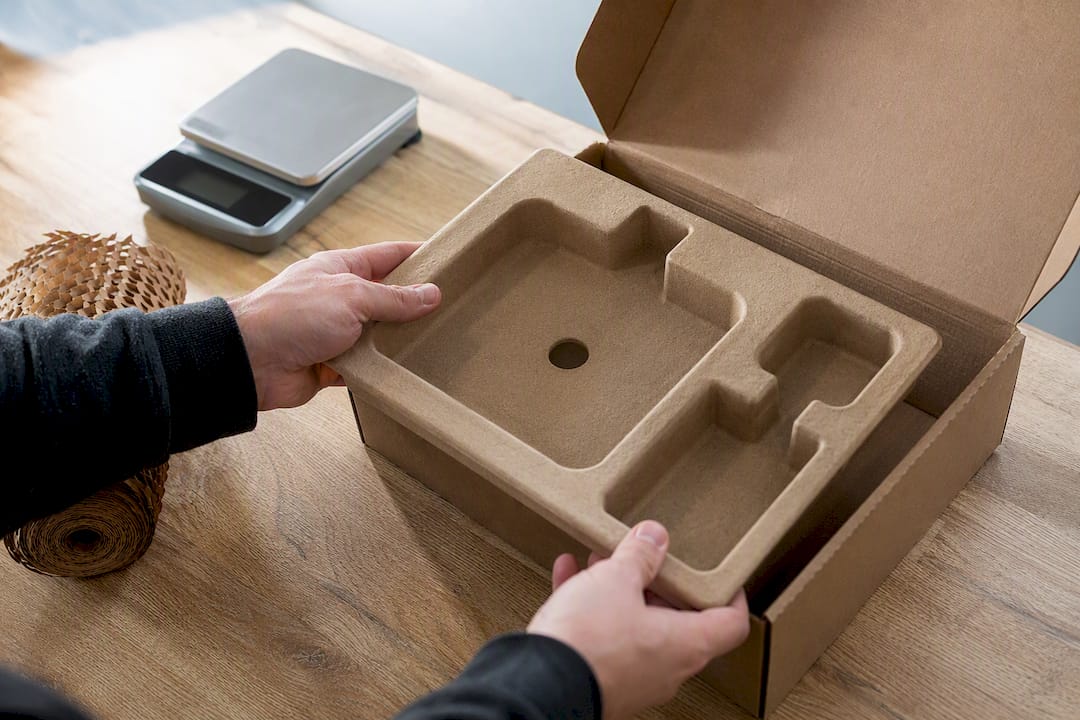
ECT ratings matter here more than most buyers realise. A box rated for stacking and compression will survive a parcel network’s sorting belts and delivery van stacking far better than a lightweight equivalent, even if both look identical on the outside. If your product has any weight to it or ships in bulk pallets before final-mile delivery, ask your supplier for the ECT rating rather than assuming “corrugated” alone tells you enough.
Practitioners in high-volume fulfilment consistently note that die-cut designs reduce internal movement compared with standard slotted cartons, largely because the box is built around the item’s shape rather than around a generic rectangular cavity. That matters most for anything with sharp edges, uneven weight distribution, or multiple loose components that could otherwise collide during a rough leg of transit.
Humidity and crushing under stacked pallets are the two failure modes worth testing for before a full production run, not after a batch of customer complaints arrives. A short pilot run, shipped to a real address rather than tested on a bench, tells you more about durability than any spec sheet.
What mistakes should you avoid when ordering die-cut mailers?
The most expensive mistake is skipping the physical sample stage to save a week of lead time. A digital proof shows colour and layout; it cannot show you whether a fold sits correctly or an insert holds its shape under pressure.
Under-specifying tolerances is a close second. If you don’t tell a supplier the exact movement allowance you need, in millimetres, you’ll get a default that may leave a product too loose or too tight for repeat packing at speed.
Ordering the minimum board grade purely to save money is a false economy when the product is heavy, sharp-edged, or breakable. The saving on board cost gets wiped out fast by damaged-item refunds and returns.
Other recurring errors worth flagging:
- Finalising artwork before the dieline is locked, forcing a costly redo when panel sizes shift
- Ignoring how a finish (laminate, foil) affects recyclability if that matters to your customer base
- Assuming litho pricing at low volumes, when digital printing is usually cheaper below a certain threshold
- Failing to document sign-off on samples in writing, leading to disputes over what was actually approved
What labelling and regulatory rules apply to packaging materials?
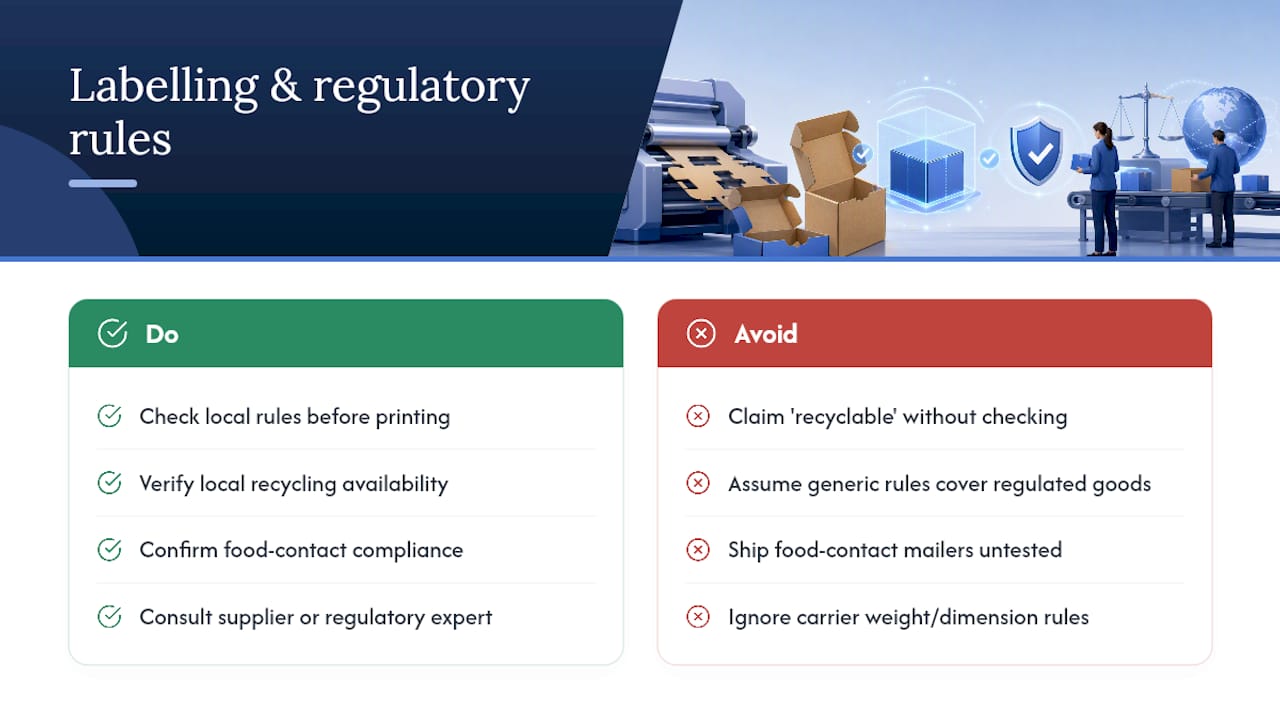
Packaging regulation in most markets focuses on two areas: material safety claims and environmental labelling, and the rules differ depending on where you sell and ship. In the United States, the Federal Trade Commission’s Green Guides govern what environmental claims, “recyclable,” “biodegradable,” “made from recycled content”, a business can legally print on packaging, and misusing these terms can create real liability.
If your packaging carries any recyclability claim, it needs to reflect genuine availability of recycling facilities for that material in the areas you ship to, not just the material’s theoretical recyclability. A kraft mailer with a plastic window insert, for instance, may not qualify for a simple “recyclable” label without qualification, since the two materials often need to be separated before recycling.
Food-contact packaging carries additional requirements if the mailer will ever touch consumable goods directly, and any brand shipping cosmetics, supplements, or similar regulated categories should check labelling requirements specific to that product category rather than assuming generic packaging rules apply. Weight and dimension declarations may also be required by some carriers or marketplaces, separate from the packaging itself. When in doubt on a specific claim or category, checking with a supplier familiar with compliant materials, or a regulatory professional for anything safety-critical, beats guessing.
What actually matters when specifying a die-cut mailer
Most packaging advice online treats die-cut mailers as a branding decision first and a logistics decision second. That’s backwards. The brands getting genuine value from custom mailers are the ones who started with tolerances and fit, then layered branding on top, not the other way round.
The conventional wisdom oversells finishes, foil, soft-touch lamination, embossing, and undersells the insert. A perfectly fitted internal tray does more to reduce damage, cut void fill, and improve the unboxing moment than any surface treatment ever will, yet most buyers spend their design budget in the opposite order.
If you take one thing from this guide, prioritise the physical sample stage. Skipping it to save a week of lead time is the single most common reason first production runs go wrong, wrong tolerances, a fold that doesn’t sit flush, an insert that shifts. No amount of dieline precision on paper substitutes for holding the finished box in your hands before committing to thousands of units.
Start with measurements, not moodboards.
— chris
Get your die-cut mailer specified without the minimum order barrier
Most custom packaging suppliers want a warehouse-sized commitment before they’ll even discuss a dieline. Some wholesalers offer no minimum order quantities, so you can commission a properly specified die-cut mailer whether you need fifty units to test a new product line or several thousand for an established one.
That matters most for e-commerce sellers who’ve been quoted five-figure minimums just to get a custom insert or a branded window mailer. Subliblanks supports dieline assistance directly, so if you’re working through measurements, tolerances, and panel layout for the first time, you’re not starting from a blank template. The full range of packaging supplies and wholesale options covers everything from flat mailer stock through to insert-ready corrugated formats.
If you’re also printing in-house, it’s worth checking the sublimation printer range alongside your packaging order, since matching your production equipment to your packaging plans early avoids a second round of specification later. Get in touch to discuss your dieline and request a sample before committing to a full run.


