



What is bulk order fulfilment? A UK business guide
TL;DR:
- Bulk order fulfillment involves managing large shipments from receipt to delivery, requiring strict compliance and documentation. It differs from consumer fulfillment by handling pallets and freight instead of individual units, with a focus on accuracy, routing guides, and automation. Properly implementing compliance and automation reduces errors, enhances efficiency, and supports scalable growth in wholesale operations.
Bulk order fulfilment is defined as the end-to-end process of receiving, picking, packing, and shipping large quantities of goods, typically from a supplier or warehouse to a business buyer. Unlike parcel-level consumer shipping, wholesale order fulfilment operates under strict compliance frameworks including EDI documentation, UCC-128 barcode labelling, and retailer routing guides. 73% of B2B buyers now expect a frictionless, high-speed ordering and tracking experience comparable to consumer retail. That expectation has forced businesses across the UK and Ireland to treat bulk order logistics as a core operational discipline, not an afterthought.
What is bulk order fulfilment and how does it work?
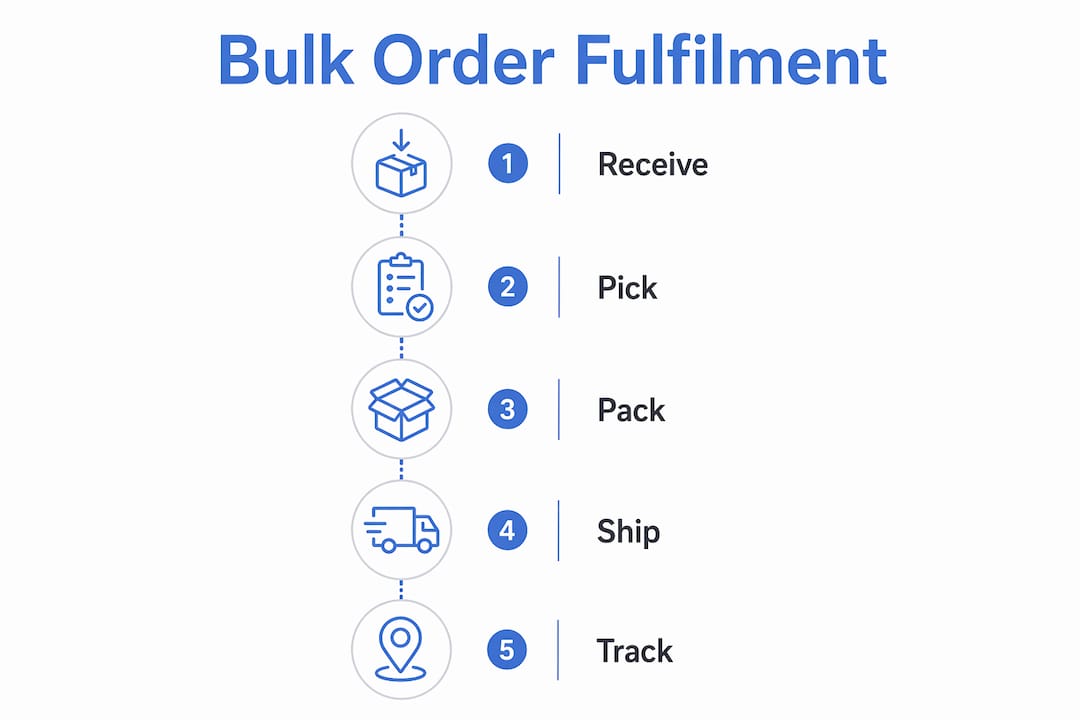
Bulk order fulfilment is the industry term for managing high-volume, business-to-business shipments from point of receipt through to final delivery. The process differs fundamentally from consumer fulfilment in its scale, documentation requirements, and transport modes. Where a consumer order might involve a single parcel, a bulk order typically involves pallets, cases, and freight carriers.
The core stages follow a consistent pattern across most wholesale operations.
-
Purchase order receipt and verification. The process begins when a buyer submits a purchase order, often via EDI or a B2B portal. Automated systems capture the PO data, verify quantities against available stock, and flag discrepancies before any picking begins.
-
Order picking. High-volume picking strategies differ from consumer fulfilment. Batch picking, zone picking, and wave picking are the three primary methods used in bulk warehouse environments. Each reduces travel time and increases throughput when handling dozens or hundreds of SKUs per order.
-
Packing and palletising. Bulk orders are packed to retailer or buyer specifications, then palletised according to routing guide requirements. Pallet configuration, weight limits, and shrink-wrap standards are not optional. Non-compliance triggers chargebacks.
-
Labelling. UCC-128 labels are the standard for pallet and carton identification in wholesale fulfilment. These labels carry shipment, order, and product data in a format scannable by retailer warehouse systems.
-
Freight coordination. Moving bulk shipments from parcel services to LTL (less-than-truckload) or FTL (full-truckload) freight requires coordinating dock appointments and Advance Shipping Notices to avoid detention fees. Timing here directly affects cost.
-
Tracking and compliance reporting. Automated systems generate ASNs, update inventory records, and provide shipment visibility to both supplier and buyer.
Pro Tip: Set up automated PO capture from day one, even at low volumes. Retrofitting automation into a manual process is significantly more disruptive than building it in from the start.
Most B2B bulk orders carry an expected turnaround of 24 hours, though this varies with order volume and freight complexity. Meeting that window consistently requires each of the six stages above to run without manual bottlenecks.

How does bulk fulfilment differ from direct-to-consumer fulfilment?
The distinction between bulk order fulfilment and direct-to-consumer (DTC) fulfilment is not simply one of size. The primary difference is the compliance layer: routing guides, EDI documentation, and pallet labelling requirements that DTC operations never encounter. That compliance layer adds cost and complexity that businesses must plan for explicitly.
| Characteristic | Bulk / wholesale fulfilment | Direct-to-consumer fulfilment |
|---|---|---|
| Order size | Pallets and cases | Individual units |
| Shipping method | LTL or FTL freight | Parcel carriers |
| Documentation | EDI, ASN, UCC-128 labels | Shipping label only |
| Compliance requirements | Retailer routing guides, chargebacks | Minimal |
| Turnaround expectation | 24 hours, scheduled dock slots | Same day to 2 days |
| Inventory management | Case pack and pallet-level tracking | Unit-level tracking |
| Customer expectation | Accuracy, compliance, volume reliability | Speed and convenience |
Warehouse operations change significantly when shifting from DTC to bulk fulfilment. DTC warehouses are optimised for speed at the unit level. Bulk warehouses are optimised for accuracy at the pallet level. The picking, packing, and storage layouts reflect those different priorities.
For businesses in the UK and Ireland moving into wholesale trade, the compliance shift is the steepest learning curve. A single non-compliant shipment can result in a chargeback that wipes the margin from an entire order. Understanding the table above before committing to a wholesale fulfilment model prevents costly surprises.
What compliance and routing requirements apply to bulk orders?
Compliance is the single greatest operational risk in bulk order fulfilment. Retailers and large buyers publish routing guides that specify exactly how shipments must arrive. Deviating from those guides, even on minor points, results in chargebacks, refused deliveries, or delayed payment.
The key compliance requirements for UK and Ireland bulk shippers include:
- UCC-128 barcode labels. These must appear on every carton and pallet, carrying GS1-standard data including SSCC (Serial Shipping Container Code) numbers. Retailers scan these labels at goods-in; an unreadable or missing label stops the shipment.
- Pallet configuration standards. Retailers’ routing guides specify pallet stacking height, weight limits, and shrink-wrap requirements. Non-compliance causes chargebacks that directly reduce profitability.
- Advance Shipping Notices (ASNs). An ASN must be transmitted to the buyer before the shipment arrives. It tells the receiving warehouse exactly what is on each pallet, enabling faster goods-in processing.
- Scheduled dock appointments. Bulk freight does not arrive unannounced. Dock appointments must be booked in advance, and late or early arrivals incur detention fees.
- EDI documentation. Electronic Data Interchange formats such as EDI 850 (purchase order) and EDI 856 (ASN) are standard in wholesale fulfilment. Businesses without EDI capability either invest in it or use a third-party provider.
Common compliance failures in UK and Ireland markets include incorrect pallet labelling, missing ASNs, and shipments arriving outside the booked dock window. Each failure has a direct financial cost.
Pro Tip: Maintain a single master data record for every SKU, including case pack quantity and pallet dimensions, and synchronise it between your ERP and warehouse management system. Discrepancies between those two systems are the most common cause of shipment rejections.
Bulk fulfilment systems must maintain precise data hygiene for SKUs, case pack quantities, and pallet dimensions to avoid shipment rejections. Getting this right is not a technology problem. It is a data discipline problem.
How can businesses use technology to improve bulk order processing?
Manual bulk order processing does not scale. Wholesale fulfilment fails when businesses try to handle disparate order formats manually. The solution is normalising all order inputs into a unified system before fulfilment begins.
Automation delivers measurable results at each stage of the process:
- AI-powered PO capture. Automated systems read purchase orders from PDFs, emails, and EDI feeds, extracting line-item data without manual re-keying. Deploying automated B2B order processing reduces manual PO processing time by 30–50% and cuts operational costs by 30%.
- Dynamic stock allocation. Rather than allocating stock at the point of packing, automated systems reserve inventory at PO receipt. This prevents overselling and enables accurate ASN generation.
- ERP and WMS integration. Connecting your enterprise resource planning system to your warehouse management system creates a single source of truth for stock levels, order status, and shipment data. Disconnected systems produce the data mismatches that cause compliance failures.
- Automated exception handling. Automated exception rules manage backorders and split shipments without manual intervention. At peak periods, this prevents the processing slowdowns that damage retailer relationships.
- Staggered packing workflows. Automation can sequence packing tasks across a shift to match freight collection windows, reducing idle time and last-minute rushes at the dock.
The businesses that handle bulk order logistics well are not necessarily the largest. They are the ones that treat their order management systems as infrastructure, not as software. Investing in that infrastructure early pays back as volumes grow, because the cost of adding a new retailer account drops significantly when the compliance and automation framework is already in place.
For businesses exploring bulk purchasing as part of a wider supply strategy, the technology choices made at the start shape what is possible at scale.
Key takeaways
Bulk order fulfilment succeeds when compliance, data accuracy, and automation are treated as foundations, not additions.
| Point | Details |
|---|---|
| Compliance is the core risk | Retailer routing guides, UCC-128 labels, and ASNs must be correct on every shipment to avoid chargebacks. |
| Automation cuts processing time | AI-powered PO capture reduces manual processing time by 30–50%, freeing teams for higher-value tasks. |
| Data hygiene prevents rejections | SKU, case pack, and pallet dimension data must be synchronised between ERP and WMS at all times. |
| Freight coordination is non-negotiable | LTL and FTL shipments require booked dock appointments and pre-transmitted ASNs to avoid detention fees. |
| Technology scales; manual processes do not | Normalising order inputs into a unified system is the prerequisite for growing wholesale volume reliably. |
Why I think most UK businesses underestimate bulk fulfilment compliance
The businesses I see struggle most with bulk order fulfilment are not the ones with volume problems. They are the ones that treated compliance as something to figure out later. A retailer routing guide is not a suggestion. It is a contract, and the penalties for ignoring it arrive quickly and without warning.
The most common mistake I observe is a disconnect between the ERP and the warehouse management system. Stock levels look correct in one system and wrong in the other. That gap produces incorrect ASNs, which produce refused shipments, which produce chargebacks. The fix is not expensive software. It is disciplined data entry and a clear rule that one system is always the master record.
Exception management is the other area where businesses consistently underinvest. When a bulk order arrives with a line item that cannot be fulfilled, the manual response is to pause, investigate, and then decide. At low volumes, that works. At scale, it creates a backlog that compounds daily. Automated rules for backorders and split shipments are not a luxury. They are the mechanism that keeps the rest of the operation moving.
My honest advice: align your fulfilment processes with retailer standards before you win the account, not after. The cost of retrofitting compliance into an existing operation is always higher than building it in from the start. Businesses that do this well treat their first wholesale account as a template, not a one-off.
— chris
Subliblanks: wholesale supply for businesses managing bulk orders
Subliblanks supplies trade buyers across the UK and Ireland with a comprehensive range of products suited to bulk order operations, from sublimation blanks and printers to DTF supplies, xTool laser engraving machines, badge-making equipment, and packaging materials. There are no minimum order quantities, which means businesses can order exactly what their current fulfilment volumes require without committing to excess stock.
For print businesses, craft suppliers, and trade buyers building out their bulk inventory, Subliblanks offers a reliable wholesale source that fits around your order cycles rather than dictating them. Visit the Subliblanks wholesale store to browse the full product range and request trade pricing.
FAQ
What is bulk order fulfilment in simple terms?
Bulk order fulfilment is the process of receiving, picking, packing, and shipping large quantities of goods to business buyers. It differs from consumer fulfilment in its use of freight transport, pallet-level logistics, and strict compliance documentation.
How long does bulk order fulfilment take?
Most B2B bulk orders carry a 24-hour turnaround expectation, though actual timing depends on order volume, freight mode, and dock scheduling requirements.
What is an ASN in bulk order logistics?
An ASN (Advance Shipping Notice) is an electronic document sent to the buyer before a shipment arrives. It details exactly what is on each pallet and enables faster goods-in processing at the receiving warehouse.
Why do bulk shipments get charged back by retailers?
Retailers issue chargebacks when shipments do not comply with their routing guides. Common causes include incorrect UCC-128 labels, wrong pallet configurations, missing ASNs, and deliveries outside the booked dock window.
What is the difference between LTL and FTL freight in bulk fulfilment?
LTL (less-than-truckload) freight combines multiple shippers’ goods in one vehicle and suits smaller bulk orders. FTL (full-truckload) dedicates an entire vehicle to one shipment and is used when order volume fills a trailer.


