



What is badge machine technology? a clear guide
TL;DR:
- Badge machine technology encompasses equipment used for creating badges through printing, pressing, and assembly processes. Manual, semi-automatic, and fully automatic machines serve different production volumes, from craft fairs to large-scale ID issuance, offering varying speeds and costs. Choosing the right machine depends on your workflow, volume needs, and material specifications to ensure efficient badge production.
Badge machine technology is the collection of machinery and techniques used to manufacture badges by pressing, printing, and assembling materials into finished pins, button badges, or ID cards. The term covers everything from a simple hand-operated lever press producing button badges at craft fairs to fully automated industrial systems issuing thousands of security passes per hour. Sectors including events management, corporate branding, education, and security all depend on this technology to produce consistent, customised results at scale. Understanding how these machines work, and which type suits your needs, is the first step to making a sound investment.
How does badge machine technology work?
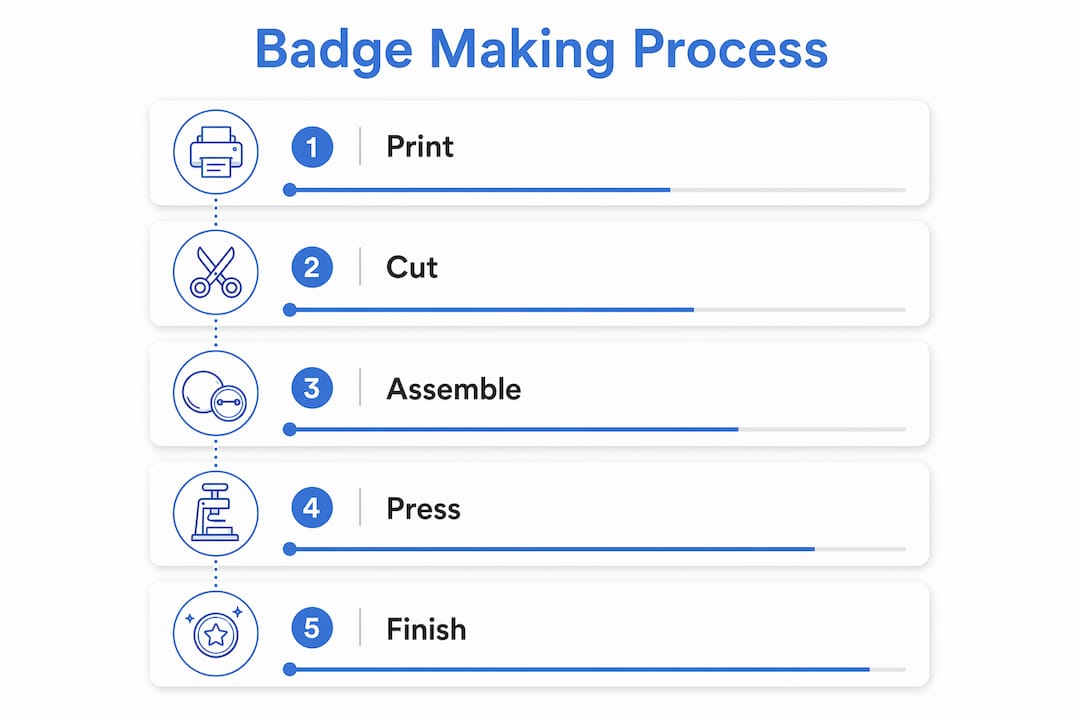
Badge machine operation follows a consistent sequence regardless of the machine’s complexity. The core steps are material preparation, printing, cutting, assembly, and pressing. What changes between machine types is how much of that sequence is automated.
On a manual press, the operator handles each step individually. Here is the typical sequence on a 58mm button badge machine:
- Print and cut the artwork insert to the correct circular size.
- Place the metal shell face-down into the lower die of the press.
- Position the printed insert on top of the shell.
- Lay a Mylar cover over the insert to protect the printed surface.
- Press the lever to crimp the shell edges over the insert and Mylar.
- Place the pin back into the upper die and press again to lock it in place.
An experienced operator following this workflow can produce 200–300 badges per hour on a manual 58mm press. That output is sufficient for small events, school projects, and promotional runs. The mechanical lever and spring system requires no power supply, which makes manual machines genuinely portable for outdoor events or markets.
Automated machines replace manual steps with motorised dies, conveyor feeds, and integrated print heads. The press cycle, insert placement, and back-pinning happen in a single continuous motion. Industrial card issuance systems take this further still, combining dual-side printing with smart card encoding to reach up to 2,000 cards per hour. That figure illustrates the enormous gap in throughput between entry-level and industrial badge production.
Pro Tip: When running a manual press for extended periods, keep a consistent rhythm. Irregular pressing force is the most common cause of uneven crimping and wasted materials.
What are the different types of badge machines?
Badge making machine types fall into three broad categories. Each serves a different production volume and budget.
Manual button badge machines
Manual machines are the entry point for most small businesses, schools, and craft sellers. They use a mechanical die set and lever to crimp metal shells around printed inserts. Common sizes include 25mm, 38mm, 44mm, and 58mm diameter dies. These machines typically cost between £30 and £200 and require no electricity. Their limitation is throughput: production speed depends entirely on the operator.
Semi-automatic badge machines
Semi-automatic machines motorise the pressing action while the operator still feeds materials by hand. This reduces physical effort and improves consistency across a batch. They suit small print shops and promotional merchandise producers who need higher output without the cost of a fully automated line. Production speeds typically reach 500–800 badges per hour depending on badge size and material.
Fully automatic and industrial badge machines
Fully automatic systems handle feeding, pressing, and ejection without operator intervention beyond loading material reels. Industrial card issuance machines add printing, encoding, and lamination in a single pass. These are the machines used by conference organisers, government ID programmes, and large manufacturers. The cost reflects the capability, with industrial systems running from several thousand to tens of thousands of pounds.
| Machine Type | Production Speed | Power Required | Typical Use Case | Approximate Cost |
|---|---|---|---|---|
| Manual press | 200–300 per hour | No | Craft, schools, small events | £30–£200 |
| Semi-automatic | 500–800 per hour | Yes | Print shops, promo merchandise | £500–£3,000 |
| Fully automatic | 1,000+ per hour | Yes | Mass production, trade | £3,000–£20,000+ |
| Industrial card issuance | Up to 2,000 per hour | Yes | Security, government ID | £20,000+ |
Key factors to weigh when choosing between types:
- Volume: How many badges do you need per day or per week?
- Variety: Do you produce multiple sizes and formats, or a single standard badge?
- Budget: Factor in consumables and maintenance, not just the purchase price.
- Portability: Manual machines travel; industrial systems do not.
Pro Tip: If you are unsure which machine type fits your volume, calculate your peak demand rather than your average. A machine that handles your busiest day comfortably will not bottleneck your workflow. For a detailed breakdown of models available in 2026, the badge machine buyer’s guide at Subliblanks covers output capacity and automation features side by side.
What materials and printing technologies do badge machines use?
The badge production process relies on a short list of core materials. The quality of each directly affects the finished badge’s durability and appearance.
Common materials used in badge production:
- Metal shells: Steel or tin-plate, typically 0.3–0.5mm thick, form the structural body of button badges.
- Printed paper or card inserts: The artwork layer, cut to match the die size.
- Mylar covers: A clear polyester film that protects the printed insert from scratching and moisture.
- Pin backs: Steel safety-pin backs or butterfly clutch backs, pressed into the rear shell.
- Enamel and resin: Used in higher-end lapel pins and decorative badges.
Badge printing technology has advanced considerably beyond basic inkjet inserts. UV-LED direct printing allows artwork to be applied directly onto rigid badge materials without printing plates. This method supports tactile effects, embossing, and fast colour changes between runs, all without additional hardware. The practical benefit is cost-effective short-run production: you can print ten badges in one design and ten in another without setup costs between batches.
Pad printing remains common for curved or irregular badge surfaces where flat-bed printing cannot reach. Digital printing covers the widest range of substrates and is the standard for paper inserts used in button badge machines.
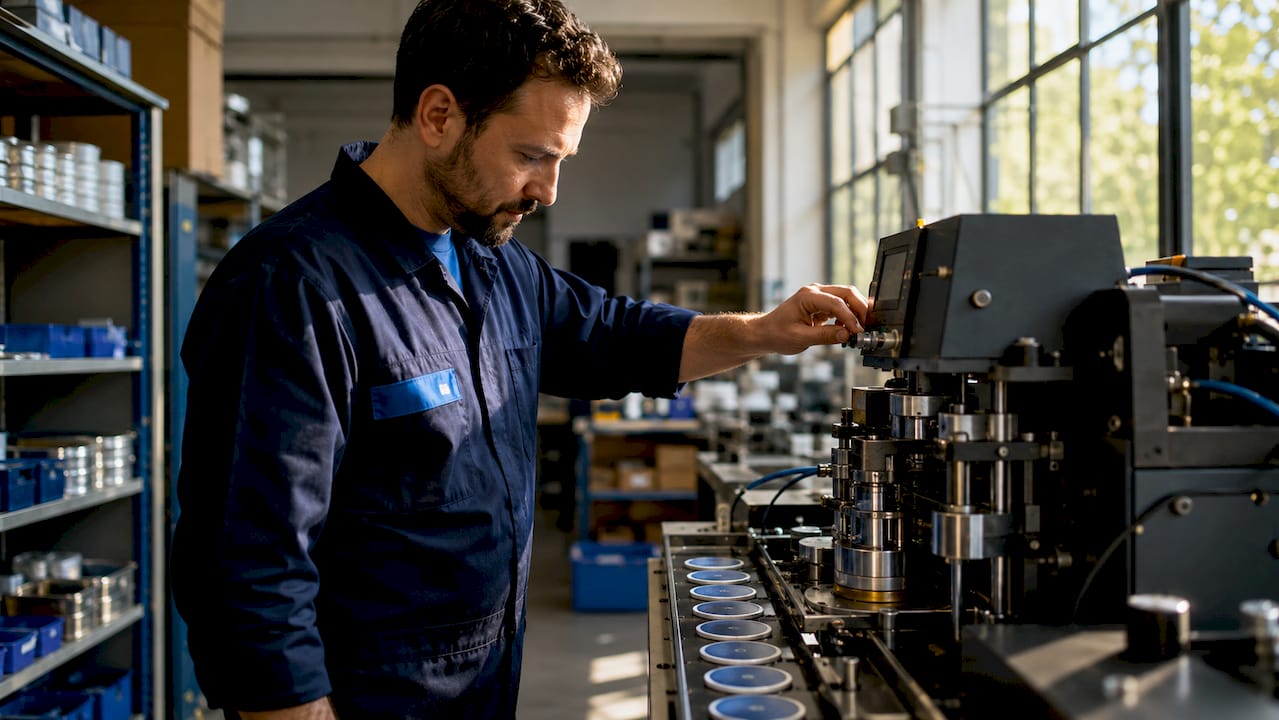
Finishing processes determine longevity. For enamel pins, polishing and baking at 160–220°C are the steps that separate a durable professional pin from a consumer-grade one. Professional enamel pin moulds can produce over 10,000 pins before requiring replacement, which makes the tooling cost manageable at volume. For standard button badges, the Mylar cover provides surface protection without any curing process.
| Printing Method | Best For | Special Effects | Setup Cost |
|---|---|---|---|
| Digital (inkjet) | Paper inserts, short runs | Full colour | Low |
| UV-LED direct | Rigid materials, mixed runs | Embossing, tactile | Low |
| Pad printing | Curved surfaces | Limited colour | Medium |
| Screen printing | High-volume single designs | Spot colour | High |
For a practical walkthrough of the steel badge manufacturing process including die stamping and finishing, the steel badge guide at Subliblanks covers each stage in detail.
What are the benefits of badge machines across sectors?
Badge machines for businesses deliver value across a wider range of applications than most buyers initially consider. The technology is not limited to promotional merchandise.
Events and conference management: On-demand badge printing reduces the risk and waste associated with overproduction by printing badges in real time at check-in. Attendee data flows directly from the registration database to the printer, so name changes and last-minute additions are handled without reprinting entire batches. The data accuracy and inventory risk reduction this creates is a measurable operational improvement for large conferences. Subliblanks covers this application in depth in their article on badge machines for events and schools.
Corporate branding and promotional merchandise: Button badge machines let marketing teams produce branded badges in-house for product launches, trade shows, and staff recognition programmes. The per-unit cost drops sharply when production moves in-house, and turnaround time falls from days to hours.
Security and ID issuance: Industrial card issuance systems produce photo ID cards, access passes, and smart cards with encoded chips. These systems combine printing, lamination, and encoding in a single automated pass, which reduces handling errors and speeds up onboarding for large organisations.
Education and community groups: Schools, universities, and charities use manual and semi-automatic badge machines to produce fundraising badges, student ID pins, and event passes at low cost. The low entry price of manual machines makes this accessible without a capital budget.
The economic case for badge machines is straightforward. In-house production eliminates supplier lead times, reduces per-unit cost at volume, and gives you full control over design changes. For businesses producing badges regularly, the machine pays for itself within months.
Key takeaways
Badge machine technology spans manual lever presses to industrial card issuance systems, and choosing the right type depends entirely on your production volume, material requirements, and budget.
| Point | Details |
|---|---|
| Core process | Every badge machine follows the same sequence: print, cut, assemble, and press. |
| Output range | Manual presses produce 200–300 badges per hour; industrial systems reach 2,000 cards per hour. |
| Printing methods | UV-LED direct printing supports short runs and special effects without extra setup costs. |
| Material quality | Finishing steps like Mylar covers and enamel baking at 160–220°C determine badge durability. |
| Sector applications | Events, corporate branding, security, and education all benefit from in-house badge production. |
Why matching machine type to workflow matters more than spec sheets
After years of working with badge production across trade and retail contexts, the mistake I see most often is buyers focusing on maximum output speed rather than workflow fit. A fully automatic machine rated at 1,000 badges per hour is genuinely impressive on paper. In practice, if your team produces 200 badges a week in ten different designs, that machine will spend most of its time being set up and cleaned between runs rather than producing.
Manual and semi-automatic machines are underestimated. A well-run manual press with a consistent operator is faster and more flexible for mixed short runs than an automated system that requires changeover time between die sizes. The network integration between registration systems and badge printers is the real bottleneck in on-demand event printing, not the press speed. I have seen events grind to a halt at check-in because the printer and the registration database were not properly synchronised, despite the hardware being more than capable.
The trend towards digital personalisation is real and worth planning for. UV-LED direct printing is making it practical to produce genuinely individual badges at near-zero additional cost per variant. That changes the economics of promotional merchandise and event ID significantly. If you are specifying a badge production setup today, build in the capacity for digital print integration even if you do not need it immediately.
My practical advice: start with your peak daily volume, add 30% headroom, and choose the machine type that handles that figure comfortably at 70% of its rated capacity. That leaves room for growth without over-specifying from day one.
— chris
Upgrade your badge printing results with Subliblanks
If sublimation printing forms part of your badge production process, the quality of your paper directly affects colour vibrancy and transfer accuracy. Subliblanks supplies a range of sublimation papers suited to badge printing workflows, with no minimum order quantities.
The SubliFlex pre-cut sublimation paper is particularly well suited to badge production, as the pre-cut format reduces preparation time and material waste between runs. For larger format printing, the A4 SubliFlex Dino paper in 200-sheet packs offers a cost-effective option for consistent, high-volume output. Browse the full range at Subliblanks to find the right paper weight and format for your machine and badge size.
FAQ
What is badge machine technology in simple terms?
Badge machine technology refers to the machinery and processes used to produce badges by combining printing, cutting, and pressing. It covers everything from hand-operated lever presses to fully automated industrial card issuance systems.
How does a manual badge machine work?
A manual badge machine uses a mechanical lever and die set to crimp a metal shell around a printed insert and Mylar cover. An experienced operator can produce 200–300 badges per hour using this method.
What printing technologies are used in badge production?
Badge printing technology includes digital inkjet printing for paper inserts, UV-LED direct printing for rigid materials, and pad printing for curved surfaces. UV-LED methods support special effects such as embossing and tactile textures without additional hardware.
What are badge machines used for in business?
Badge machines for businesses are used in events management, corporate branding, security ID issuance, and promotional merchandise production. In-house production reduces per-unit costs and eliminates supplier lead times.
How many badges can an industrial machine produce per hour?
Industrial card issuance systems can reach up to 2,000 cards per hour using automated dual-side printing and smart card encoding. Manual presses produce 200–300 badges per hour by comparison.


