



Types of badge making machines: 2026 buyer's guide
TL;DR:
- Badge making machines are categorized as manual, semi-automatic, and electric, each suited to different production volumes. Metal-bodied presses provide greater durability and consistent results, especially for regular business use, while plastic models are affordable for hobbyists. Selecting the appropriate machine depends on your projected badge volume, size needs, and long-term growth plans.
Badge making machines are mechanical or powered presses that assemble pin-back buttons by crimping a metal shell, printed graphic, Mylar cover, and pin-back together in a single action. The three main types of badge making machines are manual, semi-automatic, and electric, each suited to different production volumes and budgets. Whether you are a crafter producing a few dozen badges for a school fair or a small business supplying hundreds of custom badges for events, the right machine type changes everything. This guide covers every category of badge making equipment, from affordable hand-lever presses to fully automated electric models, so you can match the machine to your actual needs.
1. Manual badge making machines
Manual badge makers are the standard starting point for hobbyists, schools, and small creative businesses. They operate with a hand lever that crimps all badge components together in one press. The process is straightforward: load the shell and graphic into the lower die, place the Mylar cover on top, then pull the lever to crimp the assembly. A second press attaches the pin-back, and the finished badge drops out ready to use.
The appeal is largely financial. Plastic manual models cost between £35 and £90, while metal-bodied manual machines sit in the £135 to £210 range. That price gap reflects a real difference in feel and longevity, but either option gets you making badges on day one without a significant outlay.
Production speed on a manual press sits at 100 to 200 badges per hour depending on operator experience and badge size. That output is more than sufficient for batches of a few hundred, which covers most hobbyist and small-event scenarios. Manual presses are also suitable for swappable dies, meaning one machine can handle multiple badge sizes if you invest in additional die sets.
- Best for: hobbyists, schools, market traders, and small startups
- Typical output: 100 to 200 badges per hour
- Price range: £35 to £210 depending on build material
- Badge sizes available: 25mm, 38mm, 58mm, and 75mm dies commonly available
- Portability: lightweight plastic models are easy to transport to events
Pro Tip: If you are buying your first manual press, choose a metal-bodied model from the outset if your budget allows. The smoother action reduces hand fatigue during longer runs and the machine will still be performing reliably years later.
2. Semi-automatic badge making machines
Semi-automatic machines sit between hand-operated presses and fully powered electric models. They automate part of the pressing cycle, typically the crimping action, while the operator still loads components manually. The result is a faster, more consistent press with noticeably less physical effort per badge.
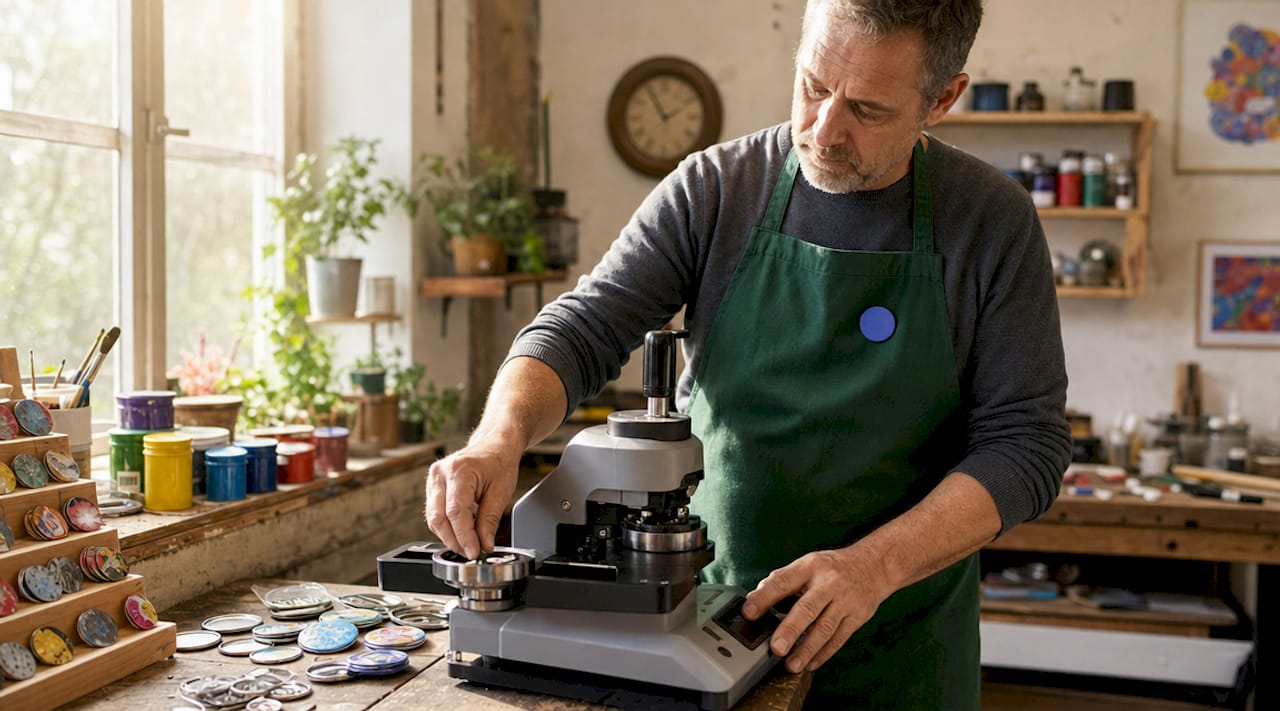
Semi-automatic and electric button makers improve throughput and reduce manual effort, making them the preferred choice for small businesses and event suppliers who need to produce larger runs without the cost of a fully automated system. A semi-automatic machine can typically produce several hundred badges per hour, roughly double the output of a skilled operator on a manual press.
The cost is higher, generally starting around £250 and rising to £600 or more for well-built models. That investment makes sense when you are running the machine regularly, because the time saved across a month of production quickly offsets the price difference. Semi-automatic machines are also more consistent: the automated pressing stroke applies the same force every time, which reduces misaligned or poorly crimped badges.
- Best for: small businesses, event badge suppliers, and craft sellers with regular orders
- Typical output: 300 to 500 badges per hour
- Key benefit: consistent crimping pressure reduces waste and rejects
- Limitation: still requires manual component loading, so throughput has a ceiling
3. Electric badge making machines
Electric badge presses fully automate the pressing action, with some models also automating component feeding. The operator loads a hopper or tray with shells and backs, and the machine handles the rest at speeds that can reach several thousand badges per hour on industrial-grade units. For small businesses, a desktop electric press producing 500 to 1,000 badges per hour is the more realistic and affordable option.
The primary criterion for choosing between machine types is throughput. If your business regularly fulfils orders of 500 or more badges per session, an electric machine pays for itself quickly. If you are producing 200 badges a week, a manual or semi-automatic press is almost certainly the better financial decision.
Electric machines also reduce repetitive strain, which matters if badge making is a daily activity. The trade-off is cost, size, and the need for a power source. Desktop electric models start at around £400 and can exceed £1,500 for high-output units. They are less portable than manual presses and require a stable workspace.
For a practical look at how production speed affects overall workflow, the principles discussed in DTF printing efficiency apply equally well to badge production planning.
4. Plastic versus metal construction
The material a badge machine is built from is not just a cosmetic detail. It directly affects how long the machine lasts, how smooth the pressing action feels, and whether the machine holds its alignment after thousands of presses.
Plastic models cost £35 to £90, while metal machines run £135 to £210, and metal machines last for thousands of presses with a noticeably smoother action. That durability gap is the core of the decision. A plastic press used daily will show wear within months. A metal press used at the same rate will still be performing consistently years later.
| Feature | Plastic/resin build | Metal build |
|---|---|---|
| Price range | £35 to £90 | £135 to £210 |
| Durability | Moderate, suits light use | High, suits regular business use |
| Pressing action | Functional but variable | Smooth and consistent |
| Weight and portability | Lightweight, easy to carry | Heavier, better for fixed workstations |
| Lifespan | Months to a year with regular use | Several years with regular use |
Pro Tip: If you plan to sell badges as part of your business, treat the machine as a long-term tool rather than a consumable. A metal-bodied press at twice the price of a plastic model will cost you far less per badge over two years of regular production.
Material choice also affects the quality of your output. Metal machines maintain tighter tolerances as they age, which means fewer misaligned badges and less wasted stock. For anyone producing custom badges for brand or commercial use, consistent output quality is not optional.
5. Badge sizes and shape compatibility
Badge presses are available in a range of sizes, and the size you choose shapes your entire product range. The most common diameters are 25mm (1 inch), 32mm (1.25 inch), 58mm (2.25 inch), and 75mm (3 inch). Each size requires its own die set, and single-size machines lock you into one diameter unless you purchase additional dies.
Interchangeable dies and multi-station presses allow switching between badge sizes in under a minute, which is a significant operational advantage for businesses offering multiple badge formats. A multi-station press holds two or three die sets simultaneously, so you can switch between a 25mm and a 58mm badge without stopping to swap components.
Shape is a separate consideration. Most badge presses produce round badges, which is the standard format for pin-back buttons. Square, oval, and specialty shapes are available on machines designed with interchangeable mould sets. Multi-size and shape compatibility expands creative and commercial options, which is particularly valuable for small businesses differentiating their product range.
| Badge size | Common use case | Notes |
|---|---|---|
| 25mm (1 inch) | Lapel pins, small promotional badges | Compact, popular for bulk giveaways |
| 38mm (1.5 inch) | Name badges, event passes | Good balance of visibility and cost |
| 58mm (2.25 inch) | Artwork badges, campaign buttons | Most popular all-round size |
| 75mm (3 inch) | Display badges, novelty items | Maximum graphic impact |
If you are starting out and unsure which size to focus on, 58mm is the safest choice. It is the most widely recognised badge format, graphic files are easy to prepare at that scale, and supplies for that size are the most readily available.
6. How to choose the right badge machine for your needs
Choosing the right badge maker comes down to four practical questions: how many badges do you need to produce per session, how often will you use the machine, how many sizes do you need, and what is your realistic budget?
Throughput is the primary selection criterion: manual presses suit low-volume batches, while semi-automatic and electric machines serve larger-scale production. A crafter making 50 badges for a craft fair needs a very different machine from a business fulfilling weekly orders of 500 badges for corporate clients.
Frequency of use determines whether durability justifies a higher price. A plastic press used twice a year is a sensible purchase. The same press used five days a week will need replacing within months. For anyone producing badges as part of a bulk badge making operation, a metal-bodied machine is the only practical choice.
Size flexibility matters if you plan to offer multiple badge formats. A single-size machine is cheaper upfront but limits your product range. A machine with swappable dies or a multi-station setup costs more initially but removes that constraint entirely.
The most common mistake first-time buyers make is underestimating how quickly their production needs will grow. Buy for where you expect to be in twelve months, not where you are today.
Accessories also affect your workflow. A circle cutter sized to your badge diameter speeds up graphic preparation considerably. Pre-cut Mylar and shell sets reduce handling time. These additions are worth budgeting for alongside the machine itself. You can find a thorough overview of what you will need in this badge making supplies guide.
It is also worth noting that badge making machines in this context refer specifically to pin-back button presses. Conference and event badge printing uses entirely different technology, including thermal printers and laminators, which serve a separate purpose and should not be confused with pin-back badge equipment.
Key takeaways
The right badge making machine is determined first by production volume, then by build quality, size flexibility, and budget.
| Point | Details |
|---|---|
| Match machine type to volume | Manual presses suit batches under a few hundred; electric models serve high-volume regular production. |
| Metal builds outlast plastic | Metal machines cost more upfront but deliver consistent results across thousands of presses. |
| Size flexibility adds value | Swappable dies or multi-station presses let you offer multiple badge formats from one machine. |
| Throughput drives the decision | Choosing between manual, semi-automatic, and electric comes down to how many badges you need per session. |
| Plan for growth | Buy a machine that suits your expected output in twelve months, not just your current volume. |
What I have learned from years of badge making equipment
The question I hear most often from creative business owners is whether they should start with a manual press or go straight to an electric machine. My honest answer is almost always the same: start manual, but buy metal.
The manual press teaches you the process. You learn how graphic alignment affects the finished badge, how Mylar placement changes the surface quality, and how consistent loading technique reduces waste. That knowledge makes you a better operator on any machine. Jumping straight to an electric press without that foundation often means producing a lot of rejects before you understand why.
What I have also found is that size versatility is consistently undervalued at the point of purchase. Buyers focus on the machine they need today and overlook the dies they will want in six months. A 58mm press is a fine starting point, but the moment a client asks for a 25mm lapel pin or a 75mm display badge, a single-size machine becomes a limitation rather than an asset. Investing in a machine with swappable dies from the start removes that ceiling entirely.
The other thing worth saying plainly: even a modest metal manual press produces results that look completely professional when the graphic preparation is done properly. The machine is only part of the equation. Good artwork, accurate circle cutting, and clean Mylar placement matter just as much as the press itself.
— chris
Get started with badge making at Subliblanks
Subliblanks supplies badge making machines and a full range of badge making equipment suited to creative individuals and small businesses across the UK. Whether you are setting up your first press or scaling up production, the range covers manual and electric options alongside the supplies you need to get producing straight away.
From badge shells and Mylar covers to circle cutters and graphic templates, everything is available with no minimum order quantity. If you are also producing sublimation-printed badge graphics, the A4 sublimation paper packs are a practical addition to your workflow, delivering sharp, colour-accurate prints that hold up through the pressing process. Browse the full Subliblanks catalogue at subliblanks.com to find the right machine and supplies for your setup.
FAQ
What are the main types of badge making machines?
Badge making machines are classified into three main types: manual, semi-automatic, and electric. Manual presses suit low-volume hobbyist and small-business use, while semi-automatic and electric models serve higher-volume production needs.
How many badges can a manual press produce per hour?
A manual badge press produces between 100 and 200 badges per hour depending on operator skill and badge size. This output is sufficient for most hobbyist and small-event production runs.
Is a plastic or metal badge machine better for a small business?
Metal badge machines are the better choice for regular business use. They cost more upfront, typically £135 to £210, but deliver consistent pressing action and last for thousands of presses compared to plastic models.
Can one badge machine make different sizes?
Yes, machines with interchangeable dies or multi-station setups can produce multiple badge sizes from a single press. Dies can be swapped in under a minute, making it practical to offer 25mm, 58mm, and 75mm badges from one machine.
What is the difference between a badge press and a conference badge printer?
A badge press is a mechanical or powered tool that crimps pin-back button components together. Conference badge printers use thermal printing and lamination technology to produce flat, printed name badges for events. The two serve entirely different purposes.


