



Laser engraving safety UK rules explained for US shops
To run a commercial laser engraving line in the United States, you need a material-specific hazard assessment, fume control that meets OSHA PELs, and written SOPs and training approved against ANSI Z136.1 and NFPA 115 guidance. Skip any one of those three and an inspection or an insurance audit will find the gap fast. Everything else in this guide exists to help you build and document that baseline properly.
TL;DR:
- Proper documentation of hazard assessments, SOPs, and licensed fume controls meeting OSHA PELs is essential to pass inspections or audits in the US.
- Ventilation systems must include certified HEPA filters and active carbon beds, with regular air sampling to verify exposure levels stay below OSHA limits.
- PPE, SOPs, and a designated Laser Safety Officer are mandatory, especially for Class IIIB and Class IV lasers, to ensure proper safety management.
- UK standards focus on statutory regulations like AOR 2010 and BS EN 60825, with stricter enforcement and legally binding exposure limits, distinct from OSHA’s voluntary standards.
- UK signage and hazard controls require clear warnings and physical barriers for Class 3B or 4 lasers, with incident reporting under regulations like RIDDOR.
Table of Contents
- Which US standards and agencies apply to laser engraving safety in the UK context
- What toxic fumes and particulates come off engraved materials
- Specifying ventilation and fume extraction that passes an audit
- PPE, SOPs and the Laser Safety Officer role
- Fire risk from combustible materials and NFPA 115 controls
- A compliance checklist you can run before any inspection
- Applicable UK laser safety regulations and standards
- How US and UK laser safety requirements actually differ
- Legal duties for UK employers and laser operators
- Laser warning signage and controlled area rules in the UK
- Reporting incidents and compliance checks under UK authorities
- UK-recognised laser safety training and certification routes
- Chris on procurement: the questions that actually matter
- Sources
Which US standards and agencies apply to laser engraving safety in the UK context
Three bodies govern how you engrave safely, and each does a different job. OSHA enforces exposure limits and can invoke the general duty clause when a hazard exists even without a laser-specific rule on the books. Table Z-1 sets the exposure ceilings your ventilation has to meet, whatever material you’re cutting or marking.
ANSI Z136.1 is the technical standard that tells you how to control the beam itself: nominal hazard zone (NHZ) calculations, interlocks, eyewear optical density, written SOPs, and Laser Safety Officer duties. NFPA 115 handles the fire side: enclosure design, ventilation during operation, and emergency preparedness specific to laser equipment.
Here’s how the three typically interact on a shop floor:
- OSHA sets the exposure limits you must not exceed and can cite you under the general duty clause if a hazard is left uncontrolled, even with no laser-specific general industry standard on the books.
- ANSI Z136.1 supplies the technical playbook: NHZ evaluation, interlocks, eyewear specification, SOPs, and LSO responsibilities.
- NFPA 115 governs fire protection: enclosure materials, suppression readiness, and ventilation during active cutting or engraving.
There’s a wrinkle worth knowing: OSHA has no single comprehensive general industry laser standard, so it leans on consensus standards like ANSI Z136.1 when assessing whether your controls are adequate. Practically, that means documentation showing you follow ANSI and NFPA guidance is your strongest evidence of compliance when an OSHA inspector walks in.
What toxic fumes and particulates come off engraved materials
Every material you feed through a laser produces a different chemical signature, and that signature is the real safety issue, not the beam itself. PVC releases hydrogen chloride gas when engraved, a corrosive that attacks lungs and equipment alike. Stainless steel throws off hexavalent chromium, a substance with an extremely low permissible action level and long-term health consequences if inhaled repeatedly. Coated substrates, laminates, and painted blanks can release volatile organic compounds and formaldehyde.
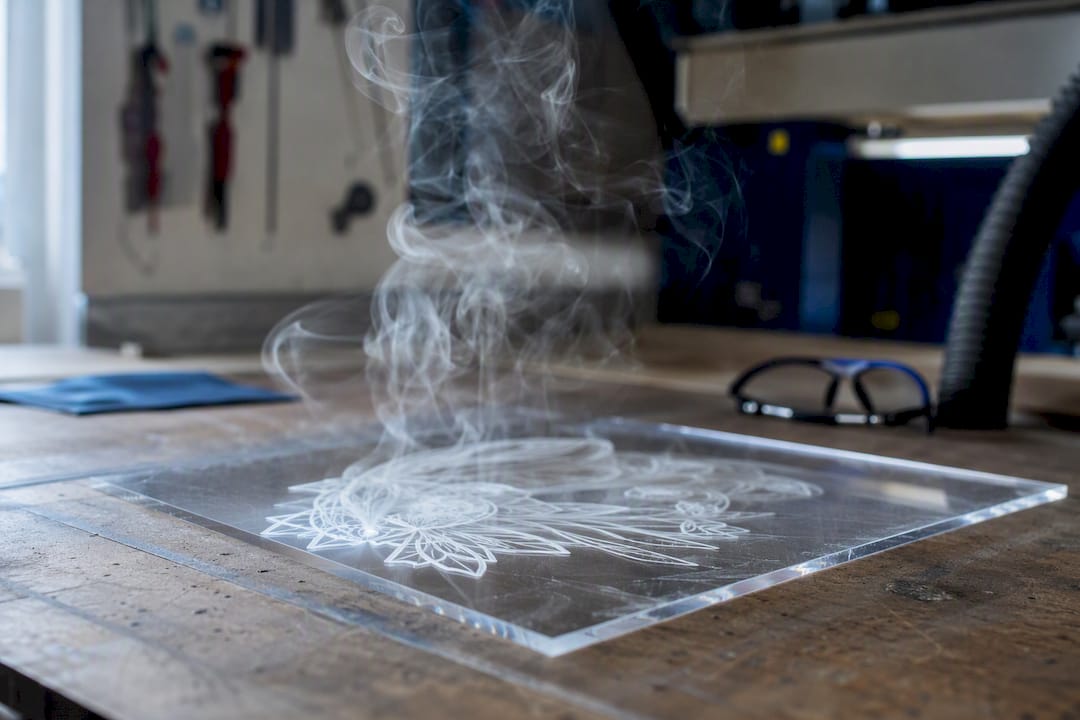
The particle size problem: laser ablation generates ultra-fine particulates in the 0.1 to 1.0 micron range. That’s small enough to bypass a standard shop dust bag entirely and settle deep in the respiratory tract.
Your PELs matter here. OSHA’s Table Z-1 caps total dust (PNOR) at 15 mg/m³ as an 8-hour time-weighted average, with the respirable fraction capped tighter at 5 mg/m³. Hydrogen chloride carries a ceiling limit of 5 ppm (7 mg/m³), meaning even brief spikes above that level are a violation, not just sustained exposure.
Pro Tip: Build a simple materials matrix before you scale production: material, byproduct, required control, and sign-off date. When a new substrate enters the shop, that document is the first thing an inspector or insurer will ask to see, and it’s the fastest way to prove you re-evaluate rather than assume.
Stainless steel and plated metals deserve special caution. If your process regularly involves them, OSHA’s chromium standard sets an action level low enough that most shops need industrial hygiene support to confirm they’re under it, not just a filter and a hope.
Specifying ventilation and fume extraction that passes an audit
You have two lawful paths for handling engraving fumes: vent the exhaust outside the building, or run a certified closed-loop filtration system that discharges clean air back indoors. Outdoor venting is simpler to document but not always possible in leased units or multi-tenant buildings, which is where most SMB print shops end up choosing filtration instead.
If you’re filtering indoors, your system needs three stages to stand up to scrutiny:
- Pre-filter to catch larger debris and extend the life of everything downstream.
- HEPA-class filtration, ideally H13 or H14 rated, capturing 99.99% of particles at 0.3 microns. This is the stage that actually deals with the sub-micron aerosols laser ablation produces, which a standard shop dust collector simply won’t touch.
- Deep-bed activated carbon to adsorb gas-phase contaminants like hydrogen chloride and VOCs that a HEPA filter passes straight through.
Having ventilation installed isn’t the same as proving it works. Merely running an extractor doesn’t satisfy OSHA; you need documented air sampling showing your actual exposure levels sit under the PELs in Table Z-1, and that testing needs to happen at intervals, not once at installation.
Before you buy, put suppliers through a short procurement checklist:
- Ask for the filter’s certified HEPA class and third-party test certificates, not just a marketing claim of “HEPA-grade.”
- Confirm the carbon bed’s specification: bed depth, media type, and expected service life against your material mix.
- Check the hooding and containment design captures fumes at the source rather than relying on general room extraction.
- Get a filter change schedule in writing, tied to your expected throughput.
- Confirm vendor service response times and spare-part lead times before you’re mid-order with a clogged filter.
Pro Tip: Ask any extraction vendor for their filter efficiency test report before signing, not after installation. A vendor who can’t produce third-party test data for their HEPA claim is a vendor whose system won’t survive an audit either.
PPE, SOPs and the Laser Safety Officer role
Eye protection becomes mandatory the moment accessible emissions could exceed the maximum permissible exposure, which in practice means most Class IIIB and Class IV engraving setups. 29 CFR 1926.54 requires suitable antilaser eyewear where those thresholds are crossed, and that eyewear has to carry a label stating its optical density and the wavelength range it protects against, not just “laser safe.”
SOPs are mandatory for Class IV lasers and strongly advisable even for Class IIIB. A usable SOP covers:
- The nominal hazard zone, mapped for each machine and material combination.
- Entry controls: who can access the area during operation, and how that’s enforced.
- Interlock procedures, including what happens if one fails.
- Scheduled maintenance checks, logged and dated.
This is where a Laser Safety Officer earns their keep. OSHA’s technical manual outlines LSO duties as classifying equipment, approving SOPs, overseeing NHZ evaluation, recommending PPE, and signing off on training, and in a small shop that’s usually one appointed manager wearing that hat alongside their other work. Centralising that accountability in a named person, rather than spreading it across whoever’s on shift, is the single easiest thing a small operation can do to look organised to an auditor.
Pro Tip: Keep operator qualification records and refresher training dates in a single file, not scattered across HR and shop-floor binders. Inspectors ask for this pack more often than any other document, and hunting for it in front of them looks worse than any individual gap.
Fire risk from combustible materials and NFPA 115 controls
Engraving surfaces can ignite under sustained high irradiance, particularly with certain plastics, coated woods, and some fabrics. This isn’t theoretical: shop fires from unattended laser runs are one of the more common insurance claims in the engraving trade, usually traced to a combustible substrate left running without supervision.
NFPA 115 is the standard to build your fire plan around. It covers ignition-potential evaluation for the materials you actually process, ventilation rules during operation, and emergency preparedness including suppression readiness.
Practical mitigations that satisfy most auditors:
- Choose flame-resistant enclosure materials and tested barrier products rather than standard sheet plastic housings.
- Fit automatic suppression where your material mix carries genuine ignition risk, not just a fire extinguisher on the wall.
- Run regular housekeeping to clear offcuts, dust, and scrap that add fuel load around the machine.
- Set material-handling rules that flag which substrates require attended-only operation.
Full material-specific guidance on combustion risk is worth reviewing before you add a new substrate to your production line.
A compliance checklist you can run before any inspection
Work through these steps in order, and you’ll have most of what an inspector or insurer wants to see:
- Classify every laser on the floor by its official class rating.
- Complete an NHZ evaluation and a material hazard assessment for everything you currently engrave.
- Choose and install engineering controls, ventilation or filtration, sized to that hazard assessment.
- Write SOPs covering entry, interlocks, maintenance, and emergency procedures.
- Appoint a Laser Safety Officer, named and documented.
- Run baseline air sampling and repeat it on a schedule.
- File everything centrally, not scattered across departments.
| Document | What it proves |
|---|---|
| Material hazard assessment | You’ve evaluated byproducts for every substrate in use |
| Written SOPs | Entry, interlock, and maintenance procedures are defined |
| LSO appointment record | One accountable person oversees the safety programme |
| Training and refresher logs | Operators are qualified and current |
| Filter certification | Extraction hardware meets its rated HEPA/carbon spec |
| Air sampling results | Actual exposure sits under OSHA PELs |
Call in an industrial hygienist the moment air monitoring flags a regulated substance like hexavalent chromium above its action level, or if you genuinely can’t demonstrate PEL compliance with in-house testing. The same applies if you’re pursuing exterior venting and local permitting gets complicated. That’s a specialist conversation, not a DIY fix.
Applicable UK laser safety regulations and standards
US shops sourcing equipment or supplies from UK-linked manufacturers, or fulfilling orders that cross into UK trade channels, should know the framework differs from the American model in structure even where the underlying physics is identical. The UK’s Health and Safety Executive (HSE) provides guidance on laser use at work, and the primary statutory instrument is the Control of Artificial Optical Radiation at Work Regulations 2010 (AOR), which sets exposure limit values for both laser and non-laser optical radiation sources.
The Laser Institute of America’s UK counterpart guidance, alongside British and European standards adopted through BS EN 60825, plays a role roughly equivalent to ANSI Z136.1 in the US system: it defines laser classification, labelling, and the technical controls that keep operators within safe exposure limits. HSE guidance sits alongside these technical standards rather than replacing them, much as OSHA relies on ANSI in the US.
For a US shop, the practical relevance is mostly about supplier relationships. If you’re importing engraving blanks, filtration components, or laser hardware manufactured or certified against UK/EU standards, the compliance paperwork you receive will often reference AOR 2010 and BS EN 60825 rather than OSHA or ANSI. Recognising these terms on a supplier’s documentation matters when you’re translating that paperwork into your own OSHA-facing hazard assessment. The regulatory language differs, but the underlying hazard classes, and the case for eyewear, interlocks, and NHZ mapping, translate directly.
How US and UK laser safety requirements actually differ
The core difference is regulatory structure, not the physics of hazard control. The US splits enforcement between OSHA (exposure limits, general duty clause) and voluntary consensus standards (ANSI Z136.1, NFPA 115) that become mandatory in practice because OSHA points to them when no specific rule exists. The UK operates through statutory regulations, principally AOR 2010, backed by HSE enforcement powers that carry direct legal force rather than relying on a general duty clause interpretation.
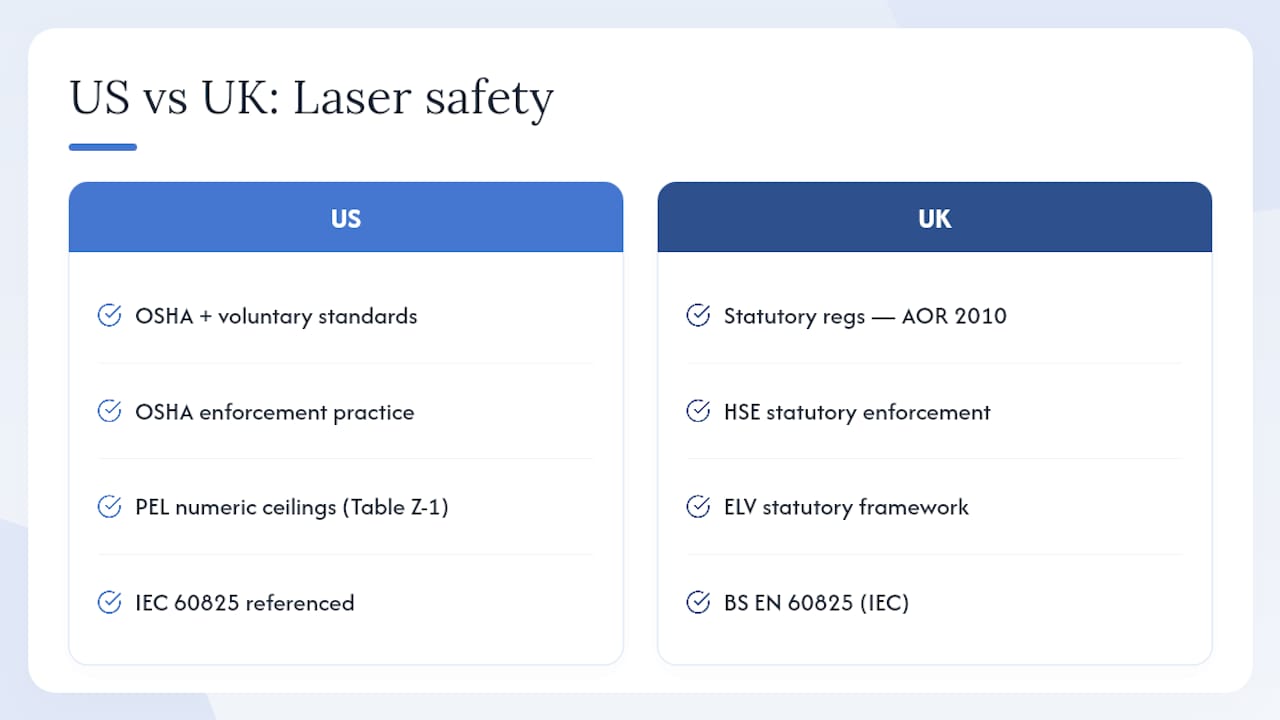
A second difference sits in exposure limit terminology. OSHA’s PELs in Table Z-1 are specific numeric ceilings tied to particular substances and time-weighted averages. The UK’s AOR 2010 framework sets Exposure Limit Values (ELVs) for optical radiation that function similarly in principle but are calculated and referenced differently within UK statutory guidance, which matters if you’re cross-referencing a UK supplier’s safety data sheet against your own OSHA compliance file.
Laser classification itself is broadly harmonised. Both systems recognise the same Class 1 through Class 4 structure via IEC 60825, adopted in the UK as BS EN 60825 and referenced informally in US ANSI guidance. A Class 4 laser is a Class 4 laser on either side of the Atlantic; what changes is which agency inspects your paperwork and which statute they cite.
For US print shops, the takeaway is this: don’t assume UK-sourced compliance documentation maps one-to-one onto an OSHA audit. Keep your own hazard assessment in OSHA and ANSI language, and treat imported paperwork as supporting evidence rather than a substitute.
Legal duties for UK employers and laser operators
Under the UK’s Health and Safety at Work etc. Act 1974, employers carry a general duty to ensure the health, safety, and welfare of employees, a duty that extends specifically to laser operations through AOR 2010’s more granular requirements. That regulation obliges employers to assess laser-related risks, set exposure limit values, and take action where those limits are likely to be exceeded, including engineering controls, PPE provision, and health surveillance where indicated.
The duty isn’t limited to the employer as an abstract entity. Individual operators also carry responsibility for following provided safety procedures and using PPE as instructed, a two-way structure that mirrors the OSHA and ANSI relationship in the US: the employer builds the system, and the operator is accountable for working within it.
For any US shop with UK operations, distributors, or contract manufacturing relationships, the practical implication is that a UK-based partner’s compliance obligations run on a separate legal track from your own OSHA duties. A shared hazard assessment template can bridge the two operationally, but the legal responsibility for each entity’s own workforce doesn’t transfer across the relationship. If you’re evaluating UK suppliers for laser-cut components, ask whether their own AOR 2010 risk assessment is current. It’s a reasonable due-diligence question and a sign the supplier takes the same discipline seriously that you’re building into your own shop.
Laser warning signage and controlled area rules in the UK
UK laser safety practice, guided by BS EN 60825 classification and HSE enforcement, requires clear demarcation of any area where a Class 3B or Class 4 laser operates. That typically means posted warning signage at every entry point, stating the laser class, the wavelength range in use, and any PPE required before entry.
Controlled areas need physical or procedural barriers, not just a sign. Interlocked doors, restricted-access signage, or a supervised entry procedure are the standard approaches, mirroring the NHZ-based entry controls that ANSI Z136.1 requires in US SOPs. The principle in both systems is identical: anyone entering the hazard zone should know they’re doing so and understand the risk before they cross the threshold.
For US shops referencing UK signage conventions, principally when supplying or maintaining equipment destined for a UK facility, the signage should match the laser’s actual classification, not a generic “laser hazard” placard. Mismatched signage, understating a Class 4 machine as a general caution area, is a common finding in UK compliance checks and translates directly to how 29 CFR 1926.54 expects US warning placards to be class-specific too. Getting the signage right isn’t a paperwork afterthought; it’s the first thing a visiting inspector checks on either side of the Atlantic.
Reporting incidents and compliance checks under UK authorities
The HSE is the primary enforcement body for laser-related workplace incidents in the UK, and reportable incidents typically fall under RIDDOR, the Reporting of Injuries, Diseases and Dangerous Occurrences Regulations. An eye injury from laser exposure, or a fire caused by uncontrolled ignition of engraved material, would generally meet the threshold for mandatory reporting to HSE within a set timeframe.
Compliance checks tend to focus on the same documentation an OSHA inspector would want in the US: a current risk assessment, evidence of exposure limit value calculations, training records, and proof that engineering controls match the hazard identified. HSE inspectors have the power to issue improvement or prohibition notices where they find gaps, a more direct enforcement mechanism than the general duty clause route OSHA sometimes has to use in the absence of a laser-specific general industry standard.
For a US shop with any UK-facing supply relationship, the relevant point is consistency: whichever authority is inspecting, the underlying expectation is the same. Show a documented hazard assessment, show engineering controls sized to that assessment, and show training records proving operators know what they’re doing. Build that documentation habit once for OSHA and it transfers almost entirely to a UK compliance conversation, just under different regulation numbers.
UK-recognised laser safety training and certification routes
The Laser Institute of America maintains training and certification pathways that align conceptually with UK Laser Safety Officer training available through UK-based providers and professional bodies connected to laser safety practice. UK-recognised courses typically cover laser classification, exposure limit value calculation under AOR 2010, NHZ-equivalent hazard zone assessment, and the practical duties expected of an appointed Laser Safety Officer within a UK employer’s health and safety structure.
Training frequency matters as much as the initial certification. UK guidance, like the US ANSI Z136.1 framework, expects periodic refresher training rather than a one-time course, particularly when new equipment or materials enter a workplace. An operator trained three years ago on a different machine class isn’t considered current under either system.
For US shops considering UK-linked hiring, contract work, or supplier vetting, checking whether a UK-based laser safety officer or technician holds a recognised UK certification, rather than an informal internal briefing, is a reasonable and increasingly common due-diligence step. It mirrors exactly what you’d expect a US customer or insurer to ask about your own LSO’s credentials, and it’s worth treating both questions with the same seriousness.
Chris on procurement: the questions that actually matter
The suppliers worth working with hand over filter certification and carbon-bed specs before you ask twice. Push for maintenance contracts and real spare-part lead times, not vague promises. Extraction and blank sourcing guides help, but the honest answer is that no supplier relationship replaces your own documented hazard assessment.
— chris
Ready to fit out a compliant engraving line? Browse SubliBlanks’ full range of laser engraving equipment and supplies for machines, blanks, and the extraction accessories your hazard assessment calls for, all shipped with no minimum order quantity. If you’re building out sublimation alongside laser work, the printer and equipment collection covers that side of the shop too. For a deeper look at material combustion behaviour before you commit to a new substrate line, manaracorp’s guide to laser cutting precision is a solid technical companion piece.
Sources
Recommended
- Laser engraving process guide for beginners and small businesses – SubliBlanks Ltd
- Best laser engraving tools UK: 2026 buyer’s guide – SubliBlanks Ltd
- What is a laser engraver: how it works and what to use it for – SubliBlanks Ltd
- Step-by-step laser engraving for beginners: first project – SubliBlanks Ltd


