



Why choose DTF supplies: maximise print versatility and ROI
TL;DR:
- DTF printing enables versatile, high-quality transfers on various fabrics without pre-treatment.
- It offers low setup costs, fast turnaround, and durability comparable to screen printing.
- Successful DTF businesses rely on trusted local supplies and proper maintenance practices.
Many print business owners assume that producing high-quality garment transfers means either investing heavily in specialist equipment for specific fabrics or accepting significant creative limitations. That assumption is simply wrong. DTF printing enables versatile printing on a wide range of fabrics without pre-treatment, which changes everything for entrepreneurs looking to expand their offering. In this guide, you will learn how DTF supplies work, how they compare to rival methods, what genuine business benefits they deliver, and how to avoid the most common pitfalls when getting started.
Table of Contents
- What are DTF supplies and how do they work?
- DTF compared to other garment printing methods
- Top benefits of DTF supplies for UK and Ireland businesses
- Considerations and common pitfalls when choosing DTF supplies
- A practical perspective: what most guides miss about DTF supplies
- Explore quality DTF supplies for your business
- Frequently asked questions
Key Takeaways
| Point | Details |
|---|---|
| Maximum fabric versatility | DTF supplies let you print vibrant designs on nearly any fabric without pre-treatment. |
| High durability | DTF prints can endure 50 to 100+ washes, ensuring long-lasting quality for your products. |
| Cost-effective and scalable | DTF offers a fast break-even and supports both small-batch and growing print businesses. |
| Local supplier importance | Choosing UK/Ireland-based suppliers ensures reliable stock and support for your business needs. |
What are DTF supplies and how do they work?
Now that we have set the scene, let’s clarify exactly what DTF supplies encompass and why they’re so distinctive. DTF stands for direct-to-film, and it refers to a printing process where designs are printed onto a special PET film, coated with a hot-melt adhesive powder, and then heat-pressed onto fabric. The result is a full-colour, durable transfer that bonds to virtually any material.
The core components of a DTF setup include:
- PET transfer film (the printable base sheet)
- CMYK plus white DTF inks (white ink is the key layer that makes colours visible on dark fabrics)
- Hot-melt adhesive powder (bonded to wet ink before curing)
- A curing unit or heat press (to set the powder and activate the transfer)
The process follows a clear sequence. First, your design is printed in mirror image onto the film, with white ink laid down either first or last depending on your printer configuration. The adhesive powder is then applied to the wet print and cured in an oven or with a heat gun. Once cooled, the transfer is ready to press onto your chosen garment using a heat press at around 160°C for 10 to 15 seconds. Peel away the film and the design is set.
What sets DTF apart from older methods is its compatibility. As any direct-to-film print guide will confirm, the process works on cotton, polyester, blends, nylon, and leather without any pre-treatment whatsoever. That is a significant operational advantage. Sublimation requires polyester-rich fabrics. DTG needs cotton and pre-treatment spray. DTF needs neither.
“The freedom to print on almost any surface, from a cotton hoodie to a nylon sports bag, without changing your consumables or workflow, is genuinely transformative for a small print shop.”
The vibrant colour output is another standout quality. Because the white ink creates a solid base layer, colours appear bold and accurate even on black or dark fabrics. Understanding DTF technology benefits helps explain why so many UK and Irish businesses are now shifting their production towards this method.
Pro Tip: White ink maintenance is the one area new DTF users consistently underestimate. Agitate or circulate white ink daily to prevent clogging, especially if your printer sits idle over weekends.
DTF compared to other garment printing methods
Understanding what DTF supplies offer, it’s crucial to see how they measure up against other printing choices.
| Method | Fabric range | Durability | Hand feel | Cost per unit | Volume suitability |
|---|---|---|---|---|---|
| DTF | All fabrics | 50 to 100+ washes | Slight texture | £2.60 to £4.20 | Low to medium |
| HTV | Most fabrics | 30 to 50 washes | Smooth | £1.50 to £3.00 | Low |
| Sublimation | Polyester only | 50+ washes | Seamless | £1.80 to £3.50 | Low to medium |
| DTG | Cotton preferred | 30 to 50 washes | Soft | £3.00 to £6.00 | Low to medium |
| Screen printing | Most fabrics | 50 to 100+ washes | Soft | £2.10+ with setup | High |
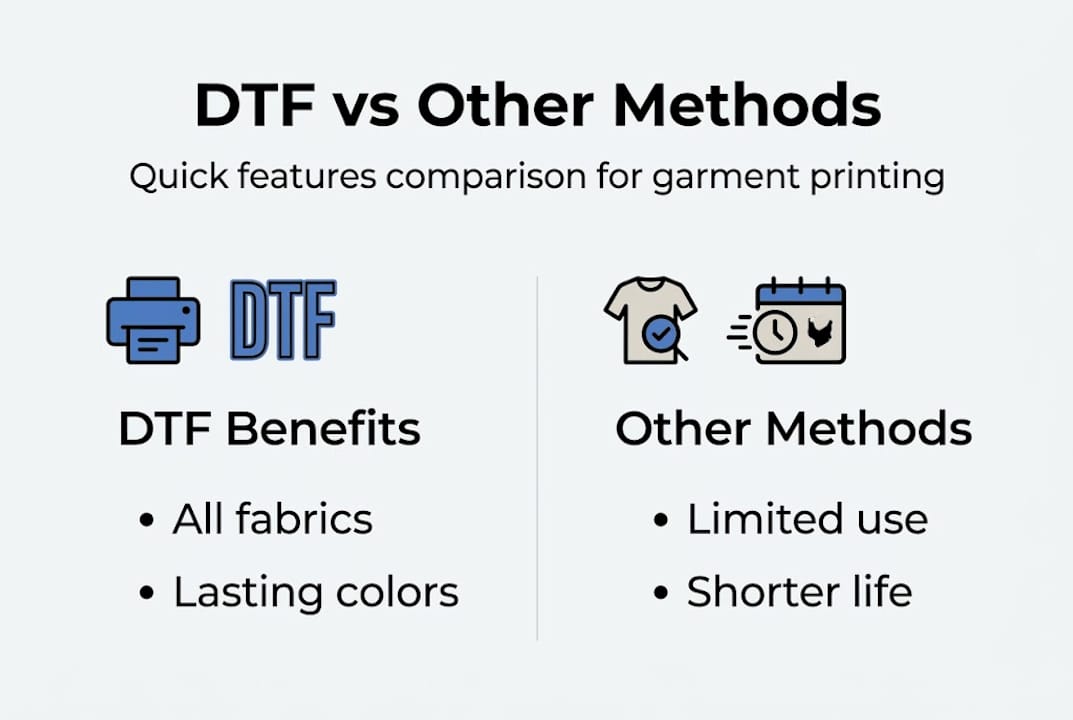
The cost picture is telling. DTF and screen printing occupy a similar per-unit range, but screen printing carries substantial setup fees that make it impractical for short runs. DTF at £2.60 to £4.20 per unit works for batches of 10 as well as batches of 100, which is exactly what most growing UK print shops need.
Advantages of DTF over rival methods:
- No pre-treatment or special fabric requirements, unlike sublimation vs DTF where sublimation is locked to polyester
- Suitable for both dark and light fabrics, unlike standard sublimation
- No screens or stencils required, unlike screen printing
- More fabric flexibility than DTG, which suits diverse materials far better
- Lower per-unit cost than DTG for comparable quality
Disadvantages to be aware of:
- Slightly raised texture on large solid fills compared to screen or DTG
- White ink maintenance adds ongoing operational commitment
- Not the most economical choice for runs above 500 units where screen printing wins on cost
For most DTF for garment businesses in the UK and Ireland producing custom orders, branded merchandise, or e-commerce fulfilment at low to medium volumes, the comparison strongly favours DTF. The flexibility alone justifies the switch for many operators.
Top benefits of DTF supplies for UK and Ireland businesses
Now that we’ve compared DTF to the alternatives, let’s break down why DTF supplies are especially valuable for UK and Irish businesses.
- Low setup investment - You do not need separate equipment for different fabric types. One DTF setup covers your entire catalogue of garments.
- No minimum order pressure - DTF is profitable at single-unit level. Custom one-off orders become viable without painful cost per unit inflation.
- Fabric flexibility - Cotton, polyester, blends, nylon, leather. Your product range is limited only by your creativity, not your equipment.
- E-commerce ready - Print on demand without holding stock. Orders arrive, you print and ship. Cash flow stays healthy.
- Colour accuracy - The white underbase ensures rich, vivid colours regardless of garment colour, which matters enormously for branded work.
- Speed to market - Transfers can be pre-printed in batches and pressed on demand, cutting turnaround times dramatically.
Durability is where DTF genuinely stands out. DTF prints last 50 to 100+ washes without cracking or peeling, which is broadly comparable to screen printing and notably better than HTV under stretch and repeated washing conditions.
| Business scenario | Daily output | Est. break-even |
|---|---|---|
| Startup (basic setup) | 30 prints | 90 to 120 days |
| Small shop (mid setup) | 75 prints | As few as 37 days |
| Scaling operation | 150+ prints | Under 30 days |
The DTF business benefits for UK and Irish operators extend beyond the print itself. Local stock availability reduces lead times significantly. When a rush order lands on a Friday afternoon, you need your film, ink, and powder ready to go, not sitting in a German warehouse.

Pro Tip: Pre-printing a library of your most popular transfer designs during quiet periods lets you fulfil orders in minutes during peak trading times. This approach works especially well for businesses selling on Etsy or Shopify.
A reliable local supplier also means technical support that understands UK voltage requirements, Royal Mail shipping norms, and VAT implications. That practical alignment is something overseas suppliers simply cannot offer. Businesses that transform with DTF consistently cite supply chain reliability as one of their top success factors.
Considerations and common pitfalls when choosing DTF supplies
Recognising the many upsides, it’s equally important to consider what can go wrong or where DTF might not fit every business.
When vetting DTF suppliers, look for these essential qualities:
- UK or Ireland-held stock - Overseas shipping adds unpredictable lead times and import costs
- Film compatibility - Not all films work equally well with all printers; confirm compatibility before bulk ordering
- Ink quality certification - Cheap inks from unknown sources can clog printheads fast
- Technical aftercare - Does the supplier offer support if something goes wrong with your setup?
- Sample packs - Any reputable supplier should allow you to test before committing to volume
Common pitfalls that catch new DTF adopters out:
- Neglecting white ink - White ink settles and clumps rapidly. Skipping daily agitation leads to printhead damage that is expensive to fix.
- Overcommitting DTF for ultra-large runs - DTF has limitations for extremely high-volume production where screen printing is more economical and offers a softer hand feel.
- Ignoring hand feel for end users - Large solid fills can feel slightly raised or plastic-like. For premium fashion garments, this matters to customers.
- Buying on price alone - The cheapest film or ink is rarely the best value. Rejected prints and reprints cost far more than the saving on supplies.
“The most expensive mistake in DTF is not buying poor equipment. It is buying cheap consumables and then blaming the equipment when quality drops.”
For anyone operating a DTF business at scale, build a relationship with one or two trusted suppliers rather than constantly shopping around. Consistency in consumables leads to consistency in output, which is what your customers will notice and remember.
A practical perspective: what most guides miss about DTF supplies
Most articles about DTF focus almost entirely on specs: ink densities, cure temperatures, film thicknesses. That is useful, but it skips the part that actually determines whether a business thrives or struggles with DTF.
Supplier trust is worth more than a 10p saving per unit. A supplier who answers the phone when your printer throws an error at 9am on a Monday, who holds UK stock and ships next day, is worth paying slightly more for. The businesses we see scaling a DTF print shop successfully are almost always the ones who prioritised supplier relationships early.
There is also a real learning curve that guides underplay. Your first 50 transfers will likely have inconsistencies. That is normal. The process rewards patience and small adjustments rather than panic buying new equipment.
Finally, the smartest operators do not go all-in on DTF alone. Pairing DTF with sublimation for hard goods, or with screen printing for very large branded runs, builds a more resilient and profitable business. Hybrid setups are not a compromise. They are the natural evolution of any serious print operation.
Explore quality DTF supplies for your business
If you’re ready to upgrade your print capabilities, here’s where to find trusted DTF and related supplies.
Choosing the right consumables is the foundation of everything discussed in this guide. Quality film, reliable inks, and consistent powder make the difference between reprints and revenue.
At Subliblanks, we supply a full range of print solutions with no minimum order quantities, making it easy to start small and scale with confidence. Browse our DTF compatible name badges for branded merchandise, explore sublimation paper supplies for complementary product lines, or view the full range of DTF and sublimation products to find everything your print business needs in one place. Our team understands the UK and Ireland market and is here to support your growth.
Frequently asked questions
What fabrics can I print on with DTF supplies?
DTF supplies work on cotton, polyester, blends, nylon, leather, and both dark and light fabrics without any pre-treatment, making them one of the most versatile options available to print businesses.
How durable are DTF prints compared to other methods?
DTF prints last 50 to 100 or more washes without cracking or peeling, rivalling screen printing and outperforming HTV for stretch durability and repeated wash cycles.
Is DTF printing cost-effective for small businesses?
Yes. DTF offers low setup costs and quick break-even potential, with moderate production levels enabling a return on investment in as little as 37 days for a small operation.
What are common challenges with DTF supplies?
DTF prints can feel slightly raised on large solid areas, require consistent white ink maintenance, and are less economical than screen printing for extremely high-volume runs above several hundred units.
Recommended
- What does DTF mean? A complete guide to direct-to-film printing – SubliBlanks Ltd
- Understanding DTF technology: Key benefits for UK printers – SubliBlanks Ltd
- DTF Printing: Transforming Garment Businesses Today – SubliBlanks Ltd
- 7 Top Sublimation Printers 2026 for Print Shops – SubliBlanks Ltd
- Trendi personaliziranega tiska 2026: inovacije in nasveti


