



How to manage trade supplies: a practical guide
TL;DR:
- Effective trade supply management involves selecting reliable suppliers, monitoring inventory with KPIs, and using technology for real-time oversight. Dual-sourcing reduces reliance on single suppliers, and consistent relationship management improves operational resilience. Centralized platforms streamline onboarding, contracts, and performance tracking to prevent disruptions.
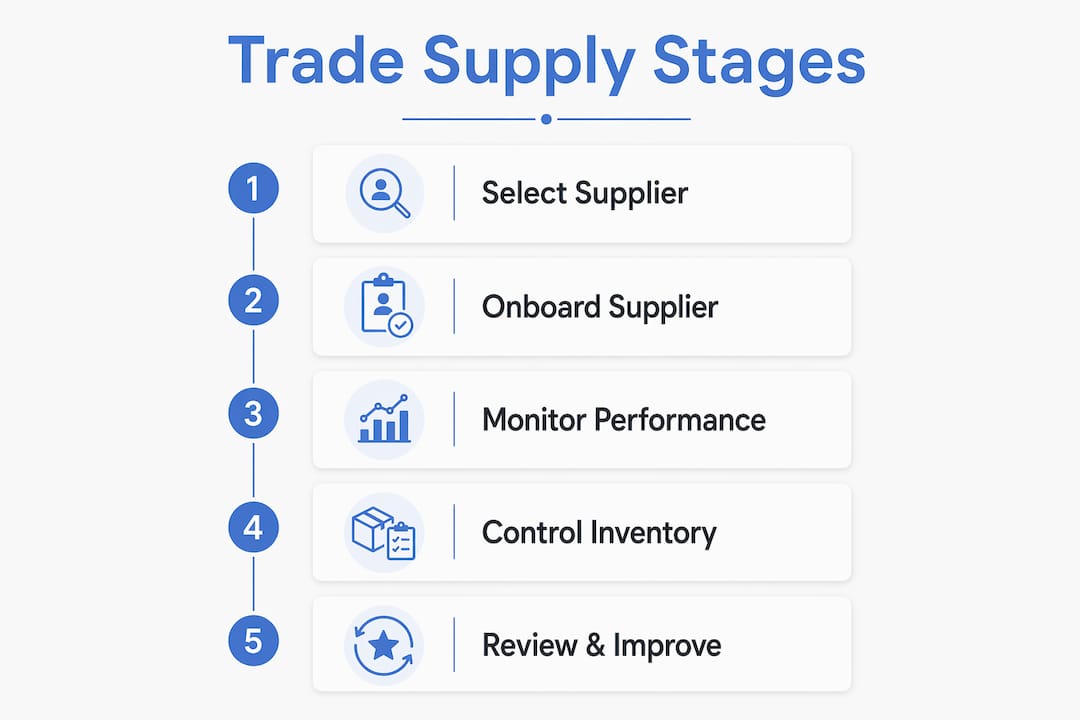
Trade supply management is the structured process of selecting, onboarding, monitoring, and controlling suppliers and inventory to maintain consistent availability and operational continuity. For trade professionals and small business owners, poor supply management is not just an inconvenience. It is a direct threat to revenue, reputation, and growth. This guide covers how to manage trade supplies from the ground up, including supplier selection, inventory tracking, risk mitigation, and the technology that ties it all together. Every section is built around what actually works in practice, not theory.
How to manage trade supplies: supplier selection and onboarding
Choosing the right supplier is the single most consequential decision in trade supply management. A supplier who fails on delivery, quality, or compliance can halt your entire operation. The evaluation process must go beyond price.
The criteria that matter most fall into four categories:
- Financial stability. A supplier in financial difficulty cannot guarantee continuity. Request recent accounts or credit reports before committing.
- Reliability and track record. Ask for references and check delivery performance history. On-time delivery rates and defect rates are the two metrics that reveal the most.
- Regulatory compliance. Confirm the supplier meets all relevant industry standards, including health and safety, product certification, and data protection requirements.
- ESG factors. Environmental, social, and governance performance is now a procurement standard, not an optional extra. Suppliers with poor ESG records carry reputational and legal risk.
Once you have selected a supplier, onboarding must be thorough. A standardised digital onboarding framework requires financial health checks, regulatory screening, ESG disclosures, cybersecurity assessments, and insurance verification for full audit readiness. That level of rigour protects you if a dispute or audit arises later.
Documentation is the backbone of onboarding. Collect signed contracts, service level agreements (SLAs), insurance certificates, and compliance declarations before placing a first order. Store everything in a centralised system so any team member can access it without delay.

Pro Tip: Keep all supplier data, contracts, and performance records in one centralised platform. When you need to act quickly during a supply disruption, you cannot afford to hunt through email threads for a contact number or certificate.
For trade businesses sourcing from multiple regions, understanding the benefits of local wholesalers alongside international options gives you a more complete picture of your sourcing risk.
What are the best practices for tracking trade supplies?
Real-time inventory visibility is the foundation of effective supply monitoring. Without it, you are reacting to shortages rather than preventing them.
The most reliable approach combines an inventory management system or ERP platform with clearly defined KPIs. The three KPIs that matter most for trade supply monitoring are:
- Delivery accuracy. The percentage of orders delivered on time and in full. Any rate below your agreed SLA threshold triggers a formal supplier review.
- Defect rate. The proportion of goods arriving damaged or non-conforming. Track this per supplier, not just in aggregate, so you can identify the source of quality failures.
- Order responsiveness. How quickly a supplier confirms, processes, and dispatches an order. Slow responsiveness is an early warning sign of capacity problems.
| KPI | What it measures | Review frequency |
|---|---|---|
| Delivery accuracy | On-time, in-full delivery rate | Weekly |
| Defect rate | Non-conforming goods per order | Per delivery |
| Order responsiveness | Time from order to dispatch confirmation | Monthly |
Set automated alerts within your inventory system to flag when stock falls below a defined reorder point. This removes the human error of manual checks and gives you lead time to act before a shortage occurs. ERP integration takes this further by connecting purchasing, stock levels, and supplier performance data in one view.
For businesses managing bulk order fulfilment, automated reorder triggers become even more critical because the volume and frequency of orders makes manual tracking unreliable.
How do you reduce supply chain risk through dual-sourcing?
87% of industry leaders cite risk mitigation as the primary objective in supplier management investments. That figure reflects a hard lesson: single-supplier dependency is the most common cause of avoidable supply disruption.
Dual-sourcing is the most direct solution. Assigning 10–20% of order volume to a secondary supplier for critical items keeps an alternative source active and ready to scale. That allocation is deliberate. Too little and the secondary supplier deprioritises you during a shortage. Too much and you lose the pricing efficiency of volume with your primary.
Risk categories to address in your supply strategy:
- Financial risk. A supplier facing insolvency cannot fulfil orders. Monitor financial health annually, not just at onboarding.
- Geographic concentration. Suppliers concentrated in one region create correlated risks from local disruptions such as extreme weather, port strikes, or regulatory changes. Spread your supplier base across regions where possible.
- Supply disruption. Component shortages, raw material price spikes, and logistics failures all require contingency plans. Safety stock for your highest-risk items is a practical buffer.
Mapping multi-tier supplier dependencies exposes hidden risks, such as two of your suppliers sharing the same sole-source manufacturer. That kind of visibility is what separates reactive businesses from resilient ones.
Pro Tip: Share demand forecasts with your key suppliers quarterly. Shared forecasting enables better capacity planning and secures priority allocation during industry-wide shortages. Suppliers prioritise customers who help them plan.
Textile and manufacturing businesses can find detailed sourcing frameworks in this textile procurement workflow guide, which covers systematic approaches applicable across trade sectors.
How do you build stronger supplier relationships for better results?
Supplier management is a strategic governance function with assigned ownership, not merely contract administration. Businesses that treat it as a back-office task consistently underperform those that treat it as a core operational discipline.
Assign a named owner to each key supplier relationship. That person is accountable for performance monitoring, escalation, and the commercial relationship. Without clear ownership, issues drift and accountability disappears.
Structured practices that strengthen supplier relationships:
- Regular performance reviews. Conduct formal reviews quarterly, tied to your KPIs. Share the data with the supplier so they can see exactly where they are falling short and what improvement looks like.
- Joint planning sessions. Bring key suppliers into your demand planning process. When they understand your growth plans, they can invest in capacity ahead of your needs.
- Transparent SLAs. Every contract should specify delivery windows, defect tolerances, and escalation procedures. Ambiguous SLAs create disputes. Clear ones prevent them.
- Aligned risk profiles. High-risk suppliers warrant tighter contract terms, more frequent reviews, and shorter notice periods. Low-risk, long-term partners can operate on lighter-touch governance.
Pro Tip: Do not wait for a problem to communicate with a supplier. Regular contact, even brief monthly check-ins, builds the kind of relationship where a supplier calls you first when they foresee a delay, rather than after it has already affected your customers.
What technology makes trade supply management easier?
Centralised supplier management systems that automate onboarding, contract management, and compliance reduce manual errors and improve operational efficiency. The technology does not need to be complex. The key is that it connects your supplier data, inventory levels, and performance records in one place.
Core capabilities worth prioritising:
- Automated onboarding workflows. Replace email-based document collection with a structured digital process. Every supplier completes the same steps, and nothing is missed.
- Contract and renewal alerts. Automated reminders for contract renewals and compliance recertification prevent gaps in coverage.
- Invoice processing automation. Matching invoices to purchase orders automatically reduces errors and speeds up payment cycles.
- Real-time dashboards. Digitised supplier performance tracking with dashboards and automated alerts enables proactive management of delivery delays, defects, and SLA breaches before they escalate.
| Capability | Operational benefit |
|---|---|
| Automated onboarding | Consistent compliance checks, no missed documents |
| Real-time dashboards | Early detection of delivery and quality issues |
| Contract renewal alerts | No lapsed agreements or compliance gaps |
| Invoice automation | Faster processing, fewer payment errors |
Data-sharing platforms take this further by giving suppliers visibility into your stock levels and demand signals. When a supplier can see that your stock of a critical item is running low, they can act without waiting for a purchase order. That kind of collaboration reduces the lag between a supply risk and a supply response.
For businesses managing bulk supplies efficiently, integrating purchasing data with inventory dashboards is where the biggest efficiency gains appear.
Key takeaways
Effective trade supply management requires structured supplier selection, real-time inventory tracking, dual-sourcing for critical items, and technology that connects all three into a single, visible system.
| Point | Details |
|---|---|
| Supplier selection criteria | Evaluate financial stability, reliability, compliance, and ESG factors before committing. |
| Inventory KPIs | Track delivery accuracy, defect rate, and order responsiveness weekly and per delivery. |
| Dual-sourcing allocation | Assign 10–20% of critical item volume to a secondary supplier to maintain ready capacity. |
| Supplier governance | Assign a named owner to each key supplier with clear accountability for performance. |
| Technology integration | Use centralised systems with dashboards and automation to reduce errors and detect issues early. |
What I have learned from managing trade supplies in practice
The biggest mistake I see trade businesses make is treating supplier management as something that only needs attention when something goes wrong. By then, the damage is already done. A customer has missed a deadline, a production run has stalled, or a key product is out of stock with no clear timeline for resolution.
The businesses that handle supply disruption well are not the ones with the most suppliers. They are the ones who know their suppliers deeply. They have shared forecasts, clear SLAs, and a named person who picks up the phone when something shifts. That relationship infrastructure is what gives you options when a disruption hits.
Dual-sourcing is the tactic I recommend most consistently to small trade businesses, and it is also the one most often dismissed as unnecessary overhead. The 10–20% volume allocation to a secondary supplier feels like inefficiency until the moment your primary supplier cannot deliver. At that point, it feels like the most sensible decision you ever made.
The other thing I would stress is the gap between onboarding and ongoing management. Many businesses invest effort in vetting a supplier at the start, then never formally review performance again. Supplier quality drifts. Contacts change. Compliance certificates lapse. A quarterly review cycle, even a brief one, catches these issues before they become crises.
— chris
Subliblanks: a simpler way to source trade supplies
Trade professionals need a supplier who can keep up with their operation, not one that imposes minimum order quantities or slow account setup.

Subliblanks is a UK-based trade wholesaler supplying sublimation blanks, DTF supplies, xTool laser engraving machines, badge-making equipment, 3D printing filaments, stamp-making machines, and packaging supplies, all with no minimum order quantities. Whether you are restocking a single product line or building out a new range, you can order exactly what you need. Setting up a trade account is straightforward, and the full product catalogue is available to browse immediately. For trade businesses looking to tighten their supply management without adding complexity, Subliblanks is worth a look.
FAQ
What is trade supply management?
Trade supply management is the structured process of selecting, onboarding, monitoring, and controlling suppliers and inventory to maintain consistent product availability. It covers supplier evaluation, inventory tracking, risk mitigation, and performance governance.
How do I track trade supplies effectively?
Use an inventory management system or ERP platform with automated reorder alerts and clearly defined KPIs, including delivery accuracy, defect rate, and order responsiveness. Review these metrics weekly and per delivery to catch issues early.
What is dual-sourcing and why does it matter?
Dual-sourcing means assigning 10–20% of order volume for critical items to a secondary supplier, keeping an alternative source ready to scale if your primary supplier fails. It is the most direct way to reduce single-supplier dependency risk.
How often should I review supplier performance?
Conduct formal performance reviews quarterly, tied to agreed KPIs and SLA terms. Brief monthly check-ins between reviews help maintain the relationship and surface early warning signs before they become operational problems.
What questions should I ask when onboarding a new supplier?
Ask for evidence of financial stability, regulatory compliance, insurance coverage, ESG disclosures, and cybersecurity practices. A supplier who cannot provide this documentation at onboarding is unlikely to meet audit requirements later.


