



How durable are DTF transfers, really?
Well-made DTF transfers typically withstand 50–100 wash cycles when pressed and cared for correctly. That range comes from industry benchmarks, with 50 washes treated as the baseline and 100 as the mark of top-tier production. Unused transfers, when stored properly, can retain quality for a considerable time before use, with storage conditions being more important than exact duration.
Three things decide where a transfer lands in that range:
- Transfer quality — ink density, powder grade, and how well the cure was managed at production
- Press application — the right temperature, time, pressure, and peel method for the fabric
- Washing habits — cold cycles, no fabric softener, and sensible drying
Get all three right and 100 washes is realistic. Get one badly wrong and you can see cracking or peeling inside ten. Subliblanks supplies the films, powders, and printers that print shops use to hit the upper end of that range, but the pressing and care still sit with whoever’s running the heat press.
Key Takeaways
DTF transfer durability depends on the combined effect of ink and powder quality, correct press settings, and proper washing care, not any single factor alone.
| Point | Details |
|---|---|
| Expect 50 to 100 washes | Well-made transfers hit this range when production, pressing, and care are all handled correctly. |
| Powder and cure decide the ceiling | Under-cured or poorly applied powder limits durability regardless of press settings used afterwards. |
| Add a finishing repress | A second press with parchment or matte sheet meaningfully improves adhesion and edge durability. |
| Match powder to fabric stretch | Spandex and Lycra need flexible TPU powder to avoid micro-cracking under movement. |
| Wash cold, skip softener | Hot water and fabric softener are the two biggest accelerants of premature adhesive failure. |
| Source consistent consumables | Subliblanks supplies trade-grade DTF films, powders, and printers with no minimum order quantity. |
Table of Contents
- What controls DTF transfer durability at the production stage
- How many washes does a DTF transfer last?
- Which fabrics help or hinder transfer durability?
- Getting press settings right for maximum wash life
- Washing and drying rules that make transfers last
- How long do unused DTF transfers last in storage?
- Diagnosing early failure and fixing the root cause
- Testing standards for measuring DTF transfer durability
- Sunlight, humidity and abrasion: environmental wear on DTF transfers
- DTF versus screen printing and heat transfer vinyl
- What actually separates standard transfers from top-tier ones
- Where to source consumables built for the upper end of that range
- Sources
What controls DTF transfer durability at the production stage
Durability starts long before anyone picks up a heat press. Ink density is the first variable: transfers laid down with thin, under-saturated ink layers fade and crack far sooner than those with proper coverage, because there’s simply less pigment to withstand friction and washing.
Adhesive powder quality matters just as much. A coarse or unevenly applied powder creates weak spots across the design, so some areas bond to the fabric properly while others barely hold. DTF transfer durability depends chiefly on ink density, powder application, press settings, and washing habits, and powder consistency is the one production variable a buyer can actually inspect before pressing anything.
Cure profile is the quiet one. Under-cured powder never fully melts into the film, so it looks fine fresh off the press and then fails within a dozen washes. Over-cured powder can go brittle. Neither shows up until the transfer’s already on a garment.
Here’s how the shortcuts tend to show up later:
- Cheap ink, thin coverage → fading and dulling within 15 to 20 washes
- Inconsistent powder application → patchy peeling, usually starting at edges or fine detail
- Under-cured powder → whole sections lifting off in one piece after a handful of washes
- No quality control on film stock → cracking across the design regardless of how well it was pressed
Pro Tip: Ask any supplier what their standard cure settings are and whether they batch-test wash resistance. A supplier who can’t answer either question probably isn’t testing at all.
How many washes does a DTF transfer last?
The 50 to 100 wash figure gets thrown around a lot, and it’s worth knowing what it actually measures. Fifty washes is the industry floor for a properly made transfer under normal use. A hundred washes represents top-tier performance under standardised laboratory testing — controlled water temperature, consistent detergent, no fabric softener, gentle agitation.

Home laundering rarely matches that setup. Hot water, aggressive spin cycles, and softener all shave washes off the total, sometimes significantly. A transfer rated for 80 washes in lab conditions might realistically deliver 50 to 60 in a household that washes on warm and uses softener out of habit.
Use case matters too. A weekend t-shirt getting washed every couple of weeks will comfortably outlast its rated wash count in calendar years. A hi-vis workwear shirt washed daily after a shift needs every one of those 100 washes just to survive a normal working month, which is why workwear specifically demands decoration methods built for heavy-use environments.
Which fabrics help or hinder transfer durability?
Fabric choice changes the durability equation more than most buyers expect, because DTF adhesive bonds mechanically rather than chemically, gripping fibres rather than melting into them.
- Cotton and cotton-poly blends give the most reliable long-term results — the fibre structure gives the adhesive plenty to grip
- High-polyester and slick performance fabrics reduce mechanical adhesion and usually need a lower press temperature and longer dwell time to compensate
- Nylon and similar synthetics can scorch at standard cotton settings, so testing a scrap swatch first isn’t optional
- High-stretch fabrics like Spandex and Lycra need flexible TPU adhesive powder, because standard powder cracks under repeated stretching
That stretch-fabric point deserves emphasis. Practitioner discussion on transfer failures consistently flags mismatched adhesive powder, not press error, as the main cause of micro-cracking on stretch garments. Swap the powder before you touch the press settings.
Getting press settings right for maximum wash life
Press settings are the single most controllable factor in DTF transfer durability, and also the one most shops get slightly wrong without realising it. Mastering temperature, time, and pressure together is what separates transfers that hit 100 washes from ones that fail at 30.
Starting ranges for cotton and cotton-blend fabrics sit around 310–325°F (155°C) for 12 to 15 seconds, medium to firm pressure. Treat that as a starting point, not gospel. Platen evenness varies between machines, fabric thickness varies between garments, and what works on one heat press can under-cure on another.
- Check platen temperature at multiple points, not just the display readout
- Apply firm, even pressure. Light pressure is the most common cause of poor adhesion
- Follow the film’s recommended peel method (hot or cold) exactly. Peeling at the wrong stage tears the adhesive layer
- Add a finishing repress with a parchment or matte sheet after the initial peel
That last step matters more than most guides admit. A second press with a parchment or matte sheet noticeably improves adhesion and hand feel, sealing down edges that the first press leaves slightly proud. It’s a ten-second addition to the workflow with a disproportionate payoff. Under-pressing shows up as edge lift within a handful of washes; over-pressing can scorch fabric or flatten texture so the design looks glossy and plasticky.
Pro Tip: Run five test presses on scrap fabric, wash them on a cold gentle cycle, and check at 10, 25, and 50 washes. That gives you a real baseline instead of a guess.
Washing and drying rules that make transfers last
Care instructions decide as much of the outcome as production quality does, and they’re the one part entirely in the customer’s hands. Hot water and fabric softener are the two biggest accelerants of adhesive breakdown, so both are worth flagging clearly on any care label.
- Wash cold, on a gentle cycle, garment turned inside out
- Skip bleach and fabric softener entirely. Softener coats the adhesive and weakens the bond over time
- Air dry where possible; tumble dry on low if not. High heat is nearly as damaging as hot water
- Wait 24 hours after pressing before the first wash
That 24 hour wait isn’t superstition. The adhesive continues to set and bond to the fibres after it leaves the heat press, and washing too early interrupts that process before it’s finished. A transfer washed within the hour of pressing can lose noticeably more life than one left to cure overnight, even with an identical press profile.
How long do unused DTF transfers last in storage?
Correctly stored transfers last from six months to two years or more, with storage conditions mattering more than elapsed time on the calendar.
- Store flat, in a cool, dry space away from direct sunlight and humidity
- Avoid stacking anything heavy on top, which can compress and crack the powder layer
- Before pressing, check for powder clumping, film discolouration, or cracking
A transfer that’s spent a year in a damp, sunlit corner will underperform one that’s spent two years in a sealed, dark drawer.
Diagnosing early failure and fixing the root cause
Most transfer failures point clearly back to one of three places: production, pressing, or care. Reading the symptom correctly saves time.
- Fine cracking across the design usually means under-curing at production or repeated hot washing. Check both before blaming the transfer itself
- Edge lift or peeling corners typically comes from insufficient press pressure or peeling at the wrong temperature. Repress with corrected settings on the next batch
- Patchy fading in specific areas points to uneven powder application, not general wear
- Whole sections lifting cleanly off almost always traces back to under-cure at the production stage. That’s a supplier or consumable problem, not a customer error
If a repress with corrected settings doesn’t resolve a recurring issue across multiple garments, the fault sits with the film or powder batch, not the technique. Swap consumables before troubleshooting the press further.
Testing standards for measuring DTF transfer durability
There’s no single universal certification body for DTF transfer durability the way there is for some textile standards, but the industry has converged on a practical testing method: standardised wash-cycle testing under controlled conditions.
The process typically runs test specimens through a fixed number of wash cycles at controlled water temperature, using a standard detergent with no additives, then inspects for cracking, fading, and edge lift at set intervals. This mirrors the practical QC approach production guides recommend: produce test specimens, wash them on a standardised cold-gentle cycle, and inspect at 10, 25, and 50 cycles, documenting results as a baseline.
That interval-based inspection matters because failure is rarely sudden. A transfer degrading toward failure typically shows early signs, like slight dulling or a barely visible crack line, well before it becomes visibly unwearable. Catching that at the 25-wash mark tells you far more about a consumable batch than waiting for total failure at wash 80.
For a print shop, replicating a simplified version of this test costs almost nothing: a handful of scrap garments, a normal domestic washing machine set to cold and gentle, and a notebook. Run it every time you switch ink batch, powder supplier, or press. It’s the only way to know whether a change actually improved durability or just felt like it should.
Sunlight, humidity and abrasion: environmental wear on DTF transfers
Wash cycles get most of the attention, but environmental exposure quietly degrades transfers even on garments that rarely see a washing machine.
UV exposure is the biggest hidden threat. Direct, prolonged sunlight breaks down both the ink pigments and the adhesive polymer structure, which is why a hi-vis jacket left on a dashboard or a promotional t-shirt displayed in a shop window fades faster than one worn and washed normally. This isn’t a washing problem at all. It’s a storage and display problem that no amount of correct pressing can prevent.
Humidity works more slowly but compounds other issues. A garment stored in a damp environment between wears can encourage the adhesive layer to soften prematurely, making it more vulnerable to abrasion the next time it’s worn or washed. That’s part of why storage advice for unused transfers (cool, dry, away from light) applies almost identically to finished, decorated garments in long-term storage.
Abrasion is the most predictable factor of the three. Friction from bag straps, seatbelts, tight waistbands, or repeated folding along the same crease wears down the raised texture of a DTF print faster than washing alone ever would. Designs placed across high-friction zones, like a full chest print under a rucksack strap, will visibly wear before an identical design placed somewhere with less contact.
None of these three factors are usually severe enough alone to cause failure. Stacked together, sunlight, humidity, and abrasion accelerate whatever wear the wash cycles are already causing.
DTF versus screen printing and heat transfer vinyl
Buyers comparing decoration methods usually want a straight answer on durability, and the picture is more favourable to DTF than older guides suggest. In practical testing, properly applied DTF transfers often outlast HTV and match or exceed screen print durability in many conditions.
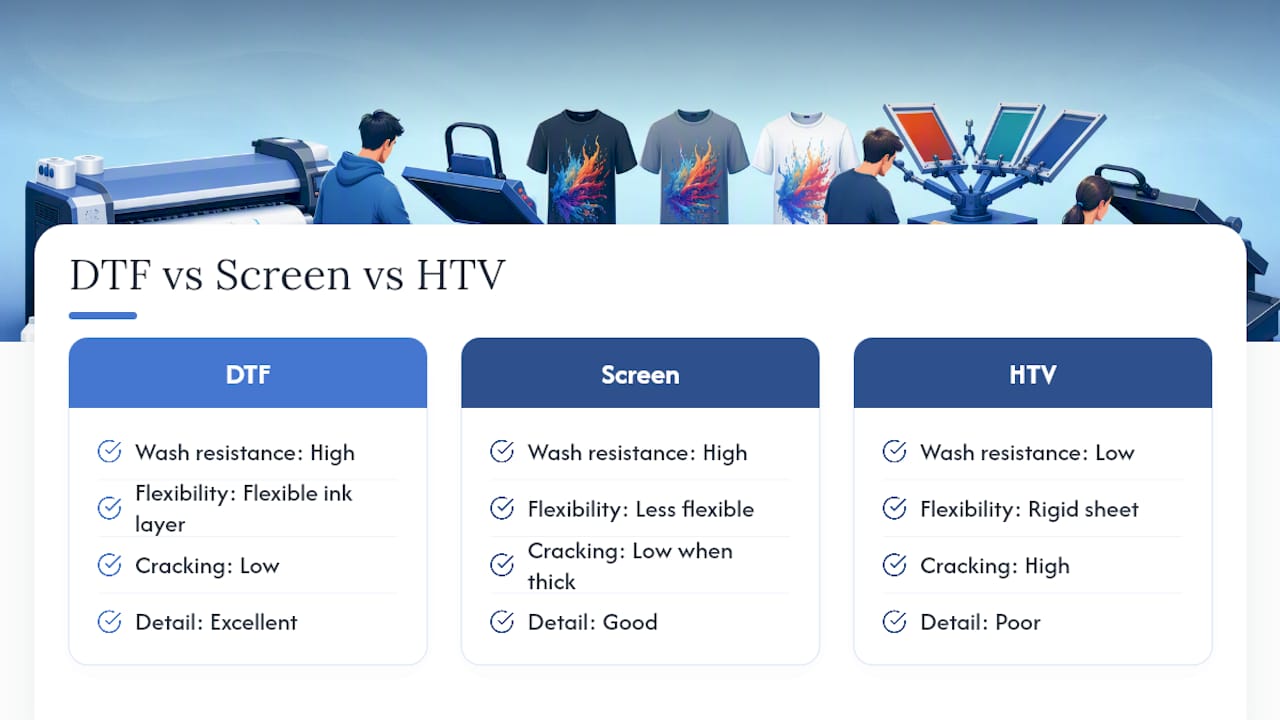
Heat transfer vinyl tends to crack over time because it’s a solid sheet of material bonded to fabric. Every crease in the garment becomes a stress point, and thick multi-colour vinyl designs are particularly prone to lifting at the edges after repeated washing. DTF’s finer, more flexible ink and powder layer flexes with the fabric rather than fighting it.
Screen printing, done well, remains genuinely durable and can outlast DTF on very high-volume runs where the ink is built up in thick layers. But screen printing struggles with fine detail, gradients, and photographic designs, exactly the territory where DTF’s advantages over other decoration methods become obvious. It also demands separate screens per colour, which makes small-batch or highly detailed work impractical.
The honest comparison isn’t “which lasts longest” in the abstract. It’s which method matches the design complexity and order volume in front of you, because a poorly executed version of any of the three will underperform a well-executed version of either of the others.
What actually separates standard transfers from top-tier ones
Most durability advice treats production, pressing, and care as three separate topics. They’re not. They’re one continuous chain, and a weak link anywhere breaks the whole thing regardless of how well the other two are handled.
Here’s what conventional advice tends to get wrong: it fixates on press temperature as the main lever, because it’s the easiest variable to write a number for. In practice, powder consistency and cure quality at production do more to determine the ceiling of a transfer’s durability than any press setting can compensate for afterwards. You cannot press your way out of an under-cured batch. You can, however, waste a perfectly good transfer with a lazy press profile.
If I had to prioritise one thing for a shop trying to move from “acceptable” to “top-tier” wash counts, it wouldn’t be buying a better press. It would be running the simple wash-test QC loop on every new batch of film or powder before it goes into full production. Most shops skip this because it feels like overkill for a consumable. It isn’t. It’s the only way to catch a bad batch before it’s on fifty customers’ t-shirts instead of five test swatches.
— chris
Where to source consumables built for the upper end of that range
Getting a transfer to survive 100 washes rather than 50 rarely comes down to one dramatic fix. It’s ink density, powder grade, cure consistency, and a correctly dialled press profile, all working together, and every one of those starts with the consumables going into the printer.

Subliblanks supplies DTF films, adhesive powders, and printers to trade customers with no minimum order quantity, which matters if you’re testing a new powder grade or press profile before committing to a full production run. Consistent consumables from batch to batch remove one of the biggest variables in the durability equation before you’ve even switched the press on. Pairing the right powder with the right fabric, following the workflow steps that reduce production errors, and stocking the film and powder types suited to your typical order mix puts top-tier wash counts within reach rather than down to luck.
If you’re ready to compare consumables or equipment for your own production line, browse Subliblanks’ full range and order exactly what you need, no minimums attached.
Sources
- DTF Transfers: Everything You Need to Know – DTFTransfers
- DTF Wash Durability | How Many Washes? – DTF Printhouse
- How Long Does a DTF Transfer Last? - 2026 Durability Guide – Winnerjet


