



DTF Film Storage for Small Shops: 15–24°C, 40–55% RH To Avoid Failures
Sealed film holds up for 12 to 24 months depending on quality; opened rolls should be used within 30 to 90 days once resealed properly; cured, pre-pressed transfers last 6 to 12 months flat and sealed. Never refrigerate it, and keep it well away from radiators, sunny windows or a damp garage corner.
TL;DR:
- Storing unopened rolls in foil-lined, sealed bags with desiccants at 15 to 24°C and 40 to 55% humidity ensures up to 24 months of shelf life depending on quality.
- Once opened, film should be resealed in moisture barrier bags with fresh desiccants, used within one to two months for optimal print quality.
- Cured transfers require flat storage with parchment or release paper between layers and are best kept in sealed containers, lasting six to twelve months if stored properly.
- Handling rolls with a core of at least 75mm, storing them horizontally, and avoiding tight rolling or stacking prevents curl and damage that cause print issues.
- Regular inspection, test presses, and proper labeling of open stock help identify degraded film early and avoid costly reprints.
Table of Contents
- Getting DTF film storage conditions right
- Storing unopened rolls and resealing film once it’s open
- Storing cured transfers and pre-pressed stock
- Rolls versus sheets: handling and physical organisation
- Spotting DTF film failure before it costs you a job
- Building a storage workflow that actually holds up
- Shop-floor tests that protect against bad stock
- Why bulk discounts on DTF film aren’t always the win they look like
- Where to buy DTF film storage supplies that actually protect your stock
- Where these storage figures come from
- Sources
Getting DTF film storage conditions right
Temperature and humidity do more damage to DTF film than time itself. A roll sitting untouched for eighteen months in a cool, dry cupboard will usually outperform one that’s spent six weeks next to a south-facing window or a humid stockroom. Get the environment wrong and the clock speeds up dramatically.
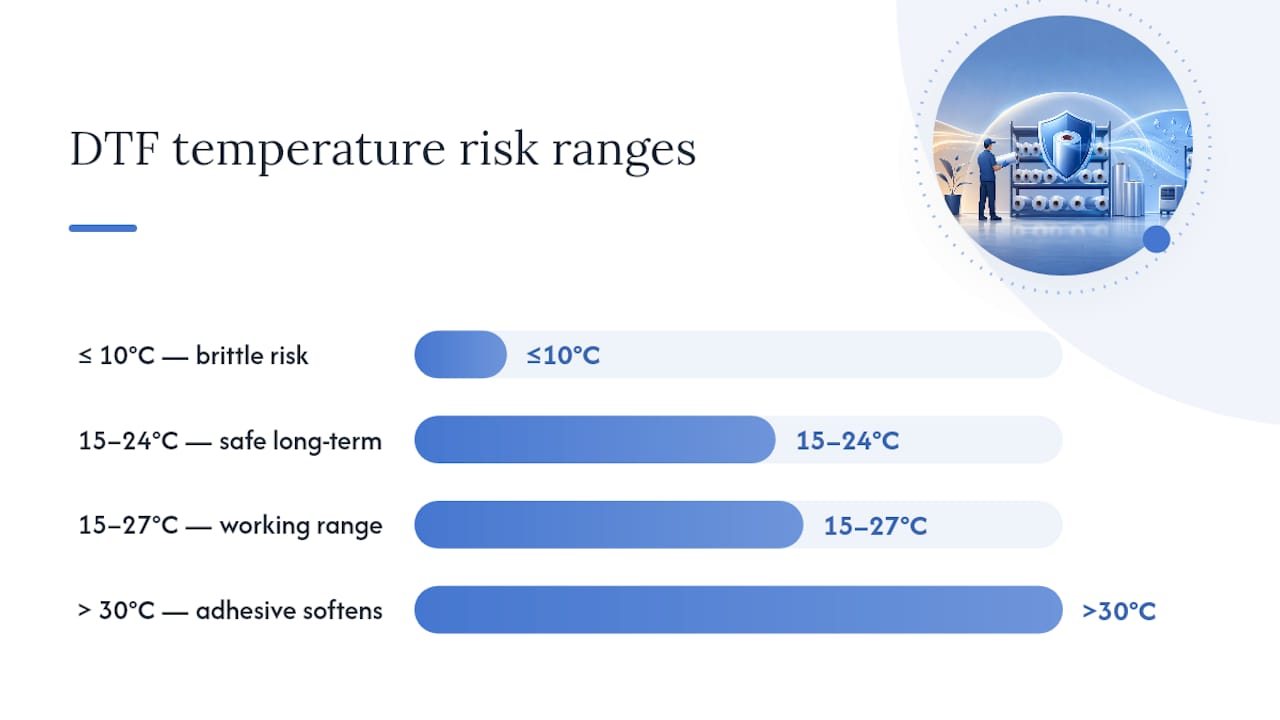
The working range most manufacturers and experienced shops settle on is 15 to 27°C, with the tighter band of 15 to 24°C being safer for anything you plan to keep long term. Push past 30°C for any sustained period and you’re not just shortening shelf life gently. Heat softens the adhesive coating, and once that happens the film starts sticking to itself or to its packaging in ways you can’t reverse. Drop below roughly 10°C, on the other hand, and the film’s coating can turn brittle, which shows up later as cracking or uneven transfer during pressing.
Humidity is the trickier variable because it’s invisible until it’s already caused a problem. That hydration is what causes bubbling and adhesive clumping during pressing, and it’s one of the most common reasons a batch of film that “looked fine” fails at the heat press.
Above 30°C or beyond 70% RH, sealed film can lose usable life dramatically, degrading in as little as three to six months instead of the twelve-plus you’d normally get. That’s the single figure worth memorising if you only remember one thing from this article.
Light matters more than most people assume. UV and even strong indoor lighting will yellow the film and start breaking down the printed inks over time, so storage needs to be genuinely dark, not just “out of direct sun.” A cupboard, a lidded bin, or a windowless stockroom all work. What doesn’t work is a shelf near a skylight or under fluorescent tubes running twelve hours a day.
Practical conditions to lock in:
- Temperature steady between 15 and 24°C, never allowed to spike above 30°C
- Relative humidity held at 40 to 55%, checked with a simple hygrometer rather than guessed
- Storage kept dark, away from windows and direct light sources
- Film left sealed in its original foil-lined bag wherever possible, since foil blocks both moisture and oxygen far better than a standard plastic sleeve
Storing unopened rolls and resealing film once it’s open
An unopened roll is the easiest thing in your stockroom to store correctly, because the manufacturer has already done the hard part. Leave it in the original foil-lined bag, with its factory desiccant pack still inside, and put it somewhere that meets the temperature and humidity ranges above. Don’t cut the bag open until you’re actually loading it onto the printer.
Once you break the seal, the clock changes. Here’s the sequence that actually protects the film:
- Cut the bag open cleanly rather than tearing it, so you can reseal along the same edge later.
- Use only what you need, then remove the roll from the printer rather than leaving it exposed on the machine between jobs.
- Reseal it in a fresh moisture-barrier bag if the original foil bag is damaged, pressing out as much air as you can before sealing.
- Drop in a new desiccant pack, since the original one may already be partially saturated by the time you reopen the bag.
- Label the bag with the date you opened it. This single step is the difference between guessing and knowing.
For best print quality, aim to use opened film within about one to two months. With careful resealing, low humidity, and stable temperature, some shops extend use up to several months, but this should be considered exceptional.
One habit worth breaking immediately: don’t rewind used film tightly or in reverse. Rewinding under tension can crease the coated surface and damage the adhesive layer, which then shows up as print defects weeks later when you’ve forgotten exactly what caused them.
Pro Tip: Keep a permanent marker and a roll of masking tape next to your storage shelf. It takes ten seconds to date a resealed bag, and it’s the habit that separates shops who know exactly what they’re pressing from shops guessing at shelf life.
Storing cured transfers and pre-pressed stock
Cured transfers behave differently to raw film, and treating them the same way is a common mistake. Once a design has been printed, powdered and cured, it’s a finished product with its own storage rules, and those rules are less forgiving.
Rolling a cured transfer risks cracking the adhesive layer along the fold line, which you won’t notice until it fails halfway through a press.
Separation matters just as much as sealing. Layer parchment or silicone release paper between individual transfers before you stack them, because two adhesive faces touching under any pressure or heat will bond to each other given enough time.
- Lay transfers flat in a sealed container, never stacked loose in a drawer
- Use parchment or release paper between every layer to stop adhesion contact
- Keep the container away from heat sources like printers, presses or sunny windows
- Check humidity with a hygrometer rather than assuming the room “feels dry enough”
Shelf life on cured, sealed transfers stored this way typically runs six to twelve months. Get the storage wrong, leave them in a hot stockroom or an unsealed bag, and that window can collapse to one to three months. Anything older than six months should get a test press before it goes anywhere near a customer order.
Rolls versus sheets: handling and physical organisation
Flat storage is the default, not the fallback. Sheets and gang-sheets should live in flat-file plan drawers or shallow trays whenever your space allows it, because flat storage eliminates curl entirely and puts zero stress on the coating.
If you’re storing rolls, diameter matters more than most people think. Use a core of at least 75mm (roughly 3 inches), and roll loosely with the print side facing out. A tight roll on a narrow core creates memory curl that never fully relaxes, which then fights you during feeding and lamination.
Orientation on the shelf is where a lot of small shops get it wrong without realising:
- Store rolls horizontally on a rack or in cradles, never standing on one end
- Vertical storage lets gravity pull the roll into an oval, creating flat spots that print unevenly for the rest of the roll’s life
- Never stack heavy boxes or equipment on top of sheets or gang-sheets, even briefly
- Limit stack height on flat sheets to a few centimetres so the bottom layers aren’t compressed for weeks at a time
None of this is complicated engineering. It’s closer to storing wine than storing paper: orientation and gentle handling protect something that’s more fragile than it looks on the shelf.
Spotting DTF film failure before it costs you a job
Film that’s degraded doesn’t always look wrong at a glance, which is exactly why it causes problems. Learn the signs and you catch a bad batch before it’s on a customer’s garment.
The most common symptoms are an oily or waxy sheen on the surface (plasticiser bloom), powder that’s clumped rather than sitting loose, sheets sticking lightly to each other or their backing, visible yellowing, and curl that won’t lie flat even under weight. Any one of these on its own is worth pausing over; two or more together means the batch needs testing before it goes anywhere near production.
- Inspect visually first. Hold the sheet to the light and check for discolouration, tackiness or an uneven surface texture.
- Run a small test press on scrap fabric rather than committing to the full job.
- Wait 24 hours, then wash. A single wash cycle after pressing is the fastest way to reveal weak adhesion that a fresh press might hide.
- Judge the result honestly. Cracking, peeling or dull colour after washing means the batch fails, no matter how it looked on the shelf.
Mild issues can sometimes be recovered. Gentle, brief warm air (a hair dryer on low, held well away from the surface) can lift surface moisture before pressing, and flattening curled sheets under light, even weight overnight often helps. Swap out any desiccant that’s turned from blue to pink, since a spent pack is doing nothing.
Pro Tip: If oiling or adhesive separation shows up again after a second test press on the same batch, stop. That’s not a storage fix anymore, that’s a batch to write off before it costs you a reprint and a customer’s patience.
Building a storage workflow that actually holds up
The best storage conditions in the world don’t help if nobody in the shop knows what’s old and what’s new. A basic labelling and rotation habit fixes that in about thirty seconds per roll.
Write the opening date on every bag the moment it’s cut open, and physically move older stock to the front of the shelf so it gets used first. This first-in-first-out approach is the single cheapest fix for wasted film, and it costs nothing but a marker pen.
- Label every opened roll or sheet pack with its open date, not just its purchase date
- Rotate stock so older film gets used before newer deliveries
- Recharge or replace desiccant packs roughly every three to six months, sooner in humid climates
- Match your order size to your realistic usage window rather than chasing bulk discounts you can’t store properly
Container choice matters here too. Gasket-sealed plastic bins work well for bulk desiccant storage and for shops without space for flat-file furniture, while dedicated flat-file drawers are worth the investment once you’re running enough SKUs that digging through a bin becomes its own time cost.
| Storage need | Best container type | Typical use case |
|---|---|---|
| Bulk sealed rolls, unopened | Original foil bag inside a lidded bin | Long-term stock, low access frequency |
| Opened rolls in active use | Moisture-barrier resealable bag | Daily or weekly production use |
| Cured transfers, flat | Gasket-seal poly bin with parchment layers | Pre-pressed inventory awaiting shipment |
| High-volume gang sheets | Flat-file plan drawers | Shops running frequent, varied print jobs |
Shop-floor tests that protect against bad stock
The single most useful habit we’ve seen among trade buyers who rarely lose stock is a standardised check before anything questionable goes into a customer order: test press, wait 24 hours, then run one wash cycle. It’s simple enough to do on every batch that’s more than a few months old, and it catches adhesion problems that a fresh press alone won’t reveal.
Tracking lot numbers against your own printing dates is the other habit worth building early. When a batch does fail, knowing which delivery it came from lets you correlate the failure with a specific supplier run rather than guessing across your whole stockroom.
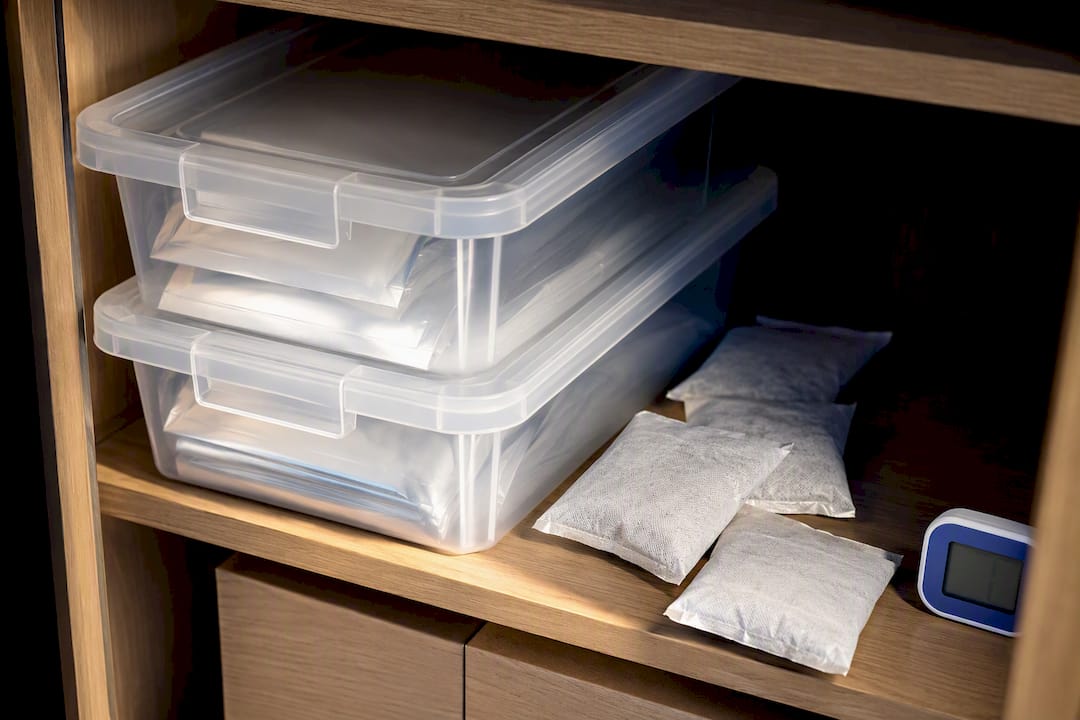
For small shops without climate-controlled storage, low-cost fixes go a long way: a portable dehumidifier in a damp stockroom, recharging silica packs in an oven on low heat instead of buying new ones every time, and gasket-sealed bins that hold humidity steady even when the room around them doesn’t.
Why bulk discounts on DTF film aren’t always the win they look like
Buying in bulk looks like the obvious move when a supplier offers a price break at higher volumes, but that discount only pays off if your storage can actually protect the stock for as long as you’ll be sitting on it. A shop without climate control buying six months of film at once is trading a small saving now for a real chance of writing off part of that order later.
Smaller, more frequent orders cost slightly more per unit but keep your exposure low, and that trade-off should shape how you buy, not just how you store. Storage quality should set your order cadence, not the other way round.
Accepting the occasional loss is part of running this kind of business. Trying to eliminate risk entirely usually means overspending on storage infrastructure that a small shop doesn’t need yet.
— chris
Where to buy DTF film storage supplies that actually protect your stock
Getting the storage right is one problem; sourcing the right containers and desiccants without buying more than you need is another. Suppliers can provide moisture-barrier resealable bags, silica desiccant packs, gasket-sealed storage bins and DTF film and consumables in flexible quantities, allowing shops to buy exactly what their storage setup calls for instead of committing to a large stock they can’t rotate fast enough.

That matters most for trade buyers still working out their real usage window. Order a modest batch of film alongside the desiccant and sealed bags you need to protect it, test how long it holds up in your own space, then scale the order size up once you know your numbers. Browse the full range on the Subliblanks catalogue and order what your storage can actually support.
Where these storage figures come from
The temperature, humidity and shelf-life ranges above come from manufacturer guidance and industry storage documentation, including LINKO’s DTF storage specifications, Haiyi’s shelf-life data, and KungFuDTF’s storage guide. Always check your own film’s datasheet, since brand-specific limits vary.
Sources
- Storage and Safekeeping - LINKO DTF Printer
- How Long Is The Shelf Life Of Heat Transfer DTF Film?
- How to Store DTF Film, Ink, and Powder: A Complete Storage Guide – KungFuDTF
- DTF Transfer Storage: How to Preserve Quality and Prevent Ink Bleeding – Iris DTF


