



Top sublimation equipment for business in the UK 2026
What are the best sublimation printers for UK businesses?
The strongest performers for UK businesses in 2026 span three tiers: the Epson SureColor F570 for growing studios, the Sawgrass Virtuoso SG500 for startups needing guided software, and the Mimaki TS100-1600 for high-volume commercial production. Choosing between them comes down to print width, daily output targets, and how much you want to spend on consumables rather than hardware.
The table below maps each major model against the criteria that actually matter at purchase time.
| Printer | Best for | Key features | Print quality | Ease of use | Footprint |
|---|---|---|---|---|---|
| Epson SureColor F570 | Small to medium businesses scaling production | 24-inch width, auto/manual cut, Windows & macOS | Excellent; smooth gradients, sharp text | Moderate; purpose-built, no conversion needed | Medium |
| Epson SureColor F170 / SC-F100 | Small studios and startups | Compact, dedicated sublimation, Epson warranty | Very good for format size | High; plug-and-print setup | Small |
| Sawgrass Virtuoso SG500 | Startups and craft businesses | Bundled MySawgrass Designer software, SubliJet inks | Good; consistent colour | Very high; beginner-friendly | Small |
| Brother Sublimation Printer | Flexible small businesses | Adaptable workflow, good value | Good | High | Small |
| Epson EcoTank ET-2400 | Budget-conscious startups and hobbyists | Refillable ink tanks, low running costs | Good for entry level | High; simple maintenance | Small |
| Epson SureColor SC-F6400 | Medium to large producers | 24-inch, pro colour management, Epson support | Professional grade | Moderate | Medium |
| HP Stitch S500 | Large production and textile factories | Wide media, high capacity, industrial build | Excellent | Low; requires trained operators | Large |
| Mimaki TS100-1600 | High-volume commercial production | Up to 753.5 sq ft/hr, 4 or 8 colour ink sets, cloud monitoring | Outstanding; vivid gamut | Low; production environment | Very large |
| Subliblanks | Entrepreneurs seeking end-to-end UK supply | Printers, blanks, equipment, no minimum order | Varies by printer chosen | Very high; expert support included | N/A (supplier) |
Beyond the printer itself, a complete sublimation setup requires:
- A flat, pneumatic, or rotary heat press matched to your output volume
- Dedicated sublimation inks (never repurpose standard inkjet cartridges)
- Sublimation transfer paper suited to your substrate range
- RIP software for colour profile management and batch control
- Sublimation-coated blanks: mugs, apparel, tiles, phone cases, and similar
Warranty coverage and UK availability vary by distributor. Epson and Sawgrass both maintain authorised UK dealer networks, while Mimaki’s industrial units typically come with direct service agreements.
Table of Contents
- How do the leading sublimation printers compare in depth?
- How to choose sublimation equipment for your business
- What do you need to understand about sublimation printing technology?
- Subliblanks: your UK source for sublimation equipment and blanks
- Key takeaways
How do the leading sublimation printers compare in depth?
Epson SureColor F570
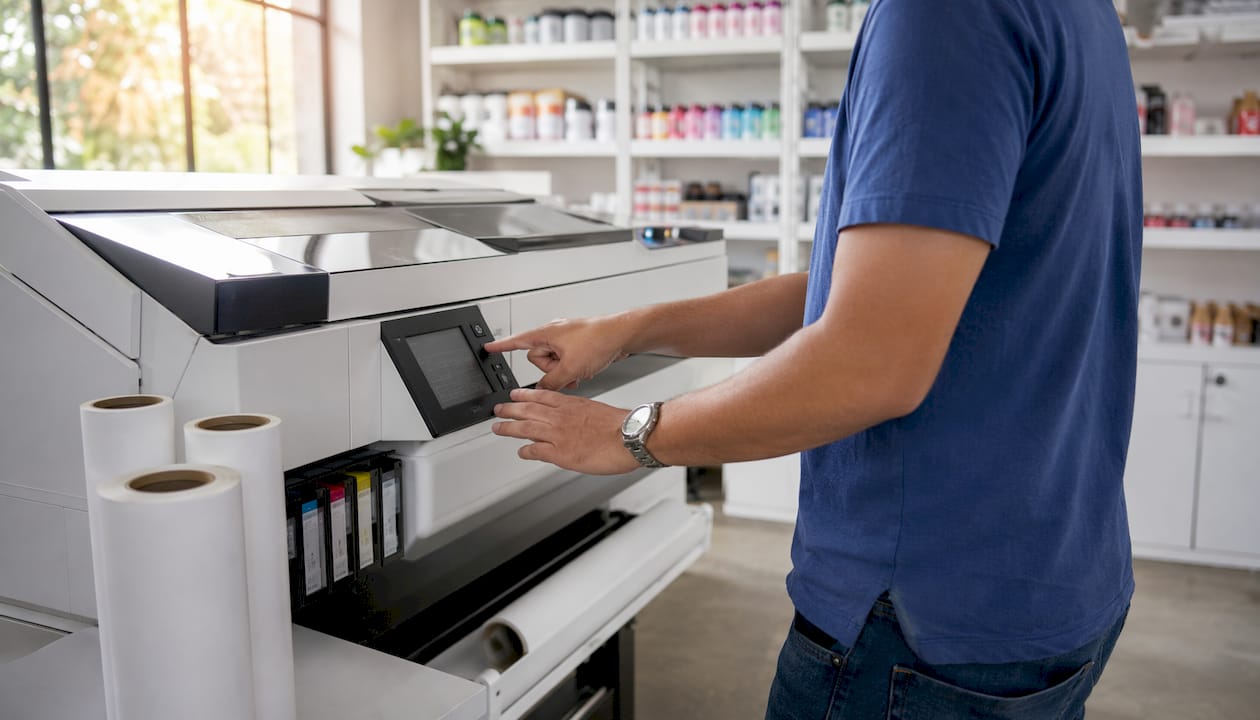
The F570 is the workhorse choice for studios that have outgrown entry-level desktop printers. Its 24-inch print width handles full-bleed jerseys, pillow panels, wide phone case sheets, and flag transfers without compromise. The internal rotary cutter manages both auto and manual cut modes, which saves real time across a production shift when you are running roll media. Transfer quality is consistently strong: gradients come through smooth, fine text holds its edges, and photographic images translate well onto poly fabrics and hard substrates. Driver support covers macOS and Windows 10, so it fits most existing shop setups without a system overhaul.
The one genuine limitation is format. If your business regularly needs output wider than 24 inches for large-format banners or full-size apparel graphics, you will eventually need a 44-inch machine. For the majority of product-based sublimation businesses, though, 24 inches covers the bulk of daily production.
Pro Tip: Use the manual cut mode when working with expensive transfer paper. Auto-cut is faster, but manual gives you more control over waste on short runs.
Epson SureColor F170 and SC-F100
These two models are effectively the same machine under different regional designations. Both are compact, dedicated sublimation printers that ship with Epson sublimation ink and a full warranty, which removes the conversion risk entirely. The trade-off versus the F570 is print width: the F170 suits small items such as mugs, coasters, keychains, and small apparel graphics rather than full-width jersey production. For a startup doing fewer than 50 orders per week, the lower upfront cost and smaller footprint make it the sensible starting point.
Sawgrass Virtuoso SG500
The SG500’s strongest selling point is its bundled MySawgrass Designer software, a web-based design tool with built-in templates that removes the need for separate design software at launch. Sawgrass uses proprietary SubliJet inks, which are optimised for the printer’s colour profiles out of the box. The small-format printer suits mugs, coasters, keychains, and small signs rather than full-size apparel. A business doing hundreds of custom orders daily will outgrow it quickly, but for a craft-based startup or kiosk operation, it is a genuinely well-integrated package.
Epson EcoTank ET-2400
The ET-2400 is the entry point for budget-conscious operators. Its refillable ink tanks keep running costs low compared with cartridge-based printers, and the setup is straightforward. The catch is that it is a converted inkjet rather than a purpose-built sublimation unit, which means no manufacturer sublimation warranty and a slightly more involved setup process. For hobbyists and early-stage startups testing the market before committing to a dedicated machine, it is a practical first step.
Brother Sublimation Printer
Brother’s sublimation offering suits businesses that need flexibility across different printing workflows. It delivers good value and user-friendly operation, making it a reasonable choice for small businesses that do not want to lock into the Epson or Sawgrass ecosystems. Specific model specs vary by retailer, so confirm print width and ink compatibility before purchasing.
Epson SureColor SC-F6400
The SC-F6400 targets medium to large producers who need professional colour fidelity at scale. At 24 inches wide, it delivers pro-grade output with Epson’s full support structure behind it. Colour management accuracy is a genuine strength here, particularly for sportswear brands and licensed merchandise where clients demand strict colour consistency.
HP Stitch S500
The HP Stitch S500 is built for large production environments and textile factories rather than studio use. Its wide media compatibility and industrial construction suit businesses running continuous high-volume jobs. The learning curve is steeper, and the footprint demands dedicated floor space, so it belongs in a production facility rather than a small studio.
Mimaki TS100-1600
The Mimaki TS100-1600 is the industrial-tier choice for high-volume commercial sublimation. It reaches print speeds up to 753.5 sq ft/hr and can be configured with a 4 or 8 colour ink set, including orange, violet, fluorescent pink, and fluorescent yellow for an extended colour gamut. Cloud-based PICT monitoring tracks device status, ink consumption, and operating metrics via smartphone or tablet. In-RIP ink-saving features can reduce ink costs by as much as 50% depending on the selected level. This is a machine for factories and large commercial print shops, not startups.
How to choose sublimation equipment for your business
Choosing sublimation equipment correctly from the outset saves you from an expensive mid-growth upgrade. The single most important variable is production volume: a home-based shop doing a handful of mugs a day has entirely different needs from a business fulfilling hundreds of custom orders daily.
Work through these criteria before committing to any purchase:
- Print width: Small-format printers (up to 8.5 inches wide) suit mugs, coasters, and small accessories. Large-format models (up to 24 inches) open up full-bleed apparel, panels, and banners.
- Substrate range: Confirm the printer and heat press combination covers every blank type you plan to sell, whether that is flat apparel, rigid hard goods, or cylindrical drinkware.
- Budget split: Allocate budget across the full system, not just the printer. Heat press, sublimation paper, inks, and RIP software all carry ongoing costs that compound quickly at volume.
- Scalability: Industry experts recommend upgrading printing and pressing equipment progressively as the business scales, to maintain throughput and quality without operator strain.
- Software compatibility: Many commercial operations add third-party RIP software for enhanced colour management and batch control, particularly for sportswear and licensed merchandise where colour consistency is non-negotiable.
- Warranty and after-sales support: Dedicated sublimation printers from Epson and Sawgrass come with manufacturer warranties through authorised UK dealers. Converted printers typically do not, which shifts repair risk onto the operator.
Delivery timelines and UK availability
Lead times for entry-level printers such as the Epson F170 and Sawgrass SG500 are generally short through UK-based distributors, often available for next-day or two-day delivery. Industrial units like the Mimaki TS100-1600 and HP Stitch S500 typically require a formal quotation process and longer lead times, sometimes several weeks, depending on stock and installation requirements.
Operational costs beyond the purchase price
Ink is the largest ongoing cost for most sublimation businesses. Dedicated sublimation printers use manufacturer inks sold in bottles or cartridges, while converted EcoTank printers use third-party sublimation inks that are generally cheaper per millilitre. Sublimation paper, heat-resistant tape, and replacement press components add further recurring costs. Factor these into your pricing model before you take your first order.
Pro Tip: Match your heat press capacity to your printer’s output from day one. A fast 24-inch printer paired with a slow manual flat press creates a bottleneck at the transfer stage that limits your effective daily output regardless of printer speed.
What do you need to understand about sublimation printing technology?
Sublimation printing works by converting solid dye into gas under heat, bonding it permanently into a polymer-coated substrate rather than sitting on the surface. The result is a print that will not crack, peel, or fade with normal washing. A complete sublimation system requires five core components: a sublimation printer, sublimation ink, sublimation paper, a heat press, and RIP software for colour management.
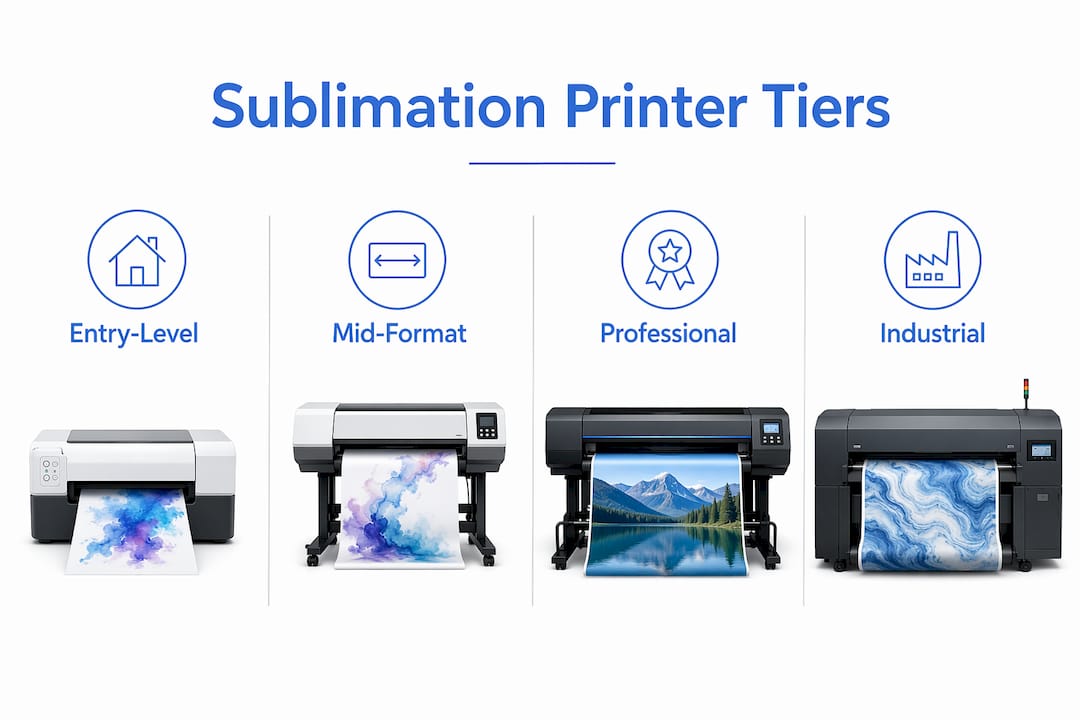
Desktop, mid-format, and industrial printers
Desktop sublimation printers suit startup studios producing low volumes per order. Mid-format printers, typically 24 inches wide, serve small production lines running daily batches. Industrial sublimation printers drive continuous textile production at factory scale, with rotary heat press systems for roll-to-roll output. The right tier depends entirely on your current volume and your realistic growth trajectory over the next two years.
Heat press types and their applications
- Flat heat press: For apparel, mousepads, keychains, and flat blanks. Manual flat presses suit low-volume work; pneumatic flat presses handle medium production batches with less operator effort.
- Rotary heat press: For continuous roll-to-roll textile production. Scaling from a home studio to a factory means upgrading from manual flat presses to pneumatic or rotary presses, which increases throughput and reduces operator fatigue significantly.
- Mug and tumbler presses: Dedicated cylindrical presses for drinkware. Automated options such as motorised tumbler presses are faster than oven-based methods for on-demand custom orders.
- Clamshell and swing-away presses: Clamshell presses are compact and beginner-friendly. Swing-away designs offer better alignment access and more even pressure distribution, which matters for precise transfers on larger or thicker substrates.
Safety considerations
Sublimation ink fumes are toxic, and dedicated sublimation equipment is mandatory in any professional environment. Never repurpose equipment previously used for food preparation, including ovens and air fryers, for sublimation work. Ventilation is not optional in a production setting.
RIP software and colour management
Print drivers and RIP software directly affect output quality and workflow efficiency. Most sublimation printers ship with bundled software adequate for basic use, but commercial operations typically add professional RIP systems for tighter ICC colour management, especially for sportswear brands, team uniforms, and licensed merchandise where enterprise clients demand strict colour consistency. Sawgrass printers include MySawgrass Designer for beginners, while the Epson F570 Pro supports third-party RIP software for more advanced colour control.
You can find a practical walkthrough of the full sublimation transfer process on the Subliblanks blog, covering temperature settings, press times, and substrate preparation for common blank types.
Subliblanks: your UK source for sublimation equipment and blanks
Buying the right printer is only half the decision. You still need a reliable UK supplier who can put the blanks, inks, and supporting equipment in your hands quickly, without forcing you into bulk minimum orders you cannot yet justify.
Subliblanks supplies the full range of sublimation equipment for UK businesses: dedicated sublimation printers, sublimation blanks across every major product category, sublimation inks, heat presses, and supporting consumables, all from a single trade wholesaler with no minimum order quantities. Whether you are equipping a startup studio with an entry-level printer and a starter pack of mugs, or sourcing blanks at volume for a growing production line, the catalogue covers both ends of the scale. Expert support is included, so you are not left working out compatibility questions on your own.
Browse the full range of sublimation printers and equipment on the Subliblanks website, or visit the main Subliblanks store to see the complete catalogue of blanks, presses, and accessories available for UK delivery.
Key takeaways
The right sublimation printer for your business is determined by print width, daily volume, and substrate range, not by price alone.
| Point | Details |
|---|---|
| Match printer to volume | Entry-level printers suit startups; mid-format and industrial printers fit medium to large-scale production. |
| Five core components | Every sublimation setup needs a printer, ink, transfer paper, heat press, and RIP software to function correctly. |
| Heat press must match printer output | A fast printer paired with a slow press creates a bottleneck that limits effective daily throughput. |
| Safety is non-negotiable | Sublimation ink fumes are toxic; always use dedicated equipment and never repurpose food-use appliances. |
| Subliblanks for UK supply | Subliblanks supplies printers, blanks, and equipment to UK businesses with no minimum order quantities. |


