



Verify Lab Data Before Buying Polymer Drinkware for Trade Decorators
Most polymer drinkware sold today is safe for its intended use, provided the resin suits the job and the product has passed real migration testing. The exception that trips people up is heat: a copolyester like Tritan handles hot-fill and repeated washing far better than a polymer never designed for it. Before you trust any bottle or mug, check the food-contact statement and the care label, not just the “BPA-free” sticker.
TL;DR:
- Heat significantly increases chemical migration from most polymers, especially when used beyond their rated temperature conditions.
- Tritan is the safest premium choice for reusable drinkware, surviving thousands of dishwasher cycles with negligible oligomer migration.
- Proper testing includes migration studies with realistic simulants and temperatures, not just generic safety certifications or vague claims.
- Recycled content and manufacturing quality, such as mold finish and wall consistency, impact the safety and durability of polymer drinkware.
- Always verify specific food-contact declarations, actual test data, and third-party lab credentials before choosing polymer drinkware for hot or repeated use.
Table of Contents
- What polymer types are used in drinkware, and how do they compare?
- How does chemical migration and leaching actually happen?
- What do regulations and safety thresholds actually mean?
- How do you choose safer polymer drinkware?
- What testing actually proves polymer drinkware is safe?
- What manufacturing choices affect drinkware safety in practice?
- Where to buy polymer drinkware built for safety and print quality
- Sources
- FAQ
What polymer types are used in drinkware, and how do they compare?
Not all plastics behave the same way once hot coffee or a dishwasher cycle gets involved. Manufacturers pick a resin based on cost, clarity, and how it needs to perform, and that choice drives almost everything about its safety profile.
Tritan is a BPA-free copolyester developed by Eastman and now the default choice for premium reusable bottles and mugs. It resists impact, stays clear after hundreds of washes, and Eastman’s own testing shows many Tritan bottles surviving 1,000 commercial dishwasher cycles without clouding.
Polycarbonate (PC) is tough and heat-resistant but contains bisphenol A, which is why it has largely disappeared from reusable drinkware over the past decade. PET, the resin behind most disposable water bottles, is fine for cold drinks and single or limited reuse but was never engineered for heat. Polypropylene (PP) tolerates warmer liquids and microwave use reasonably well and is common in reusable food containers and some travel mugs. Polystyrene (PS) is brittle, cheap, and mainly seen in disposable cups. Acrylonitrile-styrene (AS), sometimes called SAN, appears in some rigid tumblers and carries specific chemical concerns tied to acrylonitrile monomer if manufacturing quality slips.
Matched to use, each has a place:
- Tritan: reusable bottles and mugs, hot-fill drinks, dishwasher-heavy households.
- PET: cold drinks, recyclable single-use or short-term reuse.
- PP: warm drinks, microwave-safe containers, everyday lunch tumblers.
- PS: cold, disposable, one-off use only.
- PC: largely avoided now for drinkware given the BPA question.
How does chemical migration and leaching actually happen?
Migration is the technical term for chemicals moving out of a plastic and into whatever it holds. It happens because polymer chains contain small residual molecules, oligomers, unreacted monomers, or additives like plasticisers, that were never fully locked into the plastic’s structure and can work their way out under the right conditions.
Heat is the biggest accelerant. Alcohol and other solvents pull more chemicals out than water does, mechanical wear (scratches, cracking) opens new surface area, and low-quality recycled feedstock introduces contaminants a virgin resin wouldn’t have.
The numbers tell the real story. Peer-reviewed testing on Tritan found oligomer migration under 25 µg/kg at 40°C with standard food simulants over 24 hours, a genuinely low result. A separate 2025 study of polymer bottle stoppers found something more alarming in poorly matched materials: ethyl acetate concentrations 20 times higher than safety standards allow, and propyl alcohol at 0.435 mg/L against a 0.100 mg/L limit, in hot or badly controlled bottling conditions.
The takeaway is practical, not theoretical: microwaving a plastic never rated for it, or hot-filling a polymer designed for cold use, is where migration risk actually spikes.
What do regulations and safety thresholds actually mean?
The US FDA regulates food-contact plastics through the Code of Federal Regulations, and the relevant entry for polycarbonate, 21 CFR 177.1580, sets an extractives limit of no more than 0.15% by weight under reflux extraction conditions. That’s a laboratory threshold, not a consumer-facing number, but it tells you regulators test how much of a resin can dissolve out under worst-case conditions, not just whether it contains a named chemical.
“BPA-free” is a genuinely useful label, but the FDA’s own guidance on bisphenols makes clear it isn’t a blanket safety guarantee. A BPA-free plastic can still leach other substances if it’s the wrong resin for the job, or if it’s degraded through age and abuse. Recycled content adds another layer: EFSA’s assessment of recycled PET processes found migration could stay below conservatively modelled exposure levels of 0.1 to 0.15 µg/kg when critical decontamination steps were properly validated, but that safety is entirely process-dependent, not automatic.
When checking a supplier’s claims, look for:
- A specific food-contact statement, not just “food safe” with no standard cited.
- Actual migration or extraction test data, not marketing language alone.
- A named, accredited testing lab on any report you’re shown.
- Recycled-content disclosure, since uncontrolled recycled feedstock is a known risk factor.
How do you choose safer polymer drinkware?
Work through this in order, and you’ll catch most problems before you buy:
- Identify the resin. Check the recycling code or spec sheet: Tritan, PP, PET, PC, PS, or AS.
- Confirm the food-contact statement. It should reference a specific standard, not vague wording.
- Request migration or test data, especially for anything marketed for hot drinks or microwave use.
- Follow the stated care instructions exactly. A dishwasher-top-rack claim isn’t the same as dishwasher-safe everywhere.
- Prefer third-party lab testing over supplier self-certification for anything used with hot liquids regularly.
Watch for red flags: vague claims like “eco-friendly plastic” with no resin named, unspecified recycled content, or microwave and dishwasher claims with no supporting data behind them. For baby and toddler drinkware, the bar should be higher still, given repeated hot-fill use and more frequent replacement cycles. Trade decorators sourcing polymer sublimation mugs need resins that print well without compromising the food-contact layer, which is why Tritan-family and PP blanks dominate that market.
Pro Tip: Ask suppliers for their declaration of conformity and keep it on file alongside the batch number, not just the product listing screenshot. If a supplier can’t produce it on request, treat that as the red flag it is.
What testing actually proves polymer drinkware is safe?
Four test types matter most for drinkware: migration studies using food simulants (water, ethanol, acidic solutions), oligomer analysis specific to copolyesters like Tritan, hot-fill challenge testing at realistic serving temperatures, and repeat-wash durability trials.
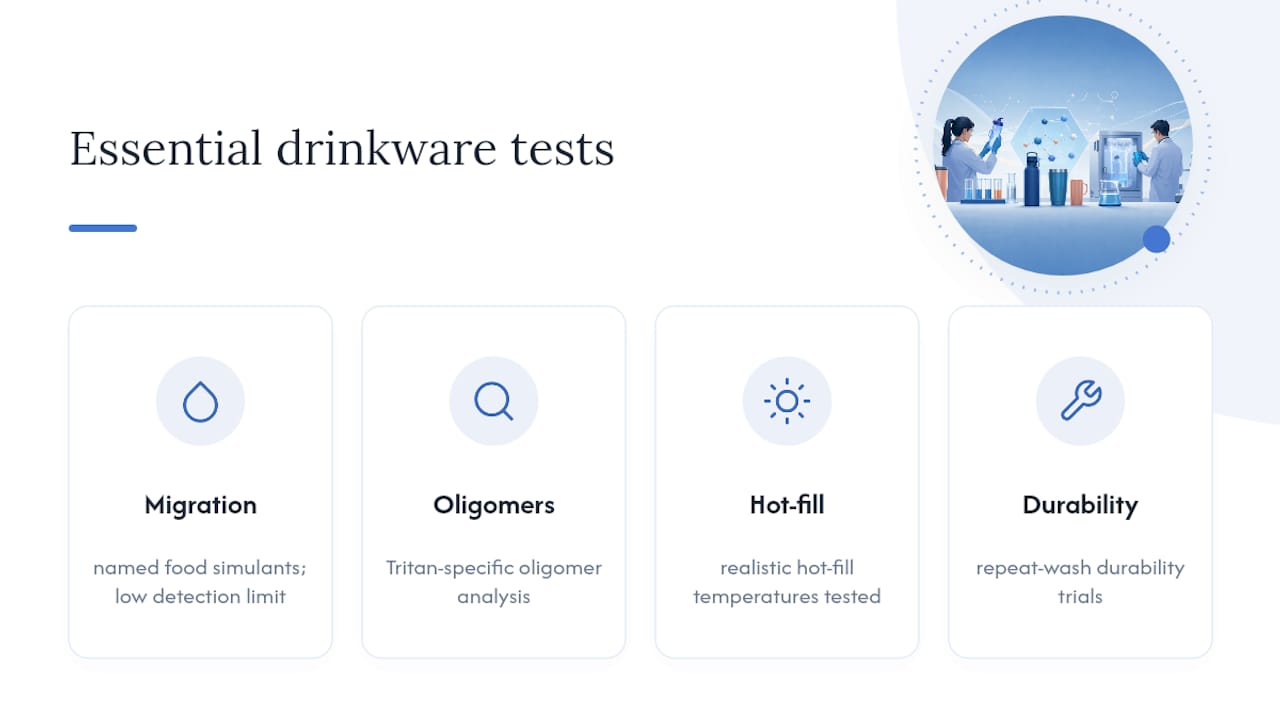
Adequate methodology means simulants that match real use (alcohol-based simulants for a hip flask, not just water), temperatures that reflect actual hot-fill or microwave conditions, and detection limits low enough to catch trace migration rather than only gross contamination. A report with no stated detection limit is close to meaningless.
Eastman’s Tritan data is a reasonable template for what a credible summary looks like: named simulants, stated temperatures, and a quantified migration figure under 25 µg/kg rather than a bare “passes safety testing” claim.
A migration report that doesn’t state its simulant, temperature, and detection limit is a marketing document, not a safety document.
Ask any supplier for a declaration of conformity and, ideally, a named third-party lab behind the numbers.
What manufacturing choices affect drinkware safety in practice?
Mould finish and wall-thickness consistency matter more than most buyers realise. Thread powder on a screw-top mug, for instance, usually signals a cheap resin or worn mould rather than anything dangerous, but it’s a fair proxy for a supplier cutting corners elsewhere too. At Subliblanks, we supply polymer sublimation mugs with no minimum order quantity and point trade buyers towards food-safe filament guidance when they’re weighing printability against food contact. The honest trade advice is this: a mug that prints beautifully but skips certification isn’t worth the margin.
— chris
Where to buy polymer drinkware built for safety and print quality
Polymer sublimation mugs are available at trade prices with no minimum order quantity, which matters if you’re testing a new resin or design run before committing stock. Some wholesalers provide product documentation and food-contact guidance as part of the buying process, avoiding the need to chase spec sheets after the sale.
If you’re sourcing drinkware for decoration, ask any supplier for three things before you order: a resin spec sheet, a food-contact declaration, and a recommended care and printing workflow. Browse the polymer mug range or start with the unbreakable 6oz option for smaller test runs, and check the full Subliblanks product range to place an order today.
This article is general information, not a substitute for advice from a qualified doctor. Consult a qualified healthcare professional about your own circumstances before acting on anything here.
Sources
- Migration of oligomers from Tritan™ copolyester (PubMed)
- Code of Federal Regulations, Title 21, 177.1580
FAQ
Are polycarbonate drinking glasses safe to use?
Polycarbonate itself is durable and heat-resistant, but it contains BPA, and FDA regulations set extractives limits precisely because of that. Most reusable drinkware brands have moved away from it in favour of Tritan for this reason.
What is the healthiest material for drinking cups?
There’s no single “healthiest” polymer, but Tritan and PP score well for reusable use because of their low migration under normal conditions and their BPA-free chemistry, while glass and stainless steel avoid polymer migration entirely.
Are plastic tumblers safe to drink out of?
They’re safe when the resin matches the use case and the product carries genuine food-contact testing, but a tumbler rated for cold drinks only becomes a real risk once you hot-fill it or run it through a microwave.
Does Tritan leach microplastics?
Tritan is a copolyester, not the kind of brittle plastic associated with microplastic shedding, and peer-reviewed testing focuses on oligomer migration rather than particle shedding, with results staying under 25 µg/kg in standard simulant tests. Migration rises under aggressive hot-fill and alcohol-based conditions, so care instructions still matter.


