



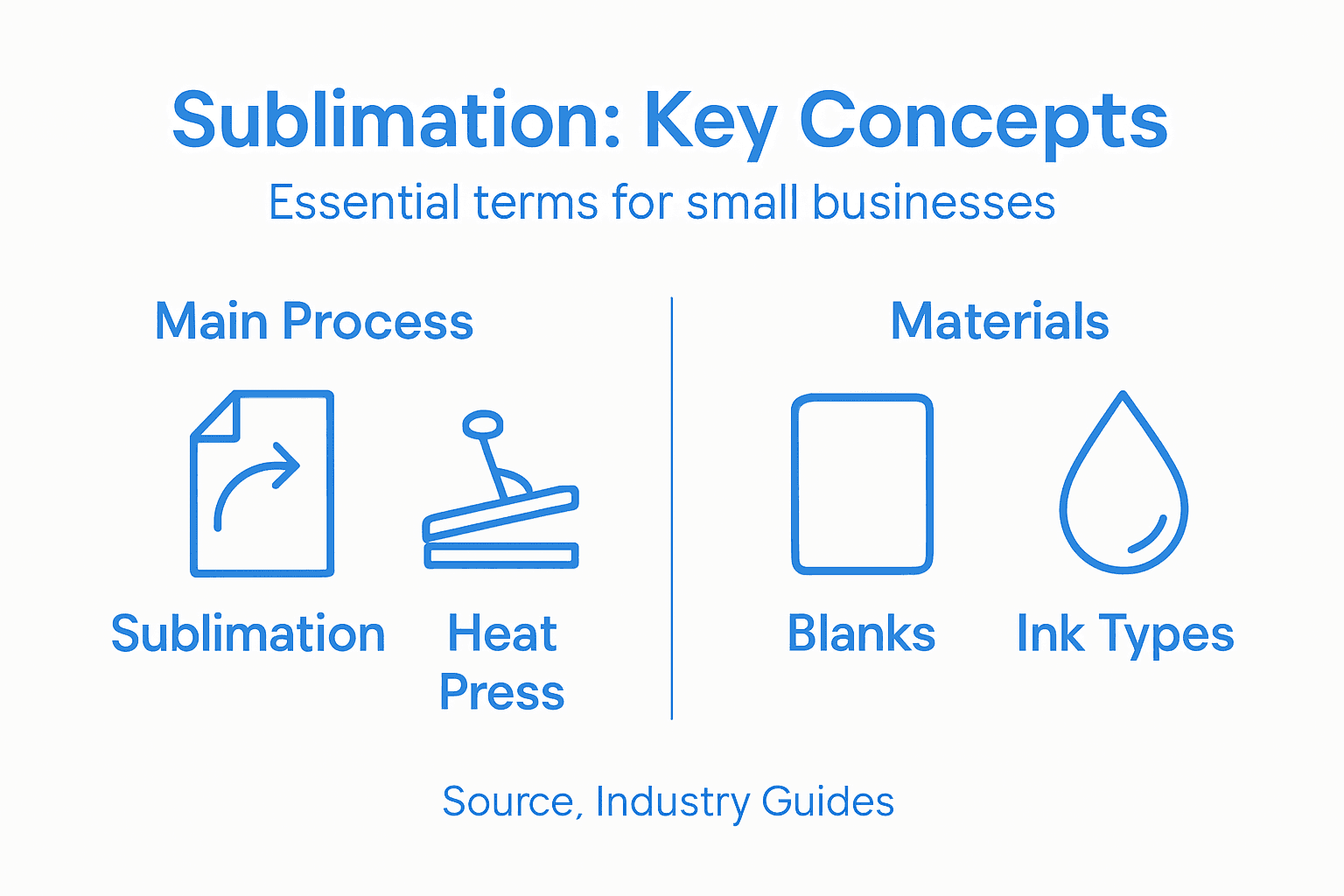
Sublimation Terminology – Key Concepts for Small Businesses
Deciphering the technical jargon around sublimation can feel confusing, especially when every substrate responds differently to heat and pressure. For small business owners and hobbyists across Europe and North America, gaining clarity is vital for turning creative designs into durable products. This guide breaks down sublimation terminology and scientific concepts, explores substrate options, walks through the printing process, and highlights key equipment. With practical insights, you will learn how to avoid mistakes and create vibrant, professional prints.
Table of Contents
- Defining Sublimation Terminology And Concepts
- Types Of Sublimation Blanks And Substrates
- The Sublimation Printing Process Explained
- Essential Equipment And Materials In Sublimation
- Common Pitfalls And Misconceptions To Avoid
Key Takeaways
| Point | Details |
|---|---|
| Understanding Sublimation | Sublimation is a direct phase transition where solids become gases, bypassing the liquid state, crucial for effective printing strategies. |
| Material Selection | Choosing the right sublimation blanks affects product quality; consider heat resistance and compatibility for optimal results. |
| Precision in Process | Each stage of sublimation printing requires careful temperature and pressure control to ensure vibrant, durable designs. |
| Common Mistakes | Avoiding incorrect temperature settings and substrate selection is crucial for maintaining high print quality and avoiding failures. |
Defining sublimation terminology and concepts
Sublimation represents a fascinating phase transition process where a solid transforms directly into a gaseous state without passing through the liquid intermediate phase. Direct molecular transition occurs due to specific temperature and pressure conditions that enable substances to bypass traditional state changes.
In scientific and industrial contexts, sublimation involves several key characteristics:
- Direct transformation from solid to gas without liquid stage
- Temperature-driven molecular movement
- Occurs under specific pressure conditions
- Commonly observed in substances like dry ice (carbon dioxide)
The International Union of Pure and Applied Chemistry provides a precise definition, emphasising that sublimation represents a fundamental phase transition mechanism. This process differs from standard melting and evaporation by skipping the liquid state entirely.
For small business owners working with sublimation printing, understanding these fundamental scientific principles helps design more effective production strategies. Different materials exhibit unique sublimation characteristics, which directly impact printing techniques and final product quality.
Pro tip: Always verify the sublimation point of your specific printing materials to optimise temperature settings and prevent potential product degradation.
Types of sublimation blanks and substrates
Sublimation printing requires carefully selected materials that can effectively transfer and retain printed designs. Small businesses must understand the diverse range of sublimation blanks available to create high-quality, durable products. Different substrate materials offer unique characteristics that impact design transfer and final product appearance.
Key categories of sublimation blanks include:
- Polyester fabrics: Ideal for clothing and textiles
- Ceramic items: Mugs, tiles, and decorative plates
- Aluminium surfaces: Photographic panels and signage
- Polymer-coated materials: Keychains, phone cases, and promotional items
- Hardboard products: Coasters, plaques, and wall hangings
Some materials are more challenging to work with than others. Sublimating aluminium surfaces requires precise temperature control and specialised coating techniques to ensure optimal design transfer. The substrate’s surface preparation dramatically influences print quality, colour vibrancy, and long-term durability.

Small business owners should consider factors like material compatibility, heat resistance, and intended product use when selecting sublimation blanks. Understanding the thermal properties and coating characteristics of different substrates enables more consistent and professional printing results.
Here’s a reference table comparing common sublimation substrates and their business implications:
| Substrate Type | Business Use | Printing Challenge | Durability Impact |
|---|---|---|---|
| Polyester Fabric | Apparel, textiles | Moderate heat needed | High wash resistance |
| Ceramic Items | Mugs, plates, tiles | Requires careful pressure | Good chip resistance |
| Aluminium Surfaces | Photo panels, signage | Demands specialised coating | Excellent fade resistance |
| Polymer-Coated Goods | Keychains, phone cases | Needs precise placement | Strong scratch resistance |
| Hardboard Products | Coasters, plaques | Surface prepping crucial | Average moisture resistance |
Pro tip: Invest in test samples of different substrate materials to determine the optimal printing parameters for each unique surface.
The sublimation printing process explained
Sublimation printing is a sophisticated transfer technique that transforms digital designs into permanent, vibrant images on various substrates. Sublimation printing works by converting specialised ink directly from solid to gaseous state, allowing it to penetrate and bond with compatible materials.
The sublimation printing process involves several critical stages:
- Design preparation: Creating digital artwork using graphic design software
- Printing: Using specialised sublimation ink on transfer paper
- Transfer setup: Positioning transfer paper precisely on the substrate
- Heat pressing: Applying controlled temperature and pressure
- Cooling and finishing: Allowing the substrate to cool and set the design
Each stage requires precision and careful attention to detail. The heat press is particularly crucial, as it must maintain consistent temperature and pressure to ensure optimal ink transfer and design clarity. Temperatures typically range between 180-200 degrees Celsius, with pressing times varying depending on the specific substrate and desired outcome.
Small business owners should understand that sublimation printing offers exceptional durability and colour vibrancy compared to traditional printing methods. The molecular bonding process creates designs that are effectively permanent, resistant to washing, and significantly more integrated with the substrate than surface-level printing techniques.
Pro tip: Invest in a high-quality digital thermometer to monitor heat press temperatures accurately and ensure consistent print results.
Essential equipment and materials in sublimation
Successful sublimation printing requires a carefully curated set of specialised equipment and high-quality materials. Essential tools for sublimators encompass more than just basic printing supplies, demanding precision and investment in professional-grade technologies.
Core equipment for sublimation businesses includes:
- Sublimation printer: Specialised inkjet printer designed for sublimation inks
- Heat press machine: Provides consistent temperature and pressure
- Sublimation transfer papers: High-quality papers for ink transfer
- Specialised sublimation inks: Designed for molecular bonding
- Temperature measuring tools: Digital thermometers and infrared guns
- Protective equipment: Heat-resistant gloves and workspace covers
The heat press machine represents the most critical piece of equipment in the sublimation workflow. Professional models offer digital temperature controls, even pressure distribution, and programmable settings that ensure consistent print quality across different substrate materials. Small business owners should prioritise investing in a reliable heat press with adjustable time, temperature, and pressure settings.
Materials selection is equally crucial, with substrate compatibility determining the final product’s durability and aesthetic appeal. Polyester fabrics, polymer-coated ceramics, and specially treated metal surfaces provide the best results, requiring careful selection and understanding of each material’s unique thermal transfer properties.
Here is a summary table showing the role of essential sublimation equipment and its benefits for small enterprise:
| Equipment | Core Function | Business Benefit |
|---|---|---|
| Sublimation Printer | Produces ink-ready designs | Supports high product variety |
| Heat Press Machine | Transfers designs with heat | Ensures print quality |
| Transfer Paper | Holds ink for transfer | Reduces ink wastage |
| Sublimation Inks | Bonds with substrates | Offers vibrant colours |
| Thermometers | Measures heat accuracy | Reduces print failures |
Pro tip: Calibrate your heat press machine monthly and maintain a detailed log of temperature and pressure settings for different substrate types to ensure consistent print quality.
Common pitfalls and misconceptions to avoid
Sublimation printing requires precision and technical understanding, with numerous potential mistakes that can compromise product quality and business profitability. Small business owners must navigate a complex landscape of technical challenges and common misconceptions that can derail their sublimation printing efforts.
Frequent sublimation printing mistakes include:
- Incorrect temperature settings: Variations can destroy print quality
- Poor substrate selection: Not all materials are sublimation-compatible
- Low-quality transfer papers: Impacts design clarity and durability
- Inconsistent pressure application: Leads to uneven design transfer
- Inadequate colour management: Causes unexpected colour variations
- Insufficient preparation of materials: Reduces print adhesion and longevity
Many novice sublimators mistakenly believe that any polyester-based material will produce excellent results. In reality, substrate quality, coating consistency, and precise thermal transfer parameters dramatically influence print outcomes. Professional sublimation requires understanding nuanced material properties and investing in high-quality, specialised equipment.
Business owners should approach sublimation printing as a technical craft requiring continuous learning and experimentation. Each substrate presents unique challenges, demanding adaptability, patience, and a willingness to refine techniques through systematic testing and measurement.
Pro tip: Maintain a detailed testing log documenting temperature, pressure, and material variations to systematically improve your sublimation printing technique.
Elevate Your Sublimation Craft with Expert Materials and Equipment
Understanding sublimation terminology and the complex science behind sublimation printing is vital for every small business owner aiming for consistent, professional results. The challenges of selecting the right sublimation blanks, mastering temperature control, and applying precise pressure can be overwhelming. Concepts like substrate compatibility and heat press calibration are not just technical terms but the key to overcoming common pitfalls highlighted in the article.
Take the stress out of your sublimation process by sourcing everything you need from Subliblanks where quality meets convenience with no minimum order volumes. Whether you require premium polyester fabrics, ceramic blanks, or reliable heat press machines, our catalogue supports your goals to deliver vibrant, durable designs every time. Start improving your sublimation printing outcomes today by exploring our range of sublimation blanks and substrates, alongside essential sublimation equipment tailored for small businesses. Unlock your full creative potential with expert tools and supplies all in one place.
Frequently Asked Questions
What is sublimation in printing?
Sublimation in printing is a process where a solid transforms directly into a gas without passing through a liquid state, allowing specialised ink to penetrate and bond with compatible substrates during the transfer process.
What types of materials can be used for sublimation printing?
Common materials for sublimation printing include polyester fabrics, ceramic items, aluminium surfaces, polymer-coated goods, and hardboard products. Each material has unique characteristics that affect the printing results and durability of the final product.
How important is substrate selection in sublimation printing?
Substrate selection is crucial in sublimation printing as not all materials are compatible. The quality, coating, and thermal properties of the substrate directly impact the design transfer, colour vibrancy, and durability of the printed product.
What are common mistakes to avoid in sublimation printing?
Frequent mistakes in sublimation printing include using incorrect temperature settings, poor substrate selection, low-quality transfer papers, inconsistent pressure application, inadequate colour management, and insufficient preparation of materials.


